

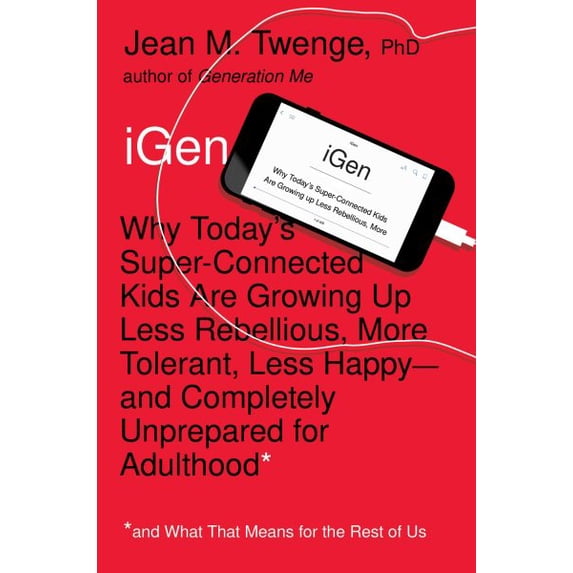
iGen
(No ratings yet)
Key item features
A highly readable and entertaining first look at how today’s members of iGen—the children, teens, and young adults born in the mid-1990s and later—are vastly different from their Millennial predecessors, and from any other generation, from the renowned psychologist and author of Generation Me.
With generational divides wider than ever, parents, educators, and employers have an urgent need to understand today’s rising generation of teens and young adults. Born in the mid-1990s to the mid-2000s and later, iGen is the first generation to spend their entire adolescence in the age of the smartphone. With social media and texting replacing other activities, iGen spends less time with their friends in person—perhaps why they are experiencing unprecedented levels of anxiety, depression, and loneliness.
But technology is not the only thing that makes iGen distinct from every generation before them; they are also different in how they spend their time, how they behave, and in their attitudes toward religion, sexuality, and politics. They socialize in completely new ways, reject once sacred social taboos, and want different things from their lives and careers. More than previous generations, they are obsessed with safety, focused on tolerance, and have no patience for inequality. iGen is also growing up more slowly than previous generations: eighteen-year-olds look and act like fifteen-year-olds used to.
As this new group of young people grows into adulthood, we all need to understand them: Friends and family need to look out for them; businesses must figure out how to recruit them and sell to them; colleges and universities must know how to educate and guide them. And members of iGen also need to understand themselves as they communicate with their elders and explain their views to their older peers. Because where iGen goes, so goes our nation—and the world.
Specs
Publication date, August, 2017
Author, Twenge, Jean M., Ph.D.
Book format, Hardcover
Genre, Political & Social Sciences, Computing & Internet
Pages, 352
Age group, Adult
Publication date
August, 2017
Author, Twenge, Jean M., Ph.D.
Author
Twenge, Jean M., Ph.D.
Book format, Hardcover
Book format
Hardcover
Genre, Political & Social Sciences, Computing & Internet
Genre
Political & Social Sciences, Computing & Internet
Pages, 352
Pages
352
Age group, Adult
Age group
Adult
About this item
Product details
9781501151989
A highly readable and entertaining first look at how today’s members of iGen—the children, teens, and young adults born in the mid-1990s and later—are vastly different from their Millennial predecessors, and from any other generation, from the renowned psychologist and author of Generation Me.
With generational divides wider than ever, parents, educators, and employers have an urgent need to understand today’s rising generation of teens and young adults. Born in the mid-1990s to the mid-2000s and later, iGen is the first generation to spend their entire adolescence in the age of the smartphone. With social media and texting replacing other activities, iGen spends less time with their friends in person—perhaps why they are experiencing unprecedented levels of anxiety, depression, and loneliness.
But technology is not the only thing that makes iGen distinct from every generation before them; they are also different in how they spend their time, how they behave, and in their attitudes toward religion, sexuality, and politics. They socialize in completely new ways, reject once sacred social taboos, and want different things from their lives and careers. More than previous generations, they are obsessed with safety, focused on tolerance, and have no patience for inequality. iGen is also growing up more slowly than previous generations: eighteen-year-olds look and act like fifteen-year-olds used to.
As this new group of young people grows into adulthood, we all need to understand them: Friends and family need to look out for them; businesses must figure out how to recruit them and sell to them; colleges and universities must know how to educate and guide them. And members of iGen also need to understand themselves as they communicate with their elders and explain their views to their older peers. Because where iGen goes, so goes our nation—and the world.
With generational divides wider than ever, parents, educators, and employers have an urgent need to understand today’s rising generation of teens and young adults. Born in the mid-1990s to the mid-2000s and later, iGen is the first generation to spend their entire adolescence in the age of the smartphone. With social media and texting replacing other activities, iGen spends less time with their friends in person—perhaps why they are experiencing unprecedented levels of anxiety, depression, and loneliness.
But technology is not the only thing that makes iGen distinct from every generation before them; they are also different in how they spend their time, how they behave, and in their attitudes toward religion, sexuality, and politics. They socialize in completely new ways, reject once sacred social taboos, and want different things from their lives and careers. More than previous generations, they are obsessed with safety, focused on tolerance, and have no patience for inequality. iGen is also growing up more slowly than previous generations: eighteen-year-olds look and act like fifteen-year-olds used to.
As this new group of young people grows into adulthood, we all need to understand them: Friends and family need to look out for them; businesses must figure out how to recruit them and sell to them; colleges and universities must know how to educate and guide them. And members of iGen also need to understand themselves as they communicate with their elders and explain their views to their older peers. Because where iGen goes, so goes our nation—and the world.
info:
We aim to show you accurate product information. Manufacturers, suppliers and others provide what you see here, and we have not verified it.
Specifications
Publication date
August, 2017
Author
Twenge, Jean M., Ph.D.
Book format
Hardcover
Genre
Political & Social Sciences, Computing & Internet
Warranty
Warranty information
Please be aware that the warranty terms on items offered for sale by third party Marketplace sellers may differ from those displayed in this section (if any). To confirm warranty terms on an item offered for sale by a third party Marketplace seller, please use the 'Contact seller' feature on the third party Marketplace seller's information page and request the item's warranty terms prior to purchase.
Warnings
Similar items you might like
Based on what customers bought
iGen: Why Today's Super-Connected Kids Are Growing Up Less Rebellious, More Tolerant, Less Happy--And Completely Unprepa, (Paperback) $11.59
 $1159current price $11.59
iGen: Why Today's Super-Connected Kids Are Growing Up Less Rebellious, More Tolerant, Less Happy--And Completely Unprepa, (Paperback)
15 out of 5 Stars. 1 reviews5 out of 5 starsBest seller, The Widow: A Novel (Paperback) $14.98
Best seller $1498current price $14.98
The Widow: A Novel (Paperback)
234.7 out of 5 Stars. 23 reviews4.7 out of 5 stars- $19.95
 $1995current price $19.95
-
L'anglomanie, (Paperback) $22.95
 $2295current price $22.95
L'anglomanie, (Paperback)
Best seller, Yesteryear: a GMA Book Club Pick: A Novel (Hardcover) $14.99
Best seller $1499current price $14.99
Yesteryear: a GMA Book Club Pick: A Novel (Hardcover)
1094.3 out of 5 Stars. 109 reviews4.3 out of 5 stars- $12.99
 $1299current price $12.99
-
- $8.00
 $800current price $8.00
-
Fall I Want: A Novel (Paperback) $14.24
 $1424current price $14.24
Fall I Want: A Novel (Paperback)
602.9 out of 5 Stars. 60 reviews2.9 out of 5 stars- $9.99
 $999current price $9.99
-
Andromaque $16.85
 $1685current price $16.85
Andromaque
- $18.56 Was $24.42
 $1856current price $18.56, Was $24.42$24.42
-
- $16.67
 $1667current price $16.67
-
Best seller, Verity (Paperback) $23.74
Best seller 2 optionsAvailable in additional 2 options$2374current price $23.74
Verity (Paperback)
4794.5 out of 5 Stars. 479 reviews4.5 out of 5 starsde l'Ãtiologie Du Tournis, (Paperback) $12.95
 $1295current price $12.95
de l'Ãtiologie Du Tournis, (Paperback)
The System of Objects, (Paperback) $17.00
 $1700current price $17.00
The System of Objects, (Paperback)
Rutschungen in Mitteleuropa $24.39
 $2439current price $24.39
Rutschungen in Mitteleuropa
- $17.75
 $1775current price $17.75
-
Unforgotten Love, (Paperback) $16.95
 $1695current price $16.95
Unforgotten Love, (Paperback)
- $11.25
 $1125current price $11.25
-
Politik : Ist Demokratie möglich? (Paperback) $15.90
 $1590current price $15.90
Politik : Ist Demokratie möglich? (Paperback)
Customer ratings & reviews
0 out of 5 stars
This item does not have any reviews yet

Current price is USD$12.4911.0 ¢/lb
Price when purchased online
- Free shipping
 Free Holiday returns until Jan 31
$12.49
$5.63
Save $6.86 vs. new
How do you want your item?
Ships to
Arrives between Nov 24 - Nov 30
|
Sold and shipped by Alibris Books
4.584860298895387 out of 5 stars

Extended holiday returns
Free Holiday returns until Jan 31