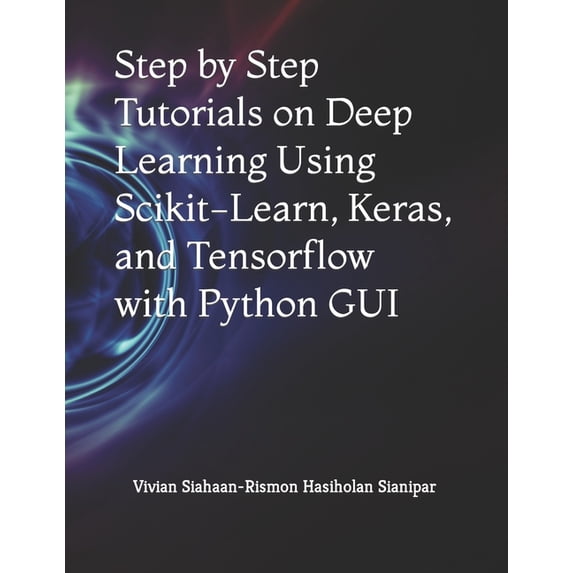
In this book, you will learn how to use TensorFlow, Keras, Scikit-Learn, OpenCV, Pandas, NumPy and other libraries to implement deep learning on classifying fruits, classifying cats/dogs, detecting furnitures, and classifying fashion.
In Chapter 1, you will learn to create GUI applications to display line graph using PyQt. You will also learn how to display image and its histogram.
In Chapter 2, you will learn how to use TensorFlow, Keras, Scikit-Learn, OpenCV, Pandas, NumPy and other libraries to perform classifying fruits using Fruits 360 dataset using Transfer Learning and CNN models. You will build a GUI application for this purpose. Here's the outline of the steps, focusing on transfer learning: 1. Dataset Preparation: Download the Fruits 360 dataset from Kaggle. Extract the dataset files and organize them into appropriate folders for training and testing. Install the necessary libraries like TensorFlow, Keras, Scikit-Learn, OpenCV, Pandas, and NumPy; Data Preprocessing: Use OpenCV to read and load the fruit images from the dataset. Resize the images to a consistent size to feed them into the neural network. Convert the images to numerical arrays using NumPy. Normalize the image pixel values to a range between 0 and 1. Split the dataset into training and testing sets using Scikit-Learn. 3. Building the Model with Transfer Learning: Import the required modules from TensorFlow and Keras. Load a pre-trained model (e.g., VGG16, ResNet50, InceptionV3) without the top (fully connected) layers. Freeze the weights of the pre-trained layers to prevent them from being updated during training. Add your own fully connected layers on top of the pre-trained layers. Compile the model by specifying the loss function, optimizer, and evaluation metrics; 4. Model Training: Use the prepared training data to train the model. Specify the number of epochs and batch size for training. Monitor the training process for accuracy and loss using callbacks; 5. Model Evaluation: Evaluate the trained model on the test dataset using Scikit-Learn. Calculate accuracy, precision, recall, and F1-score for the classification results; 6. Predictions: Load and preprocess new fruit images for prediction using the same steps as in data preprocessing. Use the trained model to predict the class labels of the new images.
In Chapter 3, you will learn how to use TensorFlow, Keras, Scikit-Learn, OpenCV, Pandas, NumPy and other libraries to perform classifying cats/dogs using dataset using Using CNN with Data Generator. You will build a GUI application for this purpose. The following steps are taken: Set up your development environment: Install the necessary libraries such as TensorFlow, Keras, Scikit-Learn, OpenCV, Pandas, NumPy, and any other dependencies required for the tutorial; Load and preprocess the dataset: Use libraries like OpenCV and NumPy to load and preprocess the dataset. Split the dataset into training and testing sets; Design and train the classification model: Use TensorFlow and Keras to design a convolutional neural network (CNN) model for image classification. Define the architecture of the model, compile it with an appropriate loss function and optimizer, and train it using the training dataset; Evaluate the model: Evaluate the trained model using the testing dataset. Calculate metrics such as accuracy, precision, recall, and F1 score to assess the model's performance; and so on.
In Chapter 4, you will learn how to use TensorFlow, Keras, Scikit-Learn, OpenCV, Pandas, NumPy and other libraries to perform detecting furnitures using Furniture Detector dataset using VGG16 model. You will build a GUI application for this purpose, and so on.
In Chapter 5, you will learn how to use TensorFlow, Keras, Scikit-Learn, OpenCV, Pandas, NumPy and other libraries to perform classifying fashion using Fashion MNIST dataset using CNN model. You will build a GUI a