

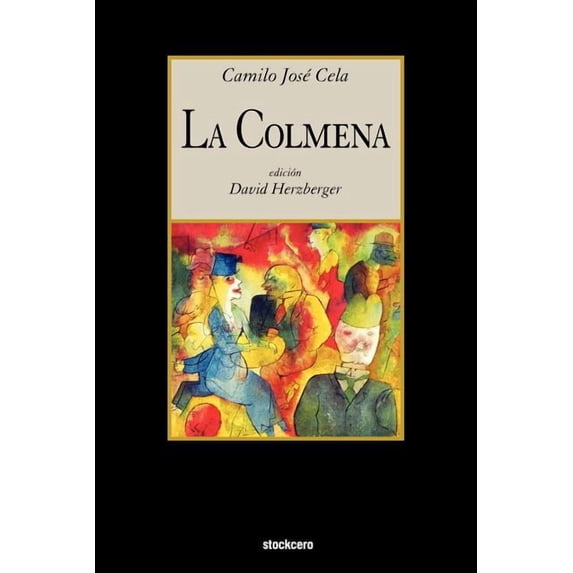
Hero image 0 of La Colmena, 0 of 1
La Colmena
(No ratings yet)
Key item features
- ISBN: 9781934768563
- Condition: New
- Trade paperback
- Language: Spanish
- Pages: 296
- Text in Spanish. Trade paperback (US). Glued binding. 296 p.
- There are reasons to believe that Camilo Jose Cela knew perfectly well what he was doing as he wrote, between 1945 and 1950, �La colmena�, a novel that would counterweight the positive image the Franco regime was striving to build. In his foreword to the first edition Cela justifies and describes his text as a �pale reflection ... a humble shadow of the daily, harsh, deep and painful reality.� His portrait of a sad and desperate Madrid immediately drew the attention of the censors: the novel was banned in Spain until 1955, four years after its first edition was released in Argentina. The idea of portraying the daily Madrid reality constitutes the very essence of �La colmena� and, quite paradoxically, gives the text its universal reach. In the first place �La colmena� is a novel with no main character or plot in a traditional sense: a host of characters (more than three hundred between real and fictitious) and sub-plots, run along the streets in this intricate work. Its unity, though, resides in the most frequently mentioned character, Martin Marco, whose wanderings along the distinct Madrid boroughs and spaces render the novel a certain structural coherence. At the same time the novel sets the �hive� characteristic right from its title, so the laborious existence of the characters allow the reader to explore the diverse corners of the city and the people that strive to survive there. But the �hive� image is also a paradox. Undoubtedly there is the racket and constant movement, but the teeming characters are portrayed as unemployed worker bees, thus without purpose or hope. In this sense Cela's Madrid is a space in which misery, poverty and decay are deeply rooted. The inhabitants of this city do not know where they are going to, or what is their purpose or destiny. And it will be from here that the most relevant topic of �La colmena� -solitude and isolation- stems. There is no real communication between characters as they all live immersed in their own, isolated, existential vacuum. �La colmena� became an immediate inspirational model for a new generation of young writers, that started publishing in the '50s centering their interests in the exploration of the social and political conditions of their present Spain. Though Cela abandoned the detailed depiction of reality in his following work (�Mrs. Caldwell habla con su hijo�, 1953) �La colmena� stood as a reference for the social realistic novel during a decade. For many writers, mainly those who foresaw to use their narrative works as social and political tools to criticize The Franco regime, Cela's novel became the indisputable starting point, both to reveal and transform the Spain ill-being.
Specs
Publication date, August, 2012
Author, Camilo Jose Cela; David K Herzberger
Book format, Paperback
Genre, Literature & Fiction
Pages, 296
Age group, Adult
Publication date
August, 2012
Author, Camilo Jose Cela; David K Herzberger
Author
Camilo Jose Cela; David K Herzberger
Book format, Paperback
Book format
Paperback
Genre, Literature & Fiction
Genre
Literature & Fiction
Pages, 296
Pages
296
Age group, Adult
Age group
Adult
About this item
Product details
There are reasons to believe that Camilo Jose Cela knew perfectly well what he was doing as he wrote, between 1945 and 1950, «La colmena», a novel that would counterweight the positive image the Franco regime was striving to build. In his foreword to the first edition Cela justifies and describes his text as a «pale reflection ... a humble shadow of the daily, harsh, deep and painful reality.» His portrait of a sad and desperate Madrid immediately drew the attention of the censors: the novel was banned in Spain until 1955, four years after its first edition was released in Argentina. The idea of portraying the daily Madrid reality constitutes the very essence of «La colmena» and, quite paradoxically, gives the text its universal reach. In the first place «La colmena» is a novel with no main character or plot in a traditional sense: a host of characters (more than three hundred between real and fictitious) and sub-plots, run along the streets in this intricate work. Its unity, though, resides in the most frequently mentioned character, Martin Marco, whose wanderings along the distinct Madrid boroughs and spaces render the novel a certain structural coherence. At the same time the novel sets the «hive» characteristic right from its title, so the laborious existence of the characters allow the reader to explore the diverse corners of the city and the people that strive to survive there. But the «hive» image is also a paradox. Undoubtedly there is the racket and constant movement, but the teeming characters are portrayed as unemployed worker bees, thus without purpose or hope. In this sense Cela's Madrid is a space in which misery, poverty and decay are deeply rooted. The inhabitants of this city do not know where they are going to, or what is their purpose or destiny. And it will be from here that the most relevant topic of «La colmena» -solitude and isolation- stems. There is no real communication between characters as they all live immersed in their own, isolated, existential vacuum. «La colmena» became an immediate inspirational model for a new generation of young writers, that started publishing in the '50s centering their interests in the exploration of the social and political conditions of their present Spain. Though Cela abandoned the detailed depiction of reality in his following work («Mrs. Caldwell habla con su hijo», 1953) «La colmena» stood as a reference for the social realistic novel during a decade. For many writers, mainly those who foresaw to use their narrative works as social and political tools to criticize The Franco regime, Cela's novel became the indisputable starting point, both to reveal and transform the Spain ill-being.
- ISBN: 9781934768563
- Condition: New
- Trade paperback
- Language: Spanish
- Pages: 296
- Text in Spanish. Trade paperback (US). Glued binding. 296 p.
- There are reasons to believe that Camilo Jose Cela knew perfectly well what he was doing as he wrote, between 1945 and 1950, �La colmena�, a novel that would counterweight the positive image the Franco regime was striving to build. In his foreword to the first edition Cela justifies and describes his text as a �pale reflection ... a humble shadow of the daily, harsh, deep and painful reality.� His portrait of a sad and desperate Madrid immediately drew the attention of the censors: the novel was banned in Spain until 1955, four years after its first edition was released in Argentina. The idea of portraying the daily Madrid reality constitutes the very essence of �La colmena� and, quite paradoxically, gives the text its universal reach. In the first place �La colmena� is a novel with no main character or plot in a traditional sense: a host of characters (more than three hundred between real and fictitious) and sub-plots, run along the streets in this intricate work. Its unity, though, resides in the most frequently mentioned character, Martin Marco, whose wanderings along the distinct Madrid boroughs and spaces render the novel a certain structural coherence. At the same time the novel sets the �hive� characteristic right from its title, so the laborious existence of the characters allow the reader to explore the diverse corners of the city and the people that strive to survive there. But the �hive� image is also a paradox. Undoubtedly there is the racket and constant movement, but the teeming characters are portrayed as unemployed worker bees, thus without purpose or hope. In this sense Cela's Madrid is a space in which misery, poverty and decay are deeply rooted. The inhabitants of this city do not know where they are going to, or what is their purpose or destiny. And it will be from here that the most relevant topic of �La colmena� -solitude and isolation- stems. There is no real communication between characters as they all live immersed in their own, isolated, existential vacuum. �La colmena� became an immediate inspirational model for a new generation of young writers, that started publishing in the '50s centering their interests in the exploration of the social and political conditions of their present Spain. Though Cela abandoned the detailed depiction of reality in his following work (�Mrs. Caldwell habla con su hijo�, 1953) �La colmena� stood as a reference for the social realistic novel during a decade. For many writers, mainly those who foresaw to use their narrative works as social and political tools to criticize The Franco regime, Cela's novel became the indisputable starting point, both to reveal and transform the Spain ill-being.
info:
We aim to show you accurate product information. Manufacturers, suppliers and others provide what you see here, and we have not verified it.
Specifications
Publication date
August, 2012
Author
Camilo Jose Cela; David K Herzberger
Book format
Paperback
Genre
Literature & Fiction
Warranty
Warranty information
Please be aware that the warranty terms on items offered for sale by third party Marketplace sellers may differ from those displayed in this section (if any). To confirm warranty terms on an item offered for sale by a third party Marketplace seller, please use the 'Contact seller' feature on the third party Marketplace seller's information page and request the item's warranty terms prior to purchase.
Similar items you might like
Based on what customers bought
Un lugar efÃmero, (Paperback) $18.60
 $1860current price $18.60
Un lugar efÃmero, (Paperback)
Sämmtliche Idyllen des Luis de Camoens, (Paperback) $28.90
 $2890current price $28.90
Sämmtliche Idyllen des Luis de Camoens, (Paperback)
De la extradicion y los delitos polÃticos, (Paperback) $29.90
 $2990current price $29.90
De la extradicion y los delitos polÃticos, (Paperback)
La Puchera, (Paperback) $25.99
 $2599current price $25.99
La Puchera, (Paperback)
Narrativa Abrazo de Relatos: Antología, (Paperback) $36.10
 $3610current price $36.10
Narrativa Abrazo de Relatos: Antología, (Paperback)
El pacto: Reseña de un rescate, (Paperback) $15.08
 $1508current price $15.08
El pacto: Reseña de un rescate, (Paperback)
The Body Knows, (Paperback) $25.49
 $2549current price $25.49
The Body Knows, (Paperback)
Noumena, (Paperback) $27.00
 $2700current price $27.00
Noumena, (Paperback)
La Numancia, (Paperback) $24.00
 $2400current price $24.00
La Numancia, (Paperback)
Senhora, (Paperback) $23.00
 $2300current price $23.00
Senhora, (Paperback)
Carne, La, (Paperback) $23.31
 $2331current price $23.31
Carne, La, (Paperback)
Moi Skitanija. Ljudi Teatra $20.39
 $2039current price $20.39
Moi Skitanija. Ljudi Teatra
O Sertanejo: Primeira Parte, (Paperback) $19.00
 $1900current price $19.00
O Sertanejo: Primeira Parte, (Paperback)
Didone Abbandonata, (Paperback) $14.95
 $1495current price $14.95
Didone Abbandonata, (Paperback)
El Alguacil Endemoniado $10.60
 $1060current price $10.60
El Alguacil Endemoniado
Discursos sobre el arte del dançado, (Paperback) $32.90
 $3290current price $32.90
Discursos sobre el arte del dançado, (Paperback)
Omar Khayyam $13.99
 $1399current price $13.99
Omar Khayyam
Cuentos de M? Mismo $19.00
 $1900current price $19.00
Cuentos de M? Mismo
Celui-là , (Paperback) $18.95
 $1895current price $18.95
Celui-là , (Paperback)
Novelle Rusticane, (Paperback) $23.42
 $2342current price $23.42
Novelle Rusticane, (Paperback)
Customer ratings & reviews
0 out of 5 stars
This item does not have any reviews yet

Current price is USD$36.61
Price when purchased online
- Free shipping
 Free Holiday returns until Jan 31
How do you want your item?
Ships to
Arrives between Dec 3 - Dec 5
|
Sold and shipped by Alibris Books
4.586262288761807 out of 5 stars

Extended holiday returns
Free Holiday returns until Jan 31Other sellers
$33.98
+ $8.98 shippingShipping, arrives by Fri, Dec 4 to Columbus, 43215
Sold and shipped by Best Prices & Service
Extended holiday returns
Free Holiday returns until Jan 31