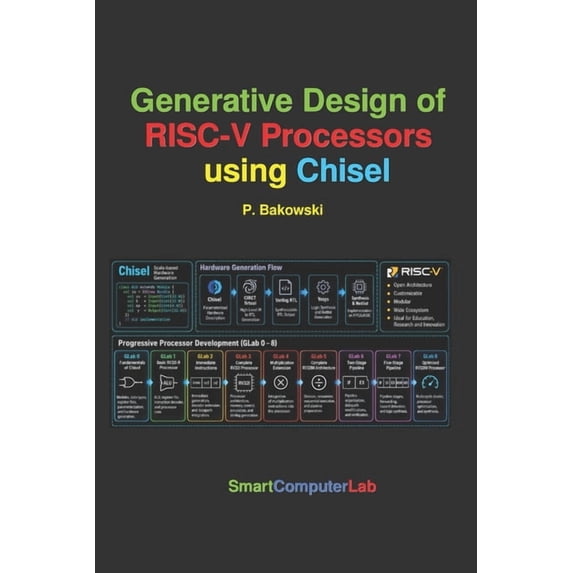
The increasing complexity of digital systems requires flexible, reusable, and scalable hardware design
methodologies. While traditional Register Transfer Level (RTL) languages such as Verilog and VHDL
remain essential, modern hardware development increasingly benefits from higher-level approaches
supporting modularity, parameterization, and automated hardware generation. generation.
Chisel (Constructing Hardware in a Scala Embedded Language) combines Scala programming with hardware description concepts, enabling the development of configurable and reusable architectures.
Together with the open RISC-V instruction set architecture, it provides an effective environment for
processor design, experimentation, and education.
This book presents a progressive methodology for designing, generating, testing, and synthesizing RISC-V
processors using Chisel. Its objective is to demonstrate the evolution from elementary processor
components to an optimized five-stage RV32IM pipeline incorporating a multi-cycle divider.
The book is organized into three parts.
Part I - Introduction and Design Environment
This part introduces the Chisel ecosystem, RISC-V developments in the United States, China, and Europe,
and the hardware generation toolchain, including Chisel, CIRCT, firtool, and Yosys. It explains the
transformation of high-level hardware descriptions into synthesizable RTL implementations.
Part II - Progressive Generative Laboratories
Nine Generative Laboratories (GLab 0-8) illustrate the incremental development of RISC-V processors.
The laboratories begin with Chisel fundamentals and the construction of a basic RV32I-R processor.
They progressively introduce immediate instructions, complete RV32I functionality, and multiplication,
division, and remainder operations to obtain an RV32IM architecture.
The final laboratories develop two-stage and five-stage pipelines, addressing data forwarding, hazard
detection, control mechanisms, and verification. An optimized multi-cycle divider is integrated to improve
hardware efficiency.
Hardware generation, simulation, testing, and logic synthesis accompany each development stage.
Part III - Conclusions and Perspectives
The final part highlights the benefits of generative hardware design, including modularity, reusability, and
parameterization. It explores future perspectives involving configurable RISC-V processor generators,
automated design-space exploration, and systems-on-chip.
Overall, this work establishes a systematic and reproducible methodology for generative processor
design, supporting education, research, and advanced RISC-V hardware development.