Direct Current Generators: Quick Book (Paperback)
Hero image 0 of Direct Current Generators: Quick Book (Paperback), 0 of 1

Direct Current Generators: Quick Book (Paperback)

(No ratings yet)

Key item features

Direct Current Generators: Quick Book (Paperback)

Specs

Publication date, February, 2015Author, A BhatiaBook format, PaperbackGenre, Technology & Engineering/ElectricalPages, 52Age group, Adult, Teen

About this item

Product details

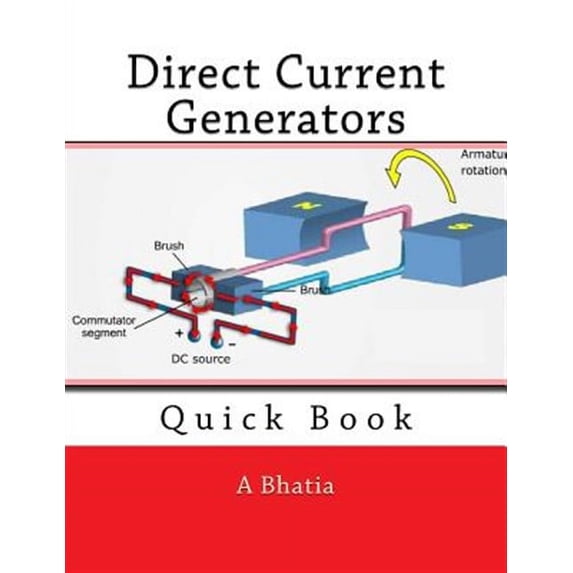
A direct current generator, or DC generator, produces a voltage of constant polarity, which means the voltage and current do not change over time. DC generators are basically AC generators whose output voltage is switched the other way round at the proper moment, so that the direction of the voltage is always in a single direction. The AC generator uses slip rings to transfer the current to the electrical circuit, while the DC generator uses a split-ring commutator. Generators can be very small or quite huge. Commercial DC generators are commonly found in traction applications like subways and trains. Factories that do electrolysis, electroplating and those that produce aluminum, caustic soda, chlorine, and some other industrial materials need large amounts of direct current and use DC generators. An electric motor is very similar to a generator, except that power is provided to turn the rotors. They may, in fact, be described as generators "running backwards". When current is passed through the armature of a DC motor, a torque is generated by magnetic reaction, and the armature revolves. Adjustable speed is difficult to obtain with motors whose armatures are connected to fixed frequency power lines (AC motors). Here is where DC motors shine; their rotating field speed depends on the rotor speed itself. The speed of DC series motors varies with load, and torque varies inversely with speed. This makes them particularly suitable to starting high inertia loads such as railway trains. Starting a DC motor requires often an external resistor or rheostat to limit the current. The value, in Ohms, of that resistor is reduced in steps as the speed of the motor increases, until finally that resistor is removed from the circuit as the motor reaches close to its final speed. This 4-hr Quick Book provides discusses salient features of DC motors and generators in detail. The course is based entirely on Naval Education and Training Materials (NAVEDTRA 14177), Electricity and Electronic Training Series; Module-5 and covers Chapter 1 and 2 titled "Direct Current Generators and Direct Current Motors". Learning Objective At the conclusion of this course, the reader will be able to: -State the principle by which generators convert mechanical energy to electrical energy. -State the rule to be applied when you determine the direction of induced emf in a coil. -State what component causes a generator to produce direct current rather than alternating current. -State how field strength can be varied in a dc generator. -State the three classifications of dc generators. -State the term that applies to voltage variation from no-load to full-load conditions and how it is expressed as a percentage. -State the factors that determine the direction of rotation in a dc motor. -State the right-hand rule for motors. -Describe the main differences and similarities between a dc generator and a dc motor. -List the advantages and disadvantages of the different types of dc motors. -Discuss the means of controlling the speed and direction of a dc motor. -Explain the need for a starting resistor in a dc motor.
Direct Current Generators: Quick Book (Paperback)
info:
We aim to show you accurate product information. Manufacturers, suppliers and others provide what you see here, and we have not verified it.  

Specifications

Publication date

February, 2015

Author

A Bhatia

Book format

Paperback

Genre

Technology & Engineering/Electrical

Warranty

Warranty information

Please be aware that the warranty terms on items offered for sale by third party Marketplace sellers may differ from those displayed in this section (if any). To confirm warranty terms on an item offered for sale by a third party Marketplace seller, please use the 'Contact seller' feature on the third party Marketplace seller's information page and request the item's warranty terms prior to purchase.

Customer ratings & reviews

0 out of 5 stars
0 ratings|0 reviews
This item does not have any reviews yet

Current price is $12.99
Price when purchased online
  • Free Holiday returns until Jan 31

How do you want your item?

How do you want your item?
Ships to
Arrives between Dec 1 - Dec 4
|
Shipping fee $8.98
Sold and shipped by Best Prices & Service
4.476038338658147 out of 5 stars
4.5 stars out of 5, based on 626 seller reviews(4.5)
Extended holiday returns
Free Holiday returns until Jan 31