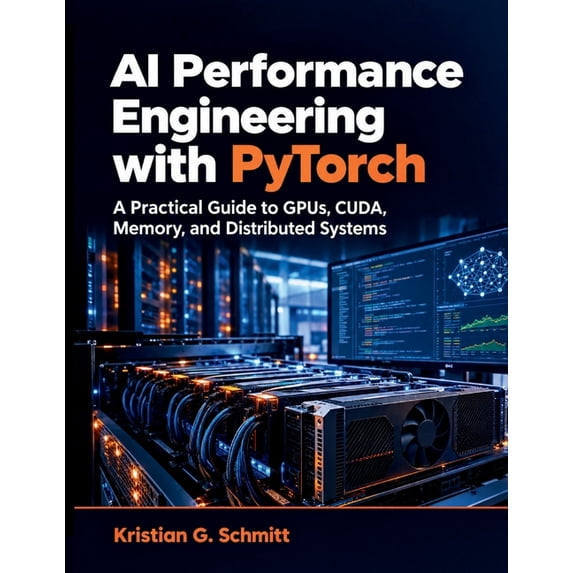
Are your PyTorch models taking too long to train? Are GPU resources sitting idle while your experiments crawl forward? Do you find yourself wondering why a model that works perfectly on a small dataset suddenly becomes painfully slow when the workload grows? What if the real problem is not your model architecture, but the way your hardware, memory, CUDA environment, and distributed system are being used?
AI Performance Engineering with PyTorch is designed to help you answer those questions and turn performance problems into measurable, solvable engineering challenges.
Have you ever increased your GPU count and expected training to become dramatically faster, only to discover that performance barely improved? Why does GPU utilization sometimes remain low even when your training job appears computationally demanding? What causes unexpected out-of-memory errors? How much performance are you losing to inefficient data loading, unnecessary memory transfers, synchronization overhead, or poorly optimized operations?
This practical guide takes you inside the performance engineering principles that can make PyTorch workloads faster, more efficient, and more predictable. Instead of treating optimization as guesswork, it encourages you to ask the right questions, measure what is actually happening, identify bottlenecks, and apply targeted improvements.
What is really happening between your Python code and the GPU? How does CUDA influence execution? How should you think about GPU architecture when designing and optimizing deep learning workloads? When should you move computation to the GPU, and when can doing so create new bottlenecks?
You will learn to look beyond simply "using a GPU" and understand how computation, memory, communication, and system resources interact.
What about memory? Why can a model consume far more GPU memory than expected? How do activations, parameters, gradients, optimizer states, temporary tensors, and allocation behavior affect your available capacity? How can careful memory management help you train larger workloads without simply buying more hardware?
And what happens when one GPU is no longer enough? How do distributed training strategies change the performance equation? What communication costs appear when multiple GPUs or machines work together? How can you recognize scaling inefficiencies before they become expensive infrastructure problems?
You will explore practical approaches to profiling, benchmarking, GPU execution, CUDA-aware optimization, memory efficiency, data pipelines, mixed precision, distributed training, and performance troubleshooting. The goal is not merely to memorize optimization techniques, but to develop an engineering mindset for diagnosing why a workload behaves the way it does.
Could a small change to your data pipeline eliminate a major bottleneck? Could better batching improve throughput? Could reducing unnecessary synchronization make distributed training substantially more efficient? What if understanding the bottleneck is more valuable than applying another optimization blindly?
Whether you are building experimental models, production AI systems, large-scale training pipelines, or GPU-intensive applications, this book provides a practical framework for thinking about performance from the code level to the distributed infrastructure level.
Are you ready to stop guessing why your PyTorch workloads are slow and start engineering them for performance?