

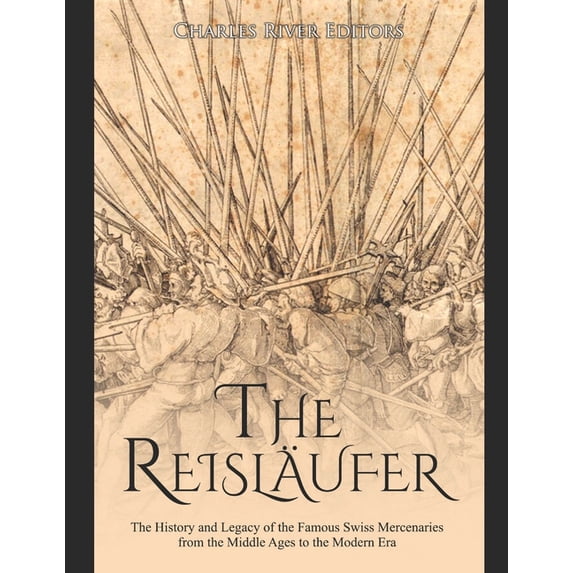
The Reisläufer (Paperback)
(No ratings yet)
Key item features
The Reisläufer (Paperback)
Specs
Publication date, November, 2020
Author, Charles River
Book format, Paperback
Genre, History
Pages, 54
Age group, Adult
Publication date
November, 2020
Author, Charles River
Author
Charles River
Book format, Paperback
Book format
Paperback
Genre, History
Genre
History
Pages, 54
Pages
54
Age group, Adult
Age group
Adult
About this item
Product details
*Includes pictures
*Includes a bibliography for further reading
The Middle Ages witnessed almost constant warfare in Europe, so mercenaries were a constant on the battlefield, but the 15th century also saw the rise of mercenary usage by the increasingly wealthy aristocracy. At the time, England and France existed in smaller versions than in the modern age, while the Spanish had unified into a few large kingdoms and were slowly pushing the Moors off the Iberian Peninsula. Norway and Hungary were larger than they are now, but otherwise, most of Europe was a patchwork quilt of small, constantly warring states. This was especially true in Germany and Italy, where innumerable city-states and little fiefdoms struggled to gain more territory and defend themselves against their neighbors.Switzerland, ringed by the Alps, was divided into numerous small statelets called cantons, with some in the valleys and some further up in the mountains. There was a great deal of local infighting like elsewhere in Europe, but by the Late Middle Ages, unification seemed possible for a few reasons. Most notably, the Swiss felt threatened by larger outside states such as the Holy Roman Empire, France, and Milan, which were poised to take advantage of Swiss division and relative weakness to invade. The Holy Roman Empire was an especially great threat because it had some political claim over the Swiss cantons, although the Swiss had always enjoyed a great deal of independence from Hapsburg rule. Furthermore, some important trade routes ran through the region, and all the cantons would benefit if these routes were kept open and secure.
In 1291, three cantons around Lake Lucerne-Schwyz, Uri, and Unterwalden-formed the so-called "Everlasting League" to counter outside aggression. This became the nucleus of what would develop into the Swiss Confederacy, and eventually the nation of Switzerland. Gradually, more and more cantons would join, ending their constant, low-level infighting and making the land more secure for trade. By the beginning of the 16th century, the Swiss Confederacy was comprised of 13 cantons, and this voluntary unification, without threats or conquest, was remarkable for the time. It was helped by the fact that the Swiss had a roughly similar culture, and that the region, with its ring of protective mountains, made the advantages of unification against a hostile outer world obvious to all.
Few powers dared try to enter Swiss territory, and they generally met with disaster when they did, but ironically, this led to a new problem. The Swiss villages had always been prone to fighting and raiding one another, maintaining a constant low-level warfare that made the Swiss good fighters, and hotheaded young men wanted a chance to fight. At the same time, other areas, especially Italy, saw a growing need for mercenaries. Constantly trying to take land from their neighbors, Italian city-states were hampered by the fact that most of their men were busy tilling fields, engaging in trade and crafts, or building the cities and monuments that would become the wonders of the Renaissance. Moreover, the cutthroat politics of the city-states were such that rulers could not trust their own officers, who might murder them and take over their positions, something that happened on numerous occasions.
The obvious solution was to hire mercenary armies, units of foreign men who had no connections or loyalty to any of the local factions and who would fight for money. The Swiss were perfectly poised to fill this need, given that they were geographically close and many already spoke Italian. They were also well trained thanks to a well-organized system of local and canton militias. With mercenary units being organized on the canton level, it was often possible to hire an entire, ready-made army with a single contract, and not only did these armies come already armed and trained, but they came from the same local area.
The Reisläufer (Paperback)
info:
We aim to show you accurate product information. Manufacturers, suppliers and others provide what you see here, and we have not verified it.
Specifications
Publication date
November, 2020
Author
Charles River
Book format
Paperback
Genre
History
Warranty
Warranty information
Please be aware that the warranty terms on items offered for sale by third party Marketplace sellers may differ from those displayed in this section (if any). To confirm warranty terms on an item offered for sale by a third party Marketplace seller, please use the 'Contact seller' feature on the third party Marketplace seller's information page and request the item's warranty terms prior to purchase.
Similar items you might like
Based on what customers bought
The Creoles (Paperback) $13.46
 $1346current price $13.46
The Creoles (Paperback)
La República de Génova (Paperback) $13.46
 $1346current price $13.46
La República de Génova (Paperback)
The Golden Horde (Paperback) $11.14
 $1114current price $11.14
The Golden Horde (Paperback)
The Longbow (Paperback) $11.14
 $1114current price $11.14
The Longbow (Paperback)
In 50+ people's carts, The Silent Patient (Paperback) $8.59 Was $9.92
In 50+ people's carts $859current price $8.59, Was $9.92$9.92
The Silent Patient (Paperback)
2924.6 out of 5 Stars. 292 reviews4.6 out of 5 starsThe Battle of Culloden, (Paperback) $8.99
 $899current price $8.99
The Battle of Culloden, (Paperback)
Game of Work, (Paperback) $10.35
 $1035current price $10.35
Game of Work, (Paperback)
The Battle of Manzikert (Paperback) $11.14
 $1114current price $11.14
The Battle of Manzikert (Paperback)
The Studebaker Brothers (Paperback) $11.14
 $1114current price $11.14
The Studebaker Brothers (Paperback)
The Mississippi Burning Case (Paperback) $7.22
 $722current price $7.22
The Mississippi Burning Case (Paperback)
Best seller, Verity (Paperback) $13.83 Was $16.99
Best seller 2 optionsAvailable in additional 2 options$1383current price $13.83, Was $16.99$16.99
Verity (Paperback)
4794.5 out of 5 Stars. 479 reviews4.5 out of 5 starsThe Johnstown Flood of 1889 (Paperback) $11.65
 $1165current price $11.65
The Johnstown Flood of 1889 (Paperback)
The Cambrian Period (Paperback) $11.14
 $1114current price $11.14
The Cambrian Period (Paperback)
The Dodo, (Paperback) $11.14
 $1114current price $11.14
The Dodo, (Paperback)
The Creoles (Paperback) $13.46
 $1346current price $13.46
The Creoles (Paperback)
The Perfect Storm of 1991 (Paperback) $8.14
 $814current price $8.14
The Perfect Storm of 1991 (Paperback)
The Cristero War, (Paperback) $10.14
 $1014current price $10.14
The Cristero War, (Paperback)
The Little Rock Nine (Paperback) $11.14
 $1114current price $11.14
The Little Rock Nine (Paperback)
The Cumans (Paperback) $13.46
 $1346current price $13.46
The Cumans (Paperback)
The World Trade Center (Paperback) $10.24
 $1024current price $10.24
The World Trade Center (Paperback)
Customer ratings & reviews
0 out of 5 stars
This item does not have any reviews yet

Current price is USD$11.14
Price when purchased online
 Free 90-day returns
How do you want your item?
Try 30 days for just $1! Choose a plan at checkout.
Ships to
Arrives by Sat, Nov 21
Sold and shipped by Walmart.com

Free 90-day returns

This item is gift eligible
More seller options (2)
Starting from $13.46

Try 30 days of Walmart+ for just $1!
T&C apply. Claim offer now