Instructions
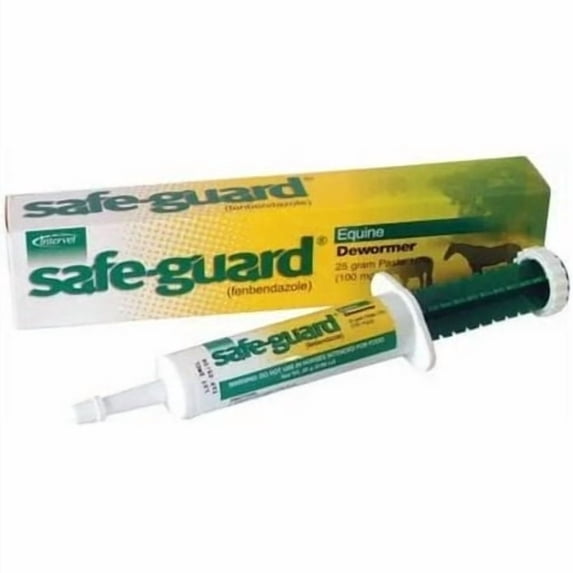
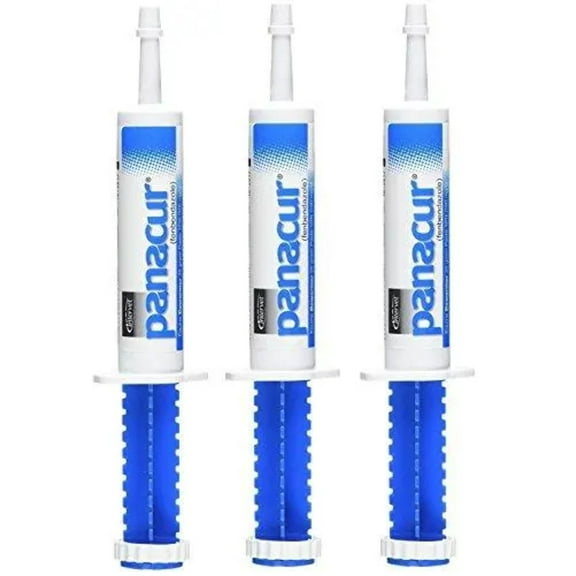
Dosage:. Safe-Guard® (fenbendazole) Paste 10% is administered orally at a rate of 2.3 mg/lb (5 mg/kg) for the control of large strongyles, small strongyles, and pinworms. One syringe will deworm a 1 ,100 lb horse. For foals and weanlings (less than 18 months of age) where ascarids are a common problem, the recommended dose is 4.6 mg/lb (10 mg/kg); one syringe will deworm a 550 lb horse. For control of encysted early third stage (hypobiotic), late third stage and fourth stage cyathostome larvae, and fourth stage larvae of Strongylus vulgaris, the recommended dose is 4.6 mg/lb (10 mg/kg) daily for 5 consecutive days; administer one syringe for each 550 lbs body weight per day. See precautions for retreatment recommendations. Directions For Use:. 1. Determine the weight of the horse. 2. Remove syringe tip. 3. Turn the dial ring until the edge of the ring nearest the tip lines up with zero. 4. Depress plunger to advance paste to tip. 5. Now set the dial ring at the graduation nearest the weight of the horse (do not underdose). 6. Horse's mouth must be free of food. 7. Insert nozzle of syringe through the interdental space and deposit the paste on the back of the tongue by depressing the plunger. How Supplied:. Safe-Guard® (fenbendazole) Paste 10% Equine Dewormer is supplied in 25 g syringes. PRECAUTIONS:. Side effects associated with Safe-Guard® (fenbendazole) Paste 10% could not be established in well-controlled safety studies in horses with single doses as high as 454 mg/lb (1,000 mg/kg) and 15 consecutive daily doses of 22.7 mg/lb (50 mg/kg). Prticularly with higher doses, the lethal action of fenbendazole may cause the release of antigens by the dying parasites. This phenomenon may result in either a local or systematic hypersensitive reaction. As with any drug, these reactions should be treated symptomatically. . INTERNAL PARASITES: Regular deworming at intervals of six to eight weeks may be required due to the possibility of reinfection. MIGRATING TISSUE PARASITES: In the case of 4th stage larvae of Strongylus vulgaris, treatment and retreatment should be based on the life cycle and the epidemiology. Treatment should be initiated in the spring and repeated in the fall after a six month interval. Optimum Deworming Program for control of S. vulgaris reduction of S. vulgaris infections is achieved by reducing the infectivity of the pastures. When horses are running on pasture, in temperate North America, maximum pasture infectivity occurs in October-December. If horses are removed from those pastures in January, pasture infectivity will decline to zero by July 1. Egg productions of S. vulgaris is minimal from January through April, peaking in August and declining to minimal values in December. Recommended Deworming Program:. **December 1, February 1, APRIL 1, June 1, August 1, OCTOBER 1. The two treatments that are in bold type are the recommended periods when the 5-day treatment regimen for the control of the migrating larvae of S. vulgaris should be performed. **For other areas in the world, retreatment periods for the migrating larvae of S. vulgaris may be different; consult with your veterinarian. CAUTIONS: KEEP THIS AND ALL MEDICATION OUT OF THE REACH OF CHILDREN. When using Safe-Guard® (fenbendazole) Paste 10% concomitantly with trichlorfon, refer to the manufacturer's labels for use and cautions for trichlorfon. WARNINGS: DO NOT USE IN HORSES INTENDED FOR HUMAN CONSUMPTION. CONSULT YOUR VETERINARIAN FOR ASSISTANCE IN THE DIAGNOSIS, TREATMENT AND CONTROL OF PARASITISM.