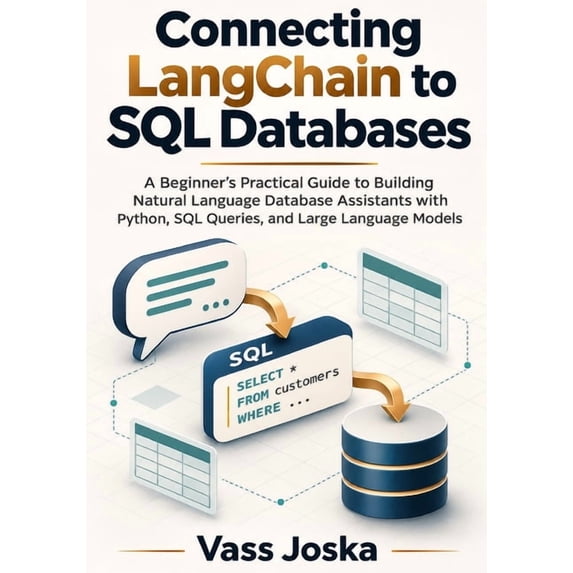
What if you could ask your SQL database a question in plain English and receive an answer without manually writing complex queries?
Connecting LangChain to SQL Databases is a practical, beginner-friendly guide to building natural language database assistants using Python, SQL, LangChain, and large language models (LLMs).
Instead of searching through tables or writing SQL statements for every question, imagine asking, "Which customers placed the most orders?" or "What were our total sales last month?" and having an AI-powered assistant generate the appropriate query, retrieve the relevant information, and explain the results.
This book shows you how to understand and build that connection, one practical step at a time.
Designed for readers with basic Python knowledge, it introduces the essential concepts behind natural language database querying without overwhelming you with unnecessary theory or complicated architectures.
What You'll Learn
-
Understand LangChain and SQL integration: Discover how LangChain connects language models to relational databases and supports natural language querying.
-
Prepare your development environment: Set up Python, install the necessary libraries, and configure a simple database project.
-
Connect Python applications to SQL databases: Understand database connections, tables, schemas, and the information an AI assistant needs to generate queries.
-
Translate everyday questions into SQL: Learn how large language models interpret user requests and produce SQL statements.
-
Build a natural language database assistant: Connect the essential components to create an application that responds to questions about stored data.
-
Work with prompts and query results: Understand how instructions guide SQL generation and how database results become readable answers.
-
Handle common errors and improve reliability: Explore practical approaches to query validation, troubleshooting, and safer database interactions.
-
Test your completed application: Run a working assistant, examine its responses, and understand how the entire process fits together.
Learn Through Practical Examples
Rather than presenting isolated technical concepts, this guide follows a progressive learning approach that connects explanations with practical Python examples, SQL queries, and guided exercises.
Each stage builds on the previous one, helping you understand not only what to do but also why each component matters.
Who Is This Book For?
This guide is suitable for: