

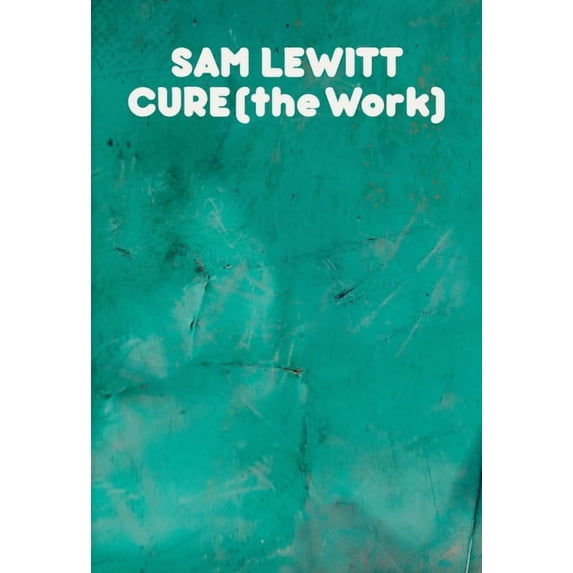
Hero image 0 of CURE (the Work) (Paperback), 0 of 1
CURE (the Work) (Paperback)
(No ratings yet)
Key item features
A graphic extension of Sam Lewitt’s 2021 exhibition at Z33 House of Contemporary Art, Design and Architecture, Belgium.
CURE (the Work) is a graphic extension of Sam Lewitt’s 2021 exhibition at Z33 House of Contemporary Art, Design and Architecture, Belgium.
Lewitt’s exhibition departs from the recent closure and demolition of Ford Genk, formerly a major employer in the region. As Ford Genk was undergoing demolition, the new wing of Z33 was under construction in the nearby city of Hasselt. CURE (the Work) retools elements of the demolished factory, as well as two manual earth ramming presses compacting soil extracted from the Ford site, recasting the galleries at Z33 as a production line for interlocking compressed earth blocks: a low-cost building material designed for self-help housing in so-called developing countries, as well as practitioners of small-scale ecological self-sufficiency. Each stage in the brick production process—compressing, curing, and stacking—is separated within the exhibition space by doors and tarps from the former factory. This dispersed presentation raises the question of where we locate the “work,” as an activity and as a product.
As a book, Cure (the Work) is structured around a template drawn from the form of a paving stone produced throughout the exhibition. Book and brick are here identified according to their portability and serial logic. This paver’s form becomes an internal frame for the book’s image content. The latter comprises research and photographic documentation of the Ford factory during demolition. The rhythm of these images throughout the book is constrained to a printing on a single side of the paper running through the press, resulting in variably patterned sequences of two-page spreads punctuated by empty pages.
This documentation and textual material at once situates CURE (the Work) within the context of this deindustrialized European city, and points beyond the site to its broader, encompassing logic and material conditions. Like the content of Lewitt’s work, the form of the book is structured by the logic of mobility, standardization, and rationalization that a broader consideration of the local context in the midst of global economic machinations implies. This includes the mobility promised by the automotive industry, capital flight in search of low wages, labor’s resulting immobilization as well as a critical self-reflection on global artistic culture and its relationship to economic and social transformation.
Newly commissioned essays on Lewitt’s work by art historians Annie Ochmanek and André Rottmann, as well as a discussion between architecture historian Felicity Scott and Sam Lewitt, moderated by Z33 curator Tim Roerig, contextualize the exhibition and book, pointing to its place within Lewitt’s practice.
Specs
Publication date, August, 2022
Author, Sam Lewitt
Book format, Paperback
Genre, Literature & Fiction
Pages, 360
Age group, Adult
Publication date
August, 2022
Author, Sam Lewitt
Author
Sam Lewitt
Book format, Paperback
Book format
Paperback
Genre, Literature & Fiction
Genre
Literature & Fiction
Pages, 360
Pages
360
Age group, Adult
Age group
Adult
About this item
Product details
A graphic extension of Sam Lewitt's 2021 exhibition at Z33 House of Contemporary Art, Design and Architecture, Belgium. CURE (the Work) is a graphic extension of Sam Lewitt's 2021 exhibition at Z33 House of Contemporary Art, Design and Architecture, Belgium. Lewitt's exhibition departs from the recent closure and demolition of Ford Genk, formerly a major employer in the region. As Ford Genk was undergoing demolition, the new wing of Z33 was under construction in the nearby city of Hasselt. CURE (the Work) retools elements of the demolished factory, as well as two manual earth ramming presses compacting soil extracted from the Ford site, recasting the galleries at Z33 as a production line for interlocking compressed earth blocks: a low-cost building material designed for self-help housing in so-called developing countries, as well as practitioners of small-scale ecological self-sufficiency. Each stage in the brick production process--compressing, curing, and stacking--is separated within the exhibition space by doors and tarps from the former factory. This dispersed presentation raises the question of where we locate the "work," as an activity and as a product. As a book, Cure (the Work) is structured around a template drawn from the form of a paving stone produced throughout the exhibition. Book and brick are here identified according to their portability and serial logic. This paver's form becomes an internal frame for the book's image content. The latter comprises research and photographic documentation of the Ford factory during demolition. The rhythm of these images throughout the book is constrained to a printing on a single side of the paper running through the press, resulting in variably patterned sequences of two-page spreads punctuated by empty pages. This documentation and textual material at once situates CURE (the Work) within the context of this deindustrialized European city, and points beyond the site to its broader, encompassing logic and material conditions. Like the content of Lewitt's work, the form of the book is structured by the logic of mobility, standardization, and rationalization that a broader consideration of the local context in the midst of global economic machinations implies. This includes the mobility promised by the automotive industry, capital flight in search of low wages, labor's resulting immobilization as well as a critical self-reflection on global artistic culture and its relationship to economic and social transformation. Newly commissioned essays on Lewitt's work by art historians Annie Ochmanek and André Rottmann, as well as a discussion between architecture historian Felicity Scott and Sam Lewitt, moderated by Z33 curator Tim Roerig, contextualize the exhibition and book, pointing to its place within Lewitt's practice.
A graphic extension of Sam Lewitt’s 2021 exhibition at Z33 House of Contemporary Art, Design and Architecture, Belgium.
CURE (the Work) is a graphic extension of Sam Lewitt’s 2021 exhibition at Z33 House of Contemporary Art, Design and Architecture, Belgium.
Lewitt’s exhibition departs from the recent closure and demolition of Ford Genk, formerly a major employer in the region. As Ford Genk was undergoing demolition, the new wing of Z33 was under construction in the nearby city of Hasselt. CURE (the Work) retools elements of the demolished factory, as well as two manual earth ramming presses compacting soil extracted from the Ford site, recasting the galleries at Z33 as a production line for interlocking compressed earth blocks: a low-cost building material designed for self-help housing in so-called developing countries, as well as practitioners of small-scale ecological self-sufficiency. Each stage in the brick production process—compressing, curing, and stacking—is separated within the exhibition space by doors and tarps from the former factory. This dispersed presentation raises the question of where we locate the “work,” as an activity and as a product.
As a book, Cure (the Work) is structured around a template drawn from the form of a paving stone produced throughout the exhibition. Book and brick are here identified according to their portability and serial logic. This paver’s form becomes an internal frame for the book’s image content. The latter comprises research and photographic documentation of the Ford factory during demolition. The rhythm of these images throughout the book is constrained to a printing on a single side of the paper running through the press, resulting in variably patterned sequences of two-page spreads punctuated by empty pages.
This documentation and textual material at once situates CURE (the Work) within the context of this deindustrialized European city, and points beyond the site to its broader, encompassing logic and material conditions. Like the content of Lewitt’s work, the form of the book is structured by the logic of mobility, standardization, and rationalization that a broader consideration of the local context in the midst of global economic machinations implies. This includes the mobility promised by the automotive industry, capital flight in search of low wages, labor’s resulting immobilization as well as a critical self-reflection on global artistic culture and its relationship to economic and social transformation.
Newly commissioned essays on Lewitt’s work by art historians Annie Ochmanek and André Rottmann, as well as a discussion between architecture historian Felicity Scott and Sam Lewitt, moderated by Z33 curator Tim Roerig, contextualize the exhibition and book, pointing to its place within Lewitt’s practice.
CURE (the Work) is a graphic extension of Sam Lewitt’s 2021 exhibition at Z33 House of Contemporary Art, Design and Architecture, Belgium.
Lewitt’s exhibition departs from the recent closure and demolition of Ford Genk, formerly a major employer in the region. As Ford Genk was undergoing demolition, the new wing of Z33 was under construction in the nearby city of Hasselt. CURE (the Work) retools elements of the demolished factory, as well as two manual earth ramming presses compacting soil extracted from the Ford site, recasting the galleries at Z33 as a production line for interlocking compressed earth blocks: a low-cost building material designed for self-help housing in so-called developing countries, as well as practitioners of small-scale ecological self-sufficiency. Each stage in the brick production process—compressing, curing, and stacking—is separated within the exhibition space by doors and tarps from the former factory. This dispersed presentation raises the question of where we locate the “work,” as an activity and as a product.
As a book, Cure (the Work) is structured around a template drawn from the form of a paving stone produced throughout the exhibition. Book and brick are here identified according to their portability and serial logic. This paver’s form becomes an internal frame for the book’s image content. The latter comprises research and photographic documentation of the Ford factory during demolition. The rhythm of these images throughout the book is constrained to a printing on a single side of the paper running through the press, resulting in variably patterned sequences of two-page spreads punctuated by empty pages.
This documentation and textual material at once situates CURE (the Work) within the context of this deindustrialized European city, and points beyond the site to its broader, encompassing logic and material conditions. Like the content of Lewitt’s work, the form of the book is structured by the logic of mobility, standardization, and rationalization that a broader consideration of the local context in the midst of global economic machinations implies. This includes the mobility promised by the automotive industry, capital flight in search of low wages, labor’s resulting immobilization as well as a critical self-reflection on global artistic culture and its relationship to economic and social transformation.
Newly commissioned essays on Lewitt’s work by art historians Annie Ochmanek and André Rottmann, as well as a discussion between architecture historian Felicity Scott and Sam Lewitt, moderated by Z33 curator Tim Roerig, contextualize the exhibition and book, pointing to its place within Lewitt’s practice.
info:
We aim to show you accurate product information. Manufacturers, suppliers and others provide what you see here, and we have not verified it.
Specifications
Publication date
August, 2022
Author
Sam Lewitt
Book format
Paperback
Genre
Literature & Fiction
Warranty
Warranty information
Please be aware that the warranty terms on items offered for sale by third party Marketplace sellers may differ from those displayed in this section (if any). To confirm warranty terms on an item offered for sale by a third party Marketplace seller, please use the 'Contact seller' feature on the third party Marketplace seller's information page and request the item's warranty terms prior to purchase.
Similar items you might like
Based on what customers bought
Back to Bukhara (Paperback) $25.99
 $2599current price $25.99
Back to Bukhara (Paperback)
Pantagruelovsko Predskazanje (Paperback) $14.00
 $1400current price $14.00
Pantagruelovsko Predskazanje (Paperback)
In 25+ people's carts, Project Hail Mary: A Novel (Paperback) $16.50
In 25+ people's carts $1650current price $16.50
Project Hail Mary: A Novel (Paperback)
2484.8 out of 5 Stars. 248 reviews4.8 out of 5 starsThe Turdox, (Paperback) $7.00
 $700current price $7.00
The Turdox, (Paperback)
Best seller, The Mistake (Paperback) $9.34 Was $16.99
Best seller $934current price $9.34, Was $16.99$16.99
The Mistake (Paperback)
844.7 out of 5 Stars. 84 reviews4.7 out of 5 stars2026 Grok, (Paperback) $18.99
 $1899current price $18.99
2026 Grok, (Paperback)
Best seller, Verity (Paperback) $7.05 Was $13.78
Best seller 2 optionsAvailable in additional 2 options$705current price $7.05, Was $13.78$13.78
Verity (Paperback)
4794.5 out of 5 Stars. 479 reviews4.5 out of 5 starsBest seller, You Shouldn't Have Come Here (Unabridged edition) (Paperback) $8.99
Best seller $899current price $8.99
You Shouldn't Have Come Here (Unabridged edition) (Paperback)
1374.7 out of 5 Stars. 137 reviews4.7 out of 5 starsFall I Want: A Novel (Paperback) $14.24
 $1424current price $14.24
Fall I Want: A Novel (Paperback)
602.9 out of 5 Stars. 60 reviews2.9 out of 5 starsThe Gamov Incident (Paperback) $18.75
 $1875current price $18.75
The Gamov Incident (Paperback)
Malencontre..., (Paperback) $25.95
 $2595current price $25.95
Malencontre..., (Paperback)
Hêliand, (Paperback) $24.95
 $2495current price $24.95
Hêliand, (Paperback)
Schapen: Fotoboek, (Paperback) $21.70
 $2170current price $21.70
Schapen: Fotoboek, (Paperback)
Cogitation, (Paperback) $16.00
 $1600current price $16.00
Cogitation, (Paperback)
Organon of Medicine, (Paperback) $23.95
 $2395current price $23.95
Organon of Medicine, (Paperback)
Autokill, (Paperback) $20.84
 $2084current price $20.84
Autokill, (Paperback)
Forsaking Midnight (Standard Edition) (Paperback) $14.98
 $1498current price $14.98
Forsaking Midnight (Standard Edition) (Paperback)
234.9 out of 5 Stars. 23 reviews4.9 out of 5 starsThe Cure (Paperback) $8.49
 $849current price $8.49
The Cure (Paperback)
Chistes, (Paperback) $14.99
 $1499current price $14.99
Chistes, (Paperback)
33 1/3 The Cure's Disintegration, (Paperback) $14.95
 $1495current price $14.95
33 1/3 The Cure's Disintegration, (Paperback)
Customer ratings & reviews
0 out of 5 stars
This item does not have any reviews yet

Current price is USD$26.10
Price when purchased online
- Free shipping
 Free Holiday returns until Jan 31
$26.10
$20.95
Save $5.15 vs. new
How do you want your item?
Ships to
Arrives between Dec 7 - Dec 11
|
Sold and shipped by RAREWAVES-USA
4.5797723856560015 out of 5 stars

Extended holiday returns
Free Holiday returns until Jan 31More seller options (1)
Starting from $26.07