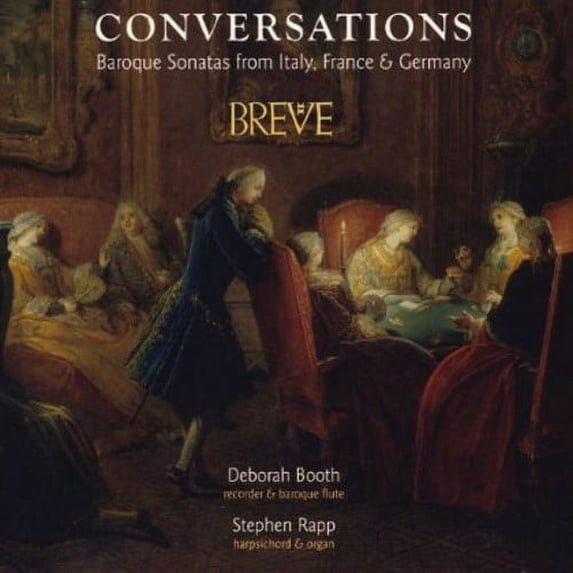
BREVE presents Conversations - Baroque Sonatas from Italy, France, and Germany Deborah Booth, recorder & traverso Stephen Rapp, harpsichord & organ Maxine Neuman, baroque cello Lisa Terry, viola da gamba Rachel Begley, baroque bassoon Conversations explores music of the 17th and 18th centuries from Italy, France, and Germany on original instruments - recorders, flutes, harpsichord, organ, cello, viola da gamba, and bassoon. Each piece has sparked a unique musical conversation of it's own. Deborah Booth and Stephen Rapp perform as an organ-recorder duo, and also invite three other musicians to join in; the result is an intricate tapestry of sound combinations. Treble instruments are carefully chosen to enhance the music, picked from a selection of recorders and baroque flutes. Even the basso continuo is tailored to the repertoire to lend variety: cello and harpsichord for the Telemann works, viola da gamba and harpsichord (in deference to French practice of the time) for the Hotteterre, solo organ for the early 17th century Italian Castello, bassoon and harpsichord in the Mancini. This multifaceted approach provides a richly colorful realization of each score. BREVE, the name of the ensemble, refers to the essence of great musicmaking-it's heartbeat. (While the term is known nowadays primarily as a tempo marking, alla breve, it originally defined the tactus, or pulse, and was used as a single beat note in standard music notation (insert Breve). Originally conceived as a duo, BREVE regularly includes additional performers, a flexibility that allows it to embrace a varied repertoire. Based in New York City since 1985, the group has toured the United States, Mexico, and Europe, offering unique programs of music from many eras on authentic instruments, in historically informed style. In addition to playing music from the Renaissance, Baroque, and Classical eras, BREVE has commissioned new works by contemporary composers for it's modern instrument combinations. Notes Georg Philipp Telemann (1681-1767) is listed in the Guinness Book of Records as the most prolific composer in history-over three thousand known compositions. After close to a century spent in near-obscurity, his popularity with modern audiences has steadily increased as the diversity and quality of his works becomes more known. Officially, Telemann worked in a series of churches in Leipzig, Sorau (now Poland), Eisenach (where he very probably knew another choirmaster, a certain J. S. Bach), Frankfurt, and Hamburg. But his musical interests refused to remain in the sacred sphere: he presented secular concerts, organized student Collegiums, and juxtaposed his cantatas and oratorios with theatrical compositions, even opera. This repeatedly got him into trouble with church officials, who complained that such performances incited quot;lasciviousness.quot; His usual response was a threat to resign his post and go where he, and his musical activities, would be more welcome. This made him a trailblazer, helping to break down the barriers between sacred and secular music. Telemann also helped to redefine the role of the professional musician by self-publishing many of his own collections, setting an important precedent regarding music as the intellectual property of it's creator. The Trio in B? Major from Telemann's Essercizii Musici, a collection of twelve solos and twelve trios, was published in 1740. The work is scored for recorder, harpsichord, and continuo, and is composed in a style