

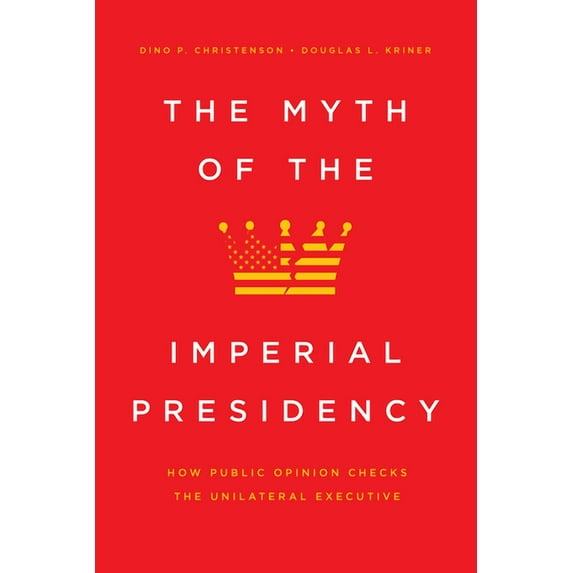
Hero image 0 of The Myth of the Imperial Presidency : How Public Opinion Checks the Unilateral Executive (Edition 1) (Hardcover), 0 of 1
The Myth of the Imperial Presidency : How Public Opinion Checks the Unilateral Executive (Edition 1) (Hardcover)
(No ratings yet)
Key item features
Throughout American history, presidents have shown a startling power to act independently of Congress and the courts. On their own initiative, presidents have taken the country to war, abolished slavery, shielded undocumented immigrants from deportation, declared a national emergency at the border, and more, leading many to decry the rise of an imperial presidency. But given the steep barriers that usually prevent Congress and the courts from formally checking unilateral power, what stops presidents from going it alone even more aggressively? The answer, Dino P. Christenson and Douglas L. Kriner argue, lies in the power of public opinion.
With robust empirical data and compelling case studies, the authors reveal the extent to which domestic public opinion limits executive might. Presidents are emboldened to pursue their own agendas when they enjoy strong public support, and constrained when they don’t, since unilateral action risks inciting political pushback, jeopardizing future initiatives, and further eroding their political capital. Although few Americans instinctively recoil against unilateralism, Congress and the courts can sway the public’s view via their criticism of unilateral policies. Thus, other branches can still check the executive branch through political means. As long as presidents are concerned with public opinion, Christenson and Kriner contend that fears of an imperial presidency are overblown.
With robust empirical data and compelling case studies, the authors reveal the extent to which domestic public opinion limits executive might. Presidents are emboldened to pursue their own agendas when they enjoy strong public support, and constrained when they don’t, since unilateral action risks inciting political pushback, jeopardizing future initiatives, and further eroding their political capital. Although few Americans instinctively recoil against unilateralism, Congress and the courts can sway the public’s view via their criticism of unilateral policies. Thus, other branches can still check the executive branch through political means. As long as presidents are concerned with public opinion, Christenson and Kriner contend that fears of an imperial presidency are overblown.
Specs
- Book formatHardcover
- Fiction/nonfictionNon-Fiction
- Pub date20201123
- Pages240
- Reading levelGeneral (US: Trade)
- SubgenreAmerican Government
Current price is USD$84.17
Price when purchased online
- Free shipping
 Free 90-day returns
How do you want your item?
Try 30 days of Free Shipping with Walmart+! Choose plan at checkout.
Columbus, 43215
Arrives by Fri, Apr 3
Sold and shipped by Walmart.com

Free 90-day returns

This item is gift eligible
More seller options (3)
Starting from $115.14

Get free delivery, shipping and more*
*Restrictions apply Try Walmart+ now
About this item
Product details
Throughout American history, presidents have shown a startling power to act independently of Congress and the courts. On their own initiative, presidents have taken the country to war, abolished slavery, shielded undocumented immigrants from deportation, declared a national emergency at the border, and more, leading many to decry the rise of an imperial presidency. But given the steep barriers that usually prevent Congress and the courts from formally checking unilateral power, what stops presidents from going it alone even more aggressively? The answer, Dino P. Christenson and Douglas L. Kriner argue, lies in the power of public opinion. With robust empirical data and compelling case studies, the authors reveal the extent to which domestic public opinion limits executive might. Presidents are emboldened to pursue their own agendas when they enjoy strong public support, and constrained when they don't, since unilateral action risks inciting political pushback, jeopardizing future initiatives, and further eroding their political capital. Although few Americans instinctively recoil against unilateralism, Congress and the courts can sway the public's view via their criticism of unilateral policies. Thus, other branches can still check the executive branch through political means. As long as presidents are concerned with public opinion, Christenson and Kriner contend that fears of an imperial presidency are overblown.
Throughout American history, presidents have shown a startling power to act independently of Congress and the courts. On their own initiative, presidents have taken the country to war, abolished slavery, shielded undocumented immigrants from deportation, declared a national emergency at the border, and more, leading many to decry the rise of an imperial presidency. But given the steep barriers that usually prevent Congress and the courts from formally checking unilateral power, what stops presidents from going it alone even more aggressively? The answer, Dino P. Christenson and Douglas L. Kriner argue, lies in the power of public opinion.
With robust empirical data and compelling case studies, the authors reveal the extent to which domestic public opinion limits executive might. Presidents are emboldened to pursue their own agendas when they enjoy strong public support, and constrained when they don’t, since unilateral action risks inciting political pushback, jeopardizing future initiatives, and further eroding their political capital. Although few Americans instinctively recoil against unilateralism, Congress and the courts can sway the public’s view via their criticism of unilateral policies. Thus, other branches can still check the executive branch through political means. As long as presidents are concerned with public opinion, Christenson and Kriner contend that fears of an imperial presidency are overblown.
With robust empirical data and compelling case studies, the authors reveal the extent to which domestic public opinion limits executive might. Presidents are emboldened to pursue their own agendas when they enjoy strong public support, and constrained when they don’t, since unilateral action risks inciting political pushback, jeopardizing future initiatives, and further eroding their political capital. Although few Americans instinctively recoil against unilateralism, Congress and the courts can sway the public’s view via their criticism of unilateral policies. Thus, other branches can still check the executive branch through political means. As long as presidents are concerned with public opinion, Christenson and Kriner contend that fears of an imperial presidency are overblown.
info:
We aim to show you accurate product information. Manufacturers, suppliers and others provide what you see here, and we have not verified it.
Specifications
Book format
Hardcover
Fiction/nonfiction
Non-Fiction
Genre
Political & Social Sciences
Pub date
20201123
Warranty
Warranty information
Please be aware that the warranty terms on items offered for sale by third party Marketplace sellers may differ from those displayed in this section (if any). To confirm warranty terms on an item offered for sale by a third party Marketplace seller, please use the 'Contact seller' feature on the third party Marketplace seller's information page and request the item's warranty terms prior to purchase.
Similar items you might like
Based on what customers bought
The Soviet Administrative Elite, (Hardcover) $90.97
 $9097current price $90.97
The Soviet Administrative Elite, (Hardcover)
Transforming Government Bureaucrats and Leadership, (Hardcover) $90.07
 $9007current price $90.07
Transforming Government Bureaucrats and Leadership, (Hardcover)
U.S. Presidents as Orators: A Bio-Critical Sourcebook, (Hardcover) $93.60
 $9360current price $93.60
U.S. Presidents as Orators: A Bio-Critical Sourcebook, (Hardcover)
The Legislative Struggle: A Study in Social Combat, (Hardcover) $93.31
 $9331current price $93.31
The Legislative Struggle: A Study in Social Combat, (Hardcover)
Modern Arms and Free Men: A Discussion of the Role of Science in Preserving Democracy, (Hardcover) $79.84
 $7984current price $79.84
Modern Arms and Free Men: A Discussion of the Role of Science in Preserving Democracy, (Hardcover)
Social Indicators Research Reframing Disability and Quality of Life: A Global Perspective, Book 52, (Hardcover) $93.02
 $9302current price $93.02
Social Indicators Research Reframing Disability and Quality of Life: A Global Perspective, Book 52, (Hardcover)
The Chameleon President: The Curious Case of George W. Bush, (Hardcover) $77.49
 $7749current price $77.49
The Chameleon President: The Curious Case of George W. Bush, (Hardcover)
Intelligent Systems Reference Library Decision Science: A Human-Oriented Perspective, Book 89, (Hardcover) $91.36
 $9136current price $91.36
Intelligent Systems Reference Library Decision Science: A Human-Oriented Perspective, Book 89, (Hardcover)
Post-Growth Politics: A Critical Theoretical and Policy Framework for Decarbonisation, (Hardcover) $90.54
 $9054current price $90.54
Post-Growth Politics: A Critical Theoretical and Policy Framework for Decarbonisation, (Hardcover)
The Influence of Public Opinion on Post-Cold War U.S. Military Interventions, (Hardcover) $107.14
 $10714current price $107.14
The Influence of Public Opinion on Post-Cold War U.S. Military Interventions, (Hardcover)
Controversies in Science Religious Politics in Global and Comparative Perspective, (Hardcover) $72.71
 $7271current price $72.71
Controversies in Science Religious Politics in Global and Comparative Perspective, (Hardcover)
Triumphs and Tragedies of the Modern Presidency: Case Studies in Presidential Leadership, (Hardcover) $90.27
 $9027current price $90.27
Triumphs and Tragedies of the Modern Presidency: Case Studies in Presidential Leadership, (Hardcover)
Building Decent Societies: Rethinking the Role of Social Security in Development, (Hardcover) $90.07
 $9007current price $90.07
Building Decent Societies: Rethinking the Role of Social Security in Development, (Hardcover)
The Case for Bureaucracy: A Public Administration Polemic, 4th Edition, (Hardcover) $90.67
 $9067current price $90.67
The Case for Bureaucracy: A Public Administration Polemic, 4th Edition, (Hardcover)
Contributions in American History Earnest Endeavors: The Life and Public Work of George Rublee, Book 202, (Hardcover) $75.45
 $7545current price $75.45
Contributions in American History Earnest Endeavors: The Life and Public Work of George Rublee, Book 202, (Hardcover)
The Fed at One Hundred: A Critical View on the Federal Reserve System, (Hardcover) $91.34
 $9134current price $91.34
The Fed at One Hundred: A Critical View on the Federal Reserve System, (Hardcover)
Sovietica Genesis and Development of Plekhanov's Theory of Knowledge: A Marxist Between Anthropological Materialism and Physi, Book 55, (Hardcover) $91.78
 $9178current price $91.78
Sovietica Genesis and Development of Plekhanov's Theory of Knowledge: A Marxist Between Anthropological Materialism and Physi, Book 55, (Hardcover)
Youssou Ndour: A Cultural Icon and Leader in Social Advocacy, (Hardcover) $98.95
 $9895current price $98.95
Youssou Ndour: A Cultural Icon and Leader in Social Advocacy, (Hardcover)
Cambridge Studies in Public Opinion and What Is It about Government That Americans Dislike?, (Hardcover) $87.40
 $8740current price $87.40
Cambridge Studies in Public Opinion and What Is It about Government That Americans Dislike?, (Hardcover)
Public Opinion, the Press, and Public Policy, (Hardcover) $88.40
 $8840current price $88.40
Public Opinion, the Press, and Public Policy, (Hardcover)
Customer ratings & reviews
0 ratings|0 reviews
This item does not have any reviews yet
