

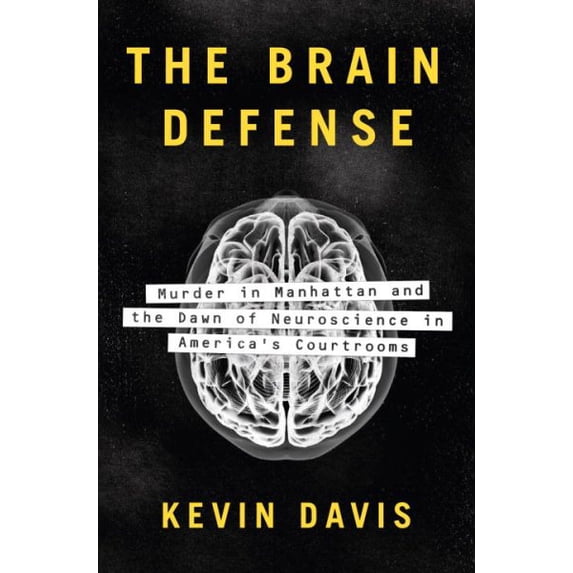
The Brain Defense
(No ratings yet)
Book Format:Hardcover-Out of stock
Key item features
Called “the best kind of nonfiction” by Michael Connelly, this riveting new book combines true crime, brain science, and courtroom drama.
In 1991, the police were called to East 72nd St. in Manhattan, where a woman's body had fallen from a twelfth-story window. The woman’s husband, Herbert Weinstein, soon confessed to having hit and strangled his wife after an argument, then dropping her body out of their apartment window to make it look like a suicide. The 65-year-old Weinstein, a quiet, unassuming retired advertising executive, had no criminal record, no history of violent behavior—not even a short temper. How, then, to explain this horrific act?
Journalist Kevin Davis uses the perplexing story of the Weinstein murder to present a riveting, deeply researched exploration of the intersection of neuroscience and criminal justice. Shortly after Weinstein was arrested, an MRI revealed a cyst the size of an orange on his brain’s frontal lobe, the part of the brain that governs judgment and impulse control. Weinstein’s lawyer seized on that discovery, arguing that the cyst had impaired Weinstein’s judgment and that he should not be held criminally responsible for the murder. It was the first case in the United States in which a judge allowed a scan showing a defendant’s brain activity to be admitted as evidence to support a claim of innocence.
The Weinstein case marked the dawn of a new era in America's courtrooms, raising complex and often troubling questions about how we define responsibility and free will, how we view the purpose of punishment, and how strongly we are willing to bring scientific evidence to bear on moral questions. Davis brings to light not only the intricacies of the Weinstein case but also the broader history linking brain injuries and aberrant behavior, from the bizarre stories of Phineas Gage and Charles Whitman, perpetrator of the 1966 Texas Tower massacre, to the role that brain damage may play in violence carried out by football players and troubled veterans of America’s twenty-first century wars. The Weinstein case opened the door for a novel defense that continues to transform the legal system: Criminal lawyers are increasingly turning to neuroscience and introducing the effects of brain injuries—whether caused by trauma or by tumors, cancer, or drug or alcohol abuse—and arguing that such damage should be considered in determining guilt or innocence, the death penalty or years behind bars. As he takes stock of the past, present and future of neuroscience in the courts, Davis offers a powerful account of its potential and its hazards.
Thought-provoking and brilliantly crafted, The Brain Defense marries a murder mystery complete with colorful characters and courtroom drama with a sophisticated discussion of how our legal system has changed—and must continue to change—as we broaden our understanding of the human mind.
In 1991, the police were called to East 72nd St. in Manhattan, where a woman's body had fallen from a twelfth-story window. The woman’s husband, Herbert Weinstein, soon confessed to having hit and strangled his wife after an argument, then dropping her body out of their apartment window to make it look like a suicide. The 65-year-old Weinstein, a quiet, unassuming retired advertising executive, had no criminal record, no history of violent behavior—not even a short temper. How, then, to explain this horrific act?
Journalist Kevin Davis uses the perplexing story of the Weinstein murder to present a riveting, deeply researched exploration of the intersection of neuroscience and criminal justice. Shortly after Weinstein was arrested, an MRI revealed a cyst the size of an orange on his brain’s frontal lobe, the part of the brain that governs judgment and impulse control. Weinstein’s lawyer seized on that discovery, arguing that the cyst had impaired Weinstein’s judgment and that he should not be held criminally responsible for the murder. It was the first case in the United States in which a judge allowed a scan showing a defendant’s brain activity to be admitted as evidence to support a claim of innocence.
The Weinstein case marked the dawn of a new era in America's courtrooms, raising complex and often troubling questions about how we define responsibility and free will, how we view the purpose of punishment, and how strongly we are willing to bring scientific evidence to bear on moral questions. Davis brings to light not only the intricacies of the Weinstein case but also the broader history linking brain injuries and aberrant behavior, from the bizarre stories of Phineas Gage and Charles Whitman, perpetrator of the 1966 Texas Tower massacre, to the role that brain damage may play in violence carried out by football players and troubled veterans of America’s twenty-first century wars. The Weinstein case opened the door for a novel defense that continues to transform the legal system: Criminal lawyers are increasingly turning to neuroscience and introducing the effects of brain injuries—whether caused by trauma or by tumors, cancer, or drug or alcohol abuse—and arguing that such damage should be considered in determining guilt or innocence, the death penalty or years behind bars. As he takes stock of the past, present and future of neuroscience in the courts, Davis offers a powerful account of its potential and its hazards.
Thought-provoking and brilliantly crafted, The Brain Defense marries a murder mystery complete with colorful characters and courtroom drama with a sophisticated discussion of how our legal system has changed—and must continue to change—as we broaden our understanding of the human mind.
Specs
- Book formatHardcover
- Fiction/nonfictionNon-Fiction
- Publication dateFebruary, 2017
- Pages326
- SubgenrePsychology
- PublisherPenguin Group USA
Current price is USD$23.34
Price when purchased online
Out of stock
How do you want your item?
Out of stock
About this item
Product details
Details Coming Soon
Called “the best kind of nonfiction” by Michael Connelly, this riveting new book combines true crime, brain science, and courtroom drama.
In 1991, the police were called to East 72nd St. in Manhattan, where a woman's body had fallen from a twelfth-story window. The woman’s husband, Herbert Weinstein, soon confessed to having hit and strangled his wife after an argument, then dropping her body out of their apartment window to make it look like a suicide. The 65-year-old Weinstein, a quiet, unassuming retired advertising executive, had no criminal record, no history of violent behavior—not even a short temper. How, then, to explain this horrific act?
Journalist Kevin Davis uses the perplexing story of the Weinstein murder to present a riveting, deeply researched exploration of the intersection of neuroscience and criminal justice. Shortly after Weinstein was arrested, an MRI revealed a cyst the size of an orange on his brain’s frontal lobe, the part of the brain that governs judgment and impulse control. Weinstein’s lawyer seized on that discovery, arguing that the cyst had impaired Weinstein’s judgment and that he should not be held criminally responsible for the murder. It was the first case in the United States in which a judge allowed a scan showing a defendant’s brain activity to be admitted as evidence to support a claim of innocence.
The Weinstein case marked the dawn of a new era in America's courtrooms, raising complex and often troubling questions about how we define responsibility and free will, how we view the purpose of punishment, and how strongly we are willing to bring scientific evidence to bear on moral questions. Davis brings to light not only the intricacies of the Weinstein case but also the broader history linking brain injuries and aberrant behavior, from the bizarre stories of Phineas Gage and Charles Whitman, perpetrator of the 1966 Texas Tower massacre, to the role that brain damage may play in violence carried out by football players and troubled veterans of America’s twenty-first century wars. The Weinstein case opened the door for a novel defense that continues to transform the legal system: Criminal lawyers are increasingly turning to neuroscience and introducing the effects of brain injuries—whether caused by trauma or by tumors, cancer, or drug or alcohol abuse—and arguing that such damage should be considered in determining guilt or innocence, the death penalty or years behind bars. As he takes stock of the past, present and future of neuroscience in the courts, Davis offers a powerful account of its potential and its hazards.
Thought-provoking and brilliantly crafted, The Brain Defense marries a murder mystery complete with colorful characters and courtroom drama with a sophisticated discussion of how our legal system has changed—and must continue to change—as we broaden our understanding of the human mind.
In 1991, the police were called to East 72nd St. in Manhattan, where a woman's body had fallen from a twelfth-story window. The woman’s husband, Herbert Weinstein, soon confessed to having hit and strangled his wife after an argument, then dropping her body out of their apartment window to make it look like a suicide. The 65-year-old Weinstein, a quiet, unassuming retired advertising executive, had no criminal record, no history of violent behavior—not even a short temper. How, then, to explain this horrific act?
Journalist Kevin Davis uses the perplexing story of the Weinstein murder to present a riveting, deeply researched exploration of the intersection of neuroscience and criminal justice. Shortly after Weinstein was arrested, an MRI revealed a cyst the size of an orange on his brain’s frontal lobe, the part of the brain that governs judgment and impulse control. Weinstein’s lawyer seized on that discovery, arguing that the cyst had impaired Weinstein’s judgment and that he should not be held criminally responsible for the murder. It was the first case in the United States in which a judge allowed a scan showing a defendant’s brain activity to be admitted as evidence to support a claim of innocence.
The Weinstein case marked the dawn of a new era in America's courtrooms, raising complex and often troubling questions about how we define responsibility and free will, how we view the purpose of punishment, and how strongly we are willing to bring scientific evidence to bear on moral questions. Davis brings to light not only the intricacies of the Weinstein case but also the broader history linking brain injuries and aberrant behavior, from the bizarre stories of Phineas Gage and Charles Whitman, perpetrator of the 1966 Texas Tower massacre, to the role that brain damage may play in violence carried out by football players and troubled veterans of America’s twenty-first century wars. The Weinstein case opened the door for a novel defense that continues to transform the legal system: Criminal lawyers are increasingly turning to neuroscience and introducing the effects of brain injuries—whether caused by trauma or by tumors, cancer, or drug or alcohol abuse—and arguing that such damage should be considered in determining guilt or innocence, the death penalty or years behind bars. As he takes stock of the past, present and future of neuroscience in the courts, Davis offers a powerful account of its potential and its hazards.
Thought-provoking and brilliantly crafted, The Brain Defense marries a murder mystery complete with colorful characters and courtroom drama with a sophisticated discussion of how our legal system has changed—and must continue to change—as we broaden our understanding of the human mind.
info:
We aim to show you accurate product information. Manufacturers, suppliers and others provide what you see here, and we have not verified it.
Specifications
Book format
Hardcover
Fiction/nonfiction
Non-Fiction
Genre
Political & Social Sciences, Health, Mind & Body
Publication date
February, 2017
Warranty
Warranty information
Please be aware that the warranty terms on items offered for sale by third party Marketplace sellers may differ from those displayed in this section (if any). To confirm warranty terms on an item offered for sale by a third party Marketplace seller, please use the 'Contact seller' feature on the third party Marketplace seller's information page and request the item's warranty terms prior to purchase.
Similar items you might like
Based on what customers bought
Shaming the Constitution : The Detrimental Results of Sexual Violent Predator Legislation (Paperback) $32.26 Was $37.95
 $3226current price $32.26, Was $37.95$37.95
Shaming the Constitution : The Detrimental Results of Sexual Violent Predator Legislation (Paperback)
Pre-Owned The Jailhouse Lawyer (Hardcover) 0593834305 9780593834305 $14.98
 $1498current price $14.98
Pre-Owned The Jailhouse Lawyer (Hardcover) 0593834305 9780593834305
FBI Intelligence Investigations, (Paperback) $13.95
 $1395current price $13.95
FBI Intelligence Investigations, (Paperback)
After Genocide: Bringing the Devil to Justice, (Hardcover) $25.14
 $2514current price $25.14
After Genocide: Bringing the Devil to Justice, (Hardcover)
Jeffrey Epstein: The Rise, Crimes, and Dark Secrets of a Criminal, (Paperback) $15.99
 $1599current price $15.99
Jeffrey Epstein: The Rise, Crimes, and Dark Secrets of a Criminal, (Paperback)
Police Accountability, (Paperback) $18.59
 $1859current price $18.59
Police Accountability, (Paperback)
Federal Cocaine Sentencing Laws, (Paperback) $22.95
 $2295current price $22.95
Federal Cocaine Sentencing Laws, (Paperback)
Living Blue: Helping Law Enforcement Officers and Their Families Survive and Thrive from Recruitment to Retirement, (Paperback) $14.74 Was $20.96
 $1474current price $14.74, Was $20.96$20.96
Living Blue: Helping Law Enforcement Officers and Their Families Survive and Thrive from Recruitment to Retirement, (Paperback)
Pre-Owned The Legal Rights of the Convicted, Second Edition $26.99
 $2699current price $26.99
Pre-Owned The Legal Rights of the Convicted, Second Edition
Pre-Owned Constitutional Law and Criminal Justice $13.49
 2 optionsAvailable in additional 2 options$1349current price $13.49
Pre-Owned Constitutional Law and Criminal Justice
The Culture of Control : Crime and Social Order in Contemporary Society (Paperback) $7.33 7.7 ¢/lb
 $733current price $7.337.7 ¢/lb
The Culture of Control : Crime and Social Order in Contemporary Society (Paperback)
Main Justice: The Men and Women Who Enforce the Nation's Criminal Laws and Guard Its Liberties, (Paperback) $23.64
 $2364current price $23.64
Main Justice: The Men and Women Who Enforce the Nation's Criminal Laws and Guard Its Liberties, (Paperback)
Criminal & Tort Law: Dominate Law School Quizmaster Point of Law Review: Torts, Book 4, (Paperback) $20.24
 $2024current price $20.24
Criminal & Tort Law: Dominate Law School Quizmaster Point of Law Review: Torts, Book 4, (Paperback)
Shaping Young Minds With Law, (Hardcover) $20.01
 $2001current price $20.01
Shaping Young Minds With Law, (Hardcover)
When Law Was in the Holster: The Frontier Life of Bob Paul, (Paperback) $23.70
 $2370current price $23.70
When Law Was in the Holster: The Frontier Life of Bob Paul, (Paperback)
Ettinger on Elder Law Estate Planning $24.58
 $2458current price $24.58
Ettinger on Elder Law Estate Planning
Law of War Deskbook: 2011 (Paperback) $19.99
 $1999current price $19.99
Law of War Deskbook: 2011 (Paperback)



Customer ratings & reviews
0 ratings|0 reviews
This item does not have any reviews yet
