

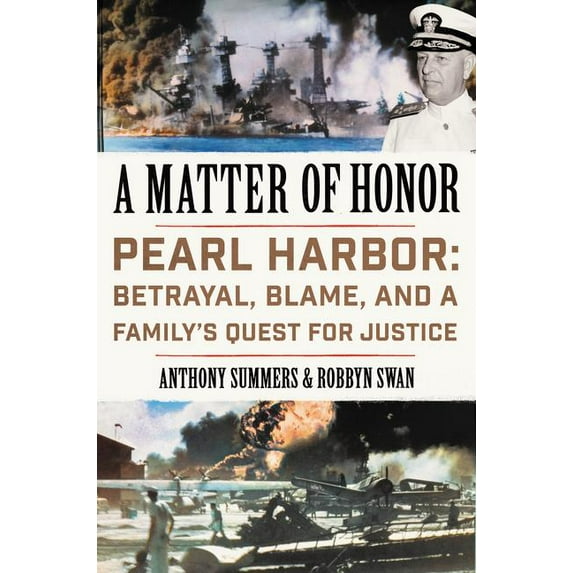
A Matter of Honor: Pearl Harbor: Betrayal, Blame, and a Family's Quest for Justice Hardcover
Key item features
Specs
- Book formatHardcover
- Fiction/nonfictionNon-Fiction
- GenreHistory
- Pub date2016-11-15
- Pages544
- Series titleOpen Concept
- Free shipping
 Free 30-day returns
How do you want your item?


About this item
Product details
Specifications
Book format
Fiction/nonfiction
Genre
Pub date
Warranty
Warranty information
Similar items you might like
Based on what customers bought
Darkhorse: Harnessing Hidden Potential in War and Life, (Hardcover) $22.98
 $2298current price $22.98
Darkhorse: Harnessing Hidden Potential in War and Life, (Hardcover)
Descent Into Darkness: Pearl Harbor, 1941: A Navy Diver's Memoir, (Paperback) $19.82
 $1982current price $19.82
Descent Into Darkness: Pearl Harbor, 1941: A Navy Diver's Memoir, (Paperback)
Martin Dugard: Taking Midway: Naval Warfare, Secret Codes, and the Battle That Turned the Tide of World War II (Hardcover) $9.90 Was $13.76
 $990current price $9.90, Was $13.76$13.76
Martin Dugard: Taking Midway: Naval Warfare, Secret Codes, and the Battle That Turned the Tide of World War II (Hardcover)
15 out of 5 Stars. 1 reviewsPaths of Dissent : Soldiers Speak Out Against America's Misguided Wars (Paperback) $7.61
 $761current price $7.61
Paths of Dissent : Soldiers Speak Out Against America's Misguided Wars (Paperback)
Secrets of Churchill's War Rooms, (Paperback) $25.61
 $2561current price $25.61
Secrets of Churchill's War Rooms, (Paperback)
Billy Heath: The Man Who Survived Custer's Last Stand, (Hardcover) $20.10
 $2010current price $20.10
Billy Heath: The Man Who Survived Custer's Last Stand, (Hardcover)
Pre-Owned Shattered Sword: The Untold Story of the Battle of Midway, 9781574889239, 1574889230, Hardcover, First Edition edition $27.58
 $2758current price $27.58
Pre-Owned Shattered Sword: The Untold Story of the Battle of Midway, 9781574889239, 1574889230, Hardcover, First Edition edition
Studies in War, Society, and the Militar American Naval History, 1607-1865: Overcoming the Colonial Legacy, (Hardcover) $34.45
 $3445current price $34.45
Studies in War, Society, and the Militar American Naval History, 1607-1865: Overcoming the Colonial Legacy, (Hardcover)
A Matter of Honor: Pearl Harbor: Betrayal, Blame, and a Family's Quest for Justice, (Paperback) $10.99
 $1099current price $10.99
A Matter of Honor: Pearl Harbor: Betrayal, Blame, and a Family's Quest for Justice, (Paperback)
Packing Inferno : The Unmaking of a Marine $19.51
 $1951current price $19.51
Packing Inferno : The Unmaking of a Marine
Pearl Harbor's Final Warning, (Paperback) $22.17
 $2217current price $22.17
Pearl Harbor's Final Warning, (Paperback)
The Most Awful Responsibility: Truman and the Secret Struggle for Control of the Atomic Age, (Hardcover) $25.60
 $2560current price $25.60
The Most Awful Responsibility: Truman and the Secret Struggle for Control of the Atomic Age, (Hardcover)
Pre-Owned The War on Warriors: Behind the Betrayal of the Men Who Keep Us Free (Hardcover) 0063389428 9780063389427 $6.47
 $647current price $6.47
Pre-Owned The War on Warriors: Behind the Betrayal of the Men Who Keep Us Free (Hardcover) 0063389428 9780063389427
704.7 out of 5 Stars. 70 reviewsPre-Owned The Wounded Generation: Coming Home After World War II, 9780593298695, 0593298691, Hardcover, $13.63 Was $17.71
 $1363current price $13.63, Was $17.71$17.71
Pre-Owned The Wounded Generation: Coming Home After World War II, 9780593298695, 0593298691, Hardcover,
15 out of 5 Stars. 1 reviewsFlight of the Forgotten : A True Story of Heroism and Betrayal $23.36
 $2336current price $23.36
Flight of the Forgotten : A True Story of Heroism and Betrayal
The Wounded Generation: Coming Home After World War II, (Hardcover) $21.76
 $2176current price $21.76
The Wounded Generation: Coming Home After World War II, (Hardcover)
35 out of 5 Stars. 3 reviewsDead Wake: The Last Crossing of the Lusitania, (Hardcover) $25.09
 $2509current price $25.09
Dead Wake: The Last Crossing of the Lusitania, (Hardcover)
15 out of 5 Stars. 1 reviewsThe Killing Season: The Autumn of 1914, Ypres, and the Afternoon That Cost Germany a War, (Hardcover) $22.65
 $2265current price $22.65
The Killing Season: The Autumn of 1914, Ypres, and the Afternoon That Cost Germany a War, (Hardcover)
Bitter Peleliu: The Forgotten Struggle on the Pacific War's Worst Battlefield, (Hardcover) $21.83 Was $30.00
 $2183current price $21.83, Was $30.00$30.00
Bitter Peleliu: The Forgotten Struggle on the Pacific War's Worst Battlefield, (Hardcover)
Customer ratings & reviews
Filtered and sorted results would be available on the new 'Customer ratings & reviews' page.
Showing 1-3 of 3 reviews
"A Matter of Honor, Indeed"
This book is a bombshell. It is the best book ever written about the Pearl Harbor attack and Admiral Kimmel. Consider some of what's revealed in the book: 1. The Washington High Command (WHC) {Marshall, Stark, Gerow, Turner, Miles & Wilkinson} provided false testimony and false evidence to falsely prove Rear Admiral Kimmel & Major General Short (K&S) guilty of a crime. That alone should be enough to compel the relief sought—posthumous advancement of K&S on the retired list. 2. The WHC told the Roberts Commission that K&S had the same information in Hawaii as they had in Washington, DC. That mis-information was calculated to do, and did, K&S irreparable prejudice. The WHC as officers and decent human beings, knowing full well what they had done, had an obligation to immediately rectify the prejudice to K&S from such deplorable mis-information. They did not do so. 3. The WHC discussed MAGIC freely with the Roberts Commission in 1941 when an impression could be left that K&S had MAGIC, but, in 1944 when that was no longer possible, the WHC declared that MAGIC could not be discussed with the Naval Court of Inquiry (NCI), or the Army Pearl Harbor Board (APHB). Clearly the WHC was playing games with the truth. 4. Why is Admiral Kimmel the only qualified flag officer in WWII not advanced under the OFFICER PERSONNEL ACT OF 1947? In 1948, the Navy Department merely omitted the name of Admiral Kimmel from the list of flag officers whose promotion was authorized—that would be everyone else—without any reference to his, or anyone's performance, constituting a belated special disciplinary action of a punitive kind taken without notice to the officer specifically singled out by such omission, Admiral Kimmel. 5. There is new information aplenty in the book. Here's some more of it: i. how the head of Army Counterintelligence in WDC tried to blow the whistle as an FBI informant; ii. how Justice Roberts perjured himself to the Joint Congressional Committee about the informant's information with the FBI's acquiescence; iii. how the Navy Department grossly misled Kimmel regarding the known threat from air-dropped shallow-water torpedoes; iv. how the Navy Department even misled its own NCI regarding the known threat from air-dropped shallow-water torpedoes; v. how the Navy Department grossly misled Kimmel regarding available spy reports; vi. how Marshall and Stark misled K&S regarding Secretary of State Hull's decision to send his 11/26/41 American Note/Ultimatum; vii. how until last year the Defense Department withheld for 59 years information exculpatory to K&S from the "Dean of American Cryptology”; and viii. how CNO Stark's perjury before the NCI was even worse than Marshall's perjury before the APHB. __________ Regards, Tom Kimmel (an Admiral Kimmel grandson)
Restore Tarnished Honor
The authors of this book are to be congratulated on a fine work. The research is exhaustive and it reveals a trove of information on one of the most tragic events in American history. Had not our luck changed in the battle of Midway, the thousands of lives lost at Pearl Harbor could have just been the beginning of our total demise in the Pacific region. Even though it cannot be proven, to keep from spending any political capital to bring the country officially into WWII, FDR orchestrated the event by making the Pacific Fleet vulnerable. Pearl Harbor was difficult to defend under the best of circumstances, but the air defense was inadequate, torpedo net protection requested well in advance was never sent, there were not enough patrol planes to keep eyes open in all directions and various other issues were brought to the attention of service chiefs, General Marshall and Admiral Stark repeatedly to no avail. Even more diabolical was the deliberate plan to deprive the fleet commander, Adm. Kimmel, and Army commander, General Short, of the vast amount of intelligence that pointed to Pearl Harbor as the Japanese target. There may not be a smoking gun to be found with FDR's fingerprints, but the blast of the Jap bombs and the fires from the sinking ships are enough to show that the tragedy was caused by more than an inept intelligence community and a slow supply chain. Caught in the middle of this ruse were the thousands of American soldiers and sailors killed in the attack. Subsequently, the cover-up ruined the reputation of the officers in charge, General Short and Admiral Kimmel. Stripped of their rank and falsely blamed for the lack of preparation and vilified in the news, neither officer was allowed a court-martial that would have forced the truth to be revealed. This was done to protect the president. This book is probably the most thorough rendition of accurate information on the presidential ruse and the less than honorable roles played by leading officials such as General Marshall and Admiral Stark among others. The honorable players in the debacle turn out to be Kimmel and Short, who, ironically, were the only flag officers in WWII who were not restored to the highest rank they achieved during the conflict. This great injustice continues, and why no president since has taken the necessary, congressionally authorized, action to officially promote them continues the ongoing puzzle. It would be a symbolic gesture, since the General and the Admiral are gone, but it would signify once and for all the debt of gratitude our nation owes all who have served, especially those who have made the ultimate sacrifice for our country. An honorable and outstanding naval officer and patriot was discredited so that the great scheme FDR set in motion to allow him to bring the country into WWII in a politically safe way would not be revealed.
A Matter of Honor
Dishonor in Washington “A Matter of Honor” is an exceptionally well-written and researched book, which left me with a sense of loss and sadness for the thousands of servicemen who died at Pearl Harbor and for the two senior career officers who never had a chance to redeem themselves. With excellent insights, a comprehensive index, bibliography, and informative documentation, it's a “must read” resource for anyone interested in the saga of the Pearl Harbor attacks. In “Honor,” authors Summers and Swan systematically explore controversies around the Pearl Harbor attack, the roles played by key participants, and the validity of actions taken against the two senior American commanders. Strictly speaking, “Honor” is more a story about interactions between U.S. government departments than a conventional military history. The writers take us back to the dawn of the national security state which began inauspiciously for the United States with Japan's attack on Hawaii in December, 1941. It serves as a useful but painful reminder that American war stories don't necessarily have a happy ending for all the individuals involved. This was certainly true for Admiral Husband Kimmel, Pacific Fleet commander, and General Walter Short, commander of Army forces in Hawaii, who were both unceremoniously relieved of duty and disgraced following the attack. In “Honor,” the authors explore several recurrent themes: (1) the inability or refusal of the Navy and War Department's intelligence functions to communicate timely information to the commanders in Hawaii who wanted it and needed it; (2) the headquarters insistence that all available actionable intelligence was shared with Kimmel and Short, but was then ignored; and (3) the defense establishment's (alleged) use of Kimmel and Short as scapegoats and their rejection of continuing efforts by the two families to restore some measure of honor to the officers by reinstating them to the ranks they held on December 7, 1941. These are interesting topics, all well-covered. Following are several key lessons that emerge from “Honor:” *The Roosevelt administration didn't conspire to precipitate war with Japan. Readers hoping for new conspiracy leads won't find them here. *The Navy, War, and State Departments (and the FBI to a lesser degree) amassed vast information about Japanese intentions and capabilities before December 7, 1941, but lacked the organizational skills to analyze this material effectively or act on it quickly. There seemed to be no lack of qualified staffing. Still, no department was able to produce timely, useful guidance from the blizzard of data received. *The lack of coordination within and between Navy and War Departments' intelligence organizations in Washington was epic. The Department of State's and FBI's pursuit of their own parochial interests contributed to the dysfunctional aura that existed among intelligence practitioners. *The Navy and War Departments were keenly aware that the Japanese Navy could attack Pearl Harbor with carrier-based aircraft. With the wisdom of hindsight, critics suggested that the Hawaii commanders lacked judgment by focusing too much on Japanese intentions, rather than capabilities. Kimmel and Short, it follows, should have recognized somehow that the Japanese had the capability to plan an undertaking unprecedented in scope, boldness, and complexity for its time. They should have anticipated that the Japanese could assemble a strike force of six fleet carriers (with 360 aircraft), develop special torpedoes for use in a shallow harbor, dispatch this force across the Pacific in complete secrecy, and execute a surprise attack on Oahu, 3,800 miles east of Tokyo. The Hawaii commanders alone were publicly shamed for failing to recognize this unique capability. Headquarters officialdom, equally culpable, largely escaped blame. *Breaking Japanese diplomatic codes was useful in Washington for predicting when hostilities might begin. The authors cover the role played by code-breaking in detail. In practice, decoded intercepts had little impact on military operations because the information lacked specifics and wasn't provided to commanders in Hawaii. * The Hawaii commanders' lack of access to useful intelligence before December 7th is a recurring refrain in “Honor.” Headquarters failure to share critical information was sometimes due to incompetence and sometimes to deliberate policy. Either way, the results were catastrophic. For example, Washington didn't notify the commanders that the Japanese consulate in Hawaii was collecting detailed information about the exact location of warships in Pearl Harbor. More critically, the final part of Tokyo's notorious 14-part message to the Japanese embassy (which indicated that a December 7th attack was imminent) was not forwarded to Hawaii until too late. Headquarters – Stark or Marshall – could have made a phone call to Hawaii that would have triggered an order for “General Quarters – All Hands” and saved some lives, but no warning came in time. *Self-serving headquarters officials demonstrated that they would say, do, and forget anything to protect their careers during numerous hearings and investigations. This included claiming to have forgotten key facts and giving perjured or evasive testimony, while betraying colleagues, friends, and service branch to evade responsibility. The most prominent sources of dodgy testimony were Stark (Chief of Naval Operations), Marshall (Army Chief of Staff), Turner (Navy War Plans), Gerow (Army War Plans), Miles (Army Intelligence), and Wilkinson (Navy Intelligence). Marshall, Turner, and Wilkinson demonstrated in their later careers that unethical behavior didn't bar future success. Even Stark, after being demoted to head a nearly invisible navy contingent in the U.K., made a successful comeback in preparing allied naval forces for the invasion of Europe. *Kimmel and Short were honorable, conscientious officers compelled to make decisions with limited information and resources. The authors show both men took a variety of steps, sometimes ineffective, to protect the fleet and ground installations from attack by an exceptionally well-prepared adversary. To their credit, neither tried to evade responsibility for the disaster. What rankles most is the unfairness of disgracing Kimmel and Short for poor judgment, while the incompetence displayed by Washington officialdom is seldom acknowledged and was never punished. One topic that needs further clarification is the status of efforts to advance Kimmel and Short to their previously held ranks authorized by the Officer Personnel Act of 1947. The last mention of the subject appears in a reference to the Dorn Report (1995) which states that while “Kimmel and Short suffered greatly from Pearl Harbor” due to “errors of judgment” … but “there can be no official remedy.” It would be interesting to learn who has blocked their advancement and whether the reasons advanced to justify inaction stand up to scrutiny today. Unquestionably, both officers deserve to have their ranks reinstated.

Related pages
- Hurricane Wwii
- Hiroshima City
- War 1975
- Halifax Bomber
- Hiroshima Shadow Nuclear Warfare Military History Books
- Best Books On Hiroshima
- Wars & Conflicts Military History Books
- World War II Military History Books
- World War I Military History Books
- Nuclear Warfare Military History Books
- Biological & Chemical Warfare Military History Books
- Napoleonic Wars Military History Books