

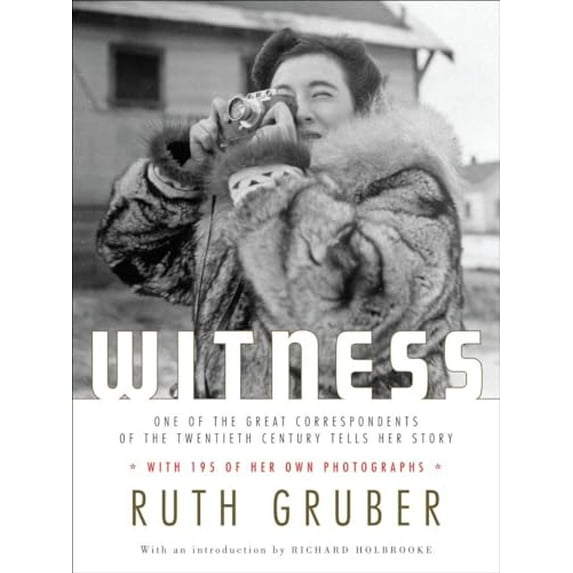
Witness: One of the Great Correspondents of the Twentieth Century Tells Her Story
(No ratings yet)
Key item features
With her perfect memory (and plenty of zip), ninety-five-year-old Ruth Gruber—adventurer, international correspondent, photographer, maker of (and witness to) history, responsible for rescuing hundreds of thousands of Jewish refugees during World War II and after—tells her story in her own words and photographs.
Gruber’s life has been extraordinary and extraordinarily heroic. She received a B.A. from New York University in three years, a master’s degree from the University of Wisconsin a year later, and a Ph.D. from the University of Cologne (magna cum laude) one year after that, becoming at age twenty the youngest Ph.D. in the world (it made headlines in The New York Times; the subject of her thesis: the then little-known Virginia Woolf).
At twenty-four, Gruber became an international correspondent for the New York Herald Tribune and traveled across the Soviet Arctic, scooping the world and witnessing, firsthand, the building of cities in the Siberian gulag by the pioneers and prisoners Stalin didn’t execute . . . At thirty, she traveled to Alaska for Harold L. Ickes, FDR’s secretary of the interior, to look into homesteading for G.I.s after World War II . . . And when she was thirty-three, Ickes assigned another secret mission to her—one that transformed her life: Gruber escorted 1,000 Holocaust survivors from Italy to America, the only Jews given refuge in this country during the war. “I have a theory,” Gruber said, “that even though we’re born Jews, there is a moment in our lives when we become Jews. On that ship, I became a Jew.”
Gruber’s role as rescuer of Jews was just beginning.
In Witness, Gruber writes about what she saw and shows us, through her haunting and life-affirming photographs–taken on each of her assignments– the worlds, the people, the landscapes, the courage, the hope, the life she witnessed up close and firsthand: the Siberian gulag of the 1930s and the new cities being built there (Gruber, then untrained as a photographer, brought her first Rolleicord with her) . . . the Alaska highway of 1943, built by 11,000 soldiers, mostly black men from the South (the highway went from Dawson Creek, British Columbia, 1,500 miles to Fairbanks) . . . her thirteen-day voyage on the army-troop transport Henry Gibbins with refugees and wounded American soldiers, escorting and then photographing the refugees as they arrived in Oswego, New York (they arrived in upstate New York as Adolf Eichmann was sending 750,000 Jews from Hungary to Auschwitz).
In 1947, Gruber traveled for the Herald Tribune with the United Nations Special Commission on Palestine (UNSCOP) through the postwar displaced persons camps in Europe, and then to North Africa, Palestine, and the Arab world; the committee’s recommendation that Palestine be partitioned into a Jewish state and an Arab state was one of the key factors that led to the founding of Israel.
We see Gruber’s remarkable photographs of a former American pleasure boat (which had been renamed Exodus 1947) as it limped into Haifa harbor, trying to deliver 4,500 Jewish refugees (including 600 orphans), under attack by five British destroyers and a cruiser that stormed the Exodus with guns, tear gas, and truncheons, while the crew of the Exodus fought back with potatoes, sticks, and cans of kosher meat. In a cable to the Herald Tribune, Gruber reported that “the ship looks like a matchbox splintered by a nutcracker.” She was with the people of the Exodus and photographed them when they were herded onto three prison ships. Gruber represented the entire American press aboard the ship Runnymede Park, photographing the prisoners as they defiantly painted a swastika on the Union Jack.
During her thirty-two years as a correspondent, Ruth Gruber photographed what she saw and captured the triumph of the human spirit.
“Take photographs with your heart,” Edward Steichen told her.
Witness is a revelation—of a time, a place, a world, a spirit, a belief. It is, above all else, a book of heart.
Gruber’s life has been extraordinary and extraordinarily heroic. She received a B.A. from New York University in three years, a master’s degree from the University of Wisconsin a year later, and a Ph.D. from the University of Cologne (magna cum laude) one year after that, becoming at age twenty the youngest Ph.D. in the world (it made headlines in The New York Times; the subject of her thesis: the then little-known Virginia Woolf).
At twenty-four, Gruber became an international correspondent for the New York Herald Tribune and traveled across the Soviet Arctic, scooping the world and witnessing, firsthand, the building of cities in the Siberian gulag by the pioneers and prisoners Stalin didn’t execute . . . At thirty, she traveled to Alaska for Harold L. Ickes, FDR’s secretary of the interior, to look into homesteading for G.I.s after World War II . . . And when she was thirty-three, Ickes assigned another secret mission to her—one that transformed her life: Gruber escorted 1,000 Holocaust survivors from Italy to America, the only Jews given refuge in this country during the war. “I have a theory,” Gruber said, “that even though we’re born Jews, there is a moment in our lives when we become Jews. On that ship, I became a Jew.”
Gruber’s role as rescuer of Jews was just beginning.
In Witness, Gruber writes about what she saw and shows us, through her haunting and life-affirming photographs–taken on each of her assignments– the worlds, the people, the landscapes, the courage, the hope, the life she witnessed up close and firsthand: the Siberian gulag of the 1930s and the new cities being built there (Gruber, then untrained as a photographer, brought her first Rolleicord with her) . . . the Alaska highway of 1943, built by 11,000 soldiers, mostly black men from the South (the highway went from Dawson Creek, British Columbia, 1,500 miles to Fairbanks) . . . her thirteen-day voyage on the army-troop transport Henry Gibbins with refugees and wounded American soldiers, escorting and then photographing the refugees as they arrived in Oswego, New York (they arrived in upstate New York as Adolf Eichmann was sending 750,000 Jews from Hungary to Auschwitz).
In 1947, Gruber traveled for the Herald Tribune with the United Nations Special Commission on Palestine (UNSCOP) through the postwar displaced persons camps in Europe, and then to North Africa, Palestine, and the Arab world; the committee’s recommendation that Palestine be partitioned into a Jewish state and an Arab state was one of the key factors that led to the founding of Israel.
We see Gruber’s remarkable photographs of a former American pleasure boat (which had been renamed Exodus 1947) as it limped into Haifa harbor, trying to deliver 4,500 Jewish refugees (including 600 orphans), under attack by five British destroyers and a cruiser that stormed the Exodus with guns, tear gas, and truncheons, while the crew of the Exodus fought back with potatoes, sticks, and cans of kosher meat. In a cable to the Herald Tribune, Gruber reported that “the ship looks like a matchbox splintered by a nutcracker.” She was with the people of the Exodus and photographed them when they were herded onto three prison ships. Gruber represented the entire American press aboard the ship Runnymede Park, photographing the prisoners as they defiantly painted a swastika on the Union Jack.
During her thirty-two years as a correspondent, Ruth Gruber photographed what she saw and captured the triumph of the human spirit.
“Take photographs with your heart,” Edward Steichen told her.
Witness is a revelation—of a time, a place, a world, a spirit, a belief. It is, above all else, a book of heart.
Specs
- Book formatHardcover
- Fiction/nonfictionNon-Fiction
- GenreHistory
- Pub date2007-04-24
- Pages288
- Number in series1
Current price is USD$27.97
Price when purchased online
- Free shipping
 Free 30-day returns
How do you want your item?
Columbus, 43215
Arrives between Apr 11 - Apr 14
|
Sold and shipped by BooksXpress
3.975015422578655 stars out of 5, based on 3242 seller reviews(4.0)3242 seller reviews

Free 30-day returns
More seller options (1)
Starting from $27.94
About this item
Product details
With her perfect memory (and plenty of zip), ninety-five-year-old Ruth Gruber--adventurer, international correspondent, photographer, maker of (and witness to) history, responsible for rescuing hundreds of thousands of Jewish refugees during World War II and after--tells her story in her own words and photographs. Gruber's life has been extraordinary and extraordinarily heroic. She received a B.A. from New York University in three years, a master's degree from the University of Wisconsin a year later, and a Ph.D. from the University of Cologne (magna cum laude) one year after that, becoming at age twenty the youngest Ph.D. in the world (it made headlines in The New York Times; the subject of her thesis: the then little-known Virginia Woolf). At twenty-four, Gruber became an international correspondent for the New York Herald Tribune and traveled across the Soviet Arctic, scooping the world and witnessing, firsthand, the building of cities in the Siberian gulag by the pioneers and prisoners Stalin didn't execute . . . At thirty, she traveled to Alaska for Harold L. Ickes, FDR's secretary of the interior, to look into homesteading for G.I.s after World War II . . . And when she was thirty-three, Ickes assigned another secret mission to her--one that transformed her life: Gruber escorted 1,000 Holocaust survivors from Italy to America, the only Jews given refuge in this country during the war. "I have a theory," Gruber said, "that even though we're born Jews, there is a moment in our lives when we become Jews. On that ship, I became a Jew." Gruber's role as rescuer of Jews was just beginning. In Witness, Gruber writes about what she saw and shows us, through her haunting and life-affirming photographs-taken on each of her assignments- the worlds, the people, the landscapes, the courage, the hope, the life she witnessed up close and firsthand: the Siberian gulag of the 1930s and the new cities being built there (Gruber, then untrained as a photographer, brought her first Rolleicord with her) . . . the Alaska highway of 1943, built by 11,000 soldiers, mostly black men from the South (the highway went from Dawson Creek, British Columbia, 1,500 miles to Fairbanks) . . . her thirteen-day voyage on the army-troop transport Henry Gibbins with refugees and wounded American soldiers, escorting and then photographing the refugees as they arrived in Oswego, New York (they arrived in upstate New York as Adolf Eichmann was sending 750,000 Jews from Hungary to Auschwitz). In 1947, Gruber traveled for the Herald Tribune with the United Nations Special Commission on Palestine (UNSCOP) through the postwar displaced persons camps in Europe, and then to North Africa, Palestine, and the Arab world; the committee's recommendation that Palestine be partitioned into a Jewish state and an Arab state was one of the key factors that led to the founding of Israel. We see Gruber's remarkable photographs of a former American pleasure boat (which had been renamed Exodus 1947) as it limped into Haifa harbor, trying to deliver 4,500 Jewish refugees (including 600 orphans), under attack by five British destroyers and a cruiser that stormed the Exodus with guns, tear gas, and truncheons, while the crew of the Exodus fought back with potatoes, sticks, and cans of kosher meat. In a cable to the Herald Tribune, Gruber reported that "the ship looks like a matchbox splintered by a nutcracker." She was with the people of the Exodus and photographed them when they were herded onto three prison ships. Gruber represented the entire American press aboard the ship Runnymede Park, photographing the prisoners as they defiantly painted a swastika on the Union Jack. During her thirty-two years as a correspondent, Ruth Gruber photographed what she saw and captured the triumph of the human spirit. "Take photographs with your heart," Edward Steichen told her. Witness is a revelation--of a time, a place, a world, a spirit, a belief. It is, above all else, a book of heart.
With her perfect memory (and plenty of zip), ninety-five-year-old Ruth Gruber—adventurer, international correspondent, photographer, maker of (and witness to) history, responsible for rescuing hundreds of thousands of Jewish refugees during World War II and after—tells her story in her own words and photographs.
Gruber’s life has been extraordinary and extraordinarily heroic. She received a B.A. from New York University in three years, a master’s degree from the University of Wisconsin a year later, and a Ph.D. from the University of Cologne (magna cum laude) one year after that, becoming at age twenty the youngest Ph.D. in the world (it made headlines in The New York Times; the subject of her thesis: the then little-known Virginia Woolf).
At twenty-four, Gruber became an international correspondent for the New York Herald Tribune and traveled across the Soviet Arctic, scooping the world and witnessing, firsthand, the building of cities in the Siberian gulag by the pioneers and prisoners Stalin didn’t execute . . . At thirty, she traveled to Alaska for Harold L. Ickes, FDR’s secretary of the interior, to look into homesteading for G.I.s after World War II . . . And when she was thirty-three, Ickes assigned another secret mission to her—one that transformed her life: Gruber escorted 1,000 Holocaust survivors from Italy to America, the only Jews given refuge in this country during the war. “I have a theory,” Gruber said, “that even though we’re born Jews, there is a moment in our lives when we become Jews. On that ship, I became a Jew.”
Gruber’s role as rescuer of Jews was just beginning.
In Witness, Gruber writes about what she saw and shows us, through her haunting and life-affirming photographs–taken on each of her assignments– the worlds, the people, the landscapes, the courage, the hope, the life she witnessed up close and firsthand: the Siberian gulag of the 1930s and the new cities being built there (Gruber, then untrained as a photographer, brought her first Rolleicord with her) . . . the Alaska highway of 1943, built by 11,000 soldiers, mostly black men from the South (the highway went from Dawson Creek, British Columbia, 1,500 miles to Fairbanks) . . . her thirteen-day voyage on the army-troop transport Henry Gibbins with refugees and wounded American soldiers, escorting and then photographing the refugees as they arrived in Oswego, New York (they arrived in upstate New York as Adolf Eichmann was sending 750,000 Jews from Hungary to Auschwitz).
In 1947, Gruber traveled for the Herald Tribune with the United Nations Special Commission on Palestine (UNSCOP) through the postwar displaced persons camps in Europe, and then to North Africa, Palestine, and the Arab world; the committee’s recommendation that Palestine be partitioned into a Jewish state and an Arab state was one of the key factors that led to the founding of Israel.
We see Gruber’s remarkable photographs of a former American pleasure boat (which had been renamed Exodus 1947) as it limped into Haifa harbor, trying to deliver 4,500 Jewish refugees (including 600 orphans), under attack by five British destroyers and a cruiser that stormed the Exodus with guns, tear gas, and truncheons, while the crew of the Exodus fought back with potatoes, sticks, and cans of kosher meat. In a cable to the Herald Tribune, Gruber reported that “the ship looks like a matchbox splintered by a nutcracker.” She was with the people of the Exodus and photographed them when they were herded onto three prison ships. Gruber represented the entire American press aboard the ship Runnymede Park, photographing the prisoners as they defiantly painted a swastika on the Union Jack.
During her thirty-two years as a correspondent, Ruth Gruber photographed what she saw and captured the triumph of the human spirit.
“Take photographs with your heart,” Edward Steichen told her.
Witness is a revelation—of a time, a place, a world, a spirit, a belief. It is, above all else, a book of heart.
Gruber’s life has been extraordinary and extraordinarily heroic. She received a B.A. from New York University in three years, a master’s degree from the University of Wisconsin a year later, and a Ph.D. from the University of Cologne (magna cum laude) one year after that, becoming at age twenty the youngest Ph.D. in the world (it made headlines in The New York Times; the subject of her thesis: the then little-known Virginia Woolf).
At twenty-four, Gruber became an international correspondent for the New York Herald Tribune and traveled across the Soviet Arctic, scooping the world and witnessing, firsthand, the building of cities in the Siberian gulag by the pioneers and prisoners Stalin didn’t execute . . . At thirty, she traveled to Alaska for Harold L. Ickes, FDR’s secretary of the interior, to look into homesteading for G.I.s after World War II . . . And when she was thirty-three, Ickes assigned another secret mission to her—one that transformed her life: Gruber escorted 1,000 Holocaust survivors from Italy to America, the only Jews given refuge in this country during the war. “I have a theory,” Gruber said, “that even though we’re born Jews, there is a moment in our lives when we become Jews. On that ship, I became a Jew.”
Gruber’s role as rescuer of Jews was just beginning.
In Witness, Gruber writes about what she saw and shows us, through her haunting and life-affirming photographs–taken on each of her assignments– the worlds, the people, the landscapes, the courage, the hope, the life she witnessed up close and firsthand: the Siberian gulag of the 1930s and the new cities being built there (Gruber, then untrained as a photographer, brought her first Rolleicord with her) . . . the Alaska highway of 1943, built by 11,000 soldiers, mostly black men from the South (the highway went from Dawson Creek, British Columbia, 1,500 miles to Fairbanks) . . . her thirteen-day voyage on the army-troop transport Henry Gibbins with refugees and wounded American soldiers, escorting and then photographing the refugees as they arrived in Oswego, New York (they arrived in upstate New York as Adolf Eichmann was sending 750,000 Jews from Hungary to Auschwitz).
In 1947, Gruber traveled for the Herald Tribune with the United Nations Special Commission on Palestine (UNSCOP) through the postwar displaced persons camps in Europe, and then to North Africa, Palestine, and the Arab world; the committee’s recommendation that Palestine be partitioned into a Jewish state and an Arab state was one of the key factors that led to the founding of Israel.
We see Gruber’s remarkable photographs of a former American pleasure boat (which had been renamed Exodus 1947) as it limped into Haifa harbor, trying to deliver 4,500 Jewish refugees (including 600 orphans), under attack by five British destroyers and a cruiser that stormed the Exodus with guns, tear gas, and truncheons, while the crew of the Exodus fought back with potatoes, sticks, and cans of kosher meat. In a cable to the Herald Tribune, Gruber reported that “the ship looks like a matchbox splintered by a nutcracker.” She was with the people of the Exodus and photographed them when they were herded onto three prison ships. Gruber represented the entire American press aboard the ship Runnymede Park, photographing the prisoners as they defiantly painted a swastika on the Union Jack.
During her thirty-two years as a correspondent, Ruth Gruber photographed what she saw and captured the triumph of the human spirit.
“Take photographs with your heart,” Edward Steichen told her.
Witness is a revelation—of a time, a place, a world, a spirit, a belief. It is, above all else, a book of heart.
info:
We aim to show you accurate product information. Manufacturers, suppliers and others provide what you see here, and we have not verified it.
Specifications
Book format
Hardcover
Fiction/nonfiction
Non-Fiction
Genre
History
Pub date
2007-04-24
Warranty
Warranty information
Please be aware that the warranty terms on items offered for sale by third party Marketplace sellers may differ from those displayed in this section (if any). To confirm warranty terms on an item offered for sale by a third party Marketplace seller, please use the 'Contact seller' feature on the third party Marketplace seller's information page and request the item's warranty terms prior to purchase.
Similar items you might like
Based on what customers bought
Reading It Wrong: An Alternative History of Early Eighteenth-Century Literature, (Paperback) $22.01
 $2201current price $22.01
Reading It Wrong: An Alternative History of Early Eighteenth-Century Literature, (Paperback)
The Sweetness of Lemon's: The Story of Ireland's Favourite Confectioner, (Hardcover) $28.69
 $2869current price $28.69
The Sweetness of Lemon's: The Story of Ireland's Favourite Confectioner, (Hardcover)
The British Country House Revival, (Paperback) $29.99
 $2999current price $29.99
The British Country House Revival, (Paperback)
Knowing Britten, (Paperback) $26.62
 $2662current price $26.62
Knowing Britten, (Paperback)
The Europeans $30.04
 $3004current price $30.04
The Europeans
Rebel Sounds: Music as Resistance, (Hardcover) $23.96
 $2396current price $23.96
Rebel Sounds: Music as Resistance, (Hardcover)
Stranger Than Fiction: Lives of the Twentieth-Century Novel, (Paperback) $18.42 Was $20.64
 $1842current price $18.42, Was $20.64$20.64
Stranger Than Fiction: Lives of the Twentieth-Century Novel, (Paperback)
Your Greater Self : Or the Inner Consciousness $17.95
 $1795current price $17.95
Your Greater Self : Or the Inner Consciousness
Henry The Leper : DerArme Heinrich V1 (Paperback) $20.64
 $2064current price $20.64
Henry The Leper : DerArme Heinrich V1 (Paperback)
Only God Can Judge Me: The Many Lives of Tupac Shakur, (Hardcover) $21.49
 $2149current price $21.49
Only God Can Judge Me: The Many Lives of Tupac Shakur, (Hardcover)
44 out of 5 Stars. 4 reviewsBamburgh Castle $18.95
 $1895current price $18.95
Bamburgh Castle
The Life Of Paul Gauguin (Paperback) $32.94
 $3294current price $32.94
The Life Of Paul Gauguin (Paperback)
Cosimo Classics: The Wonderful Century (Paperback) $25.95
 $2595current price $25.95
Cosimo Classics: The Wonderful Century (Paperback)
Stealing George Washington, (Hardcover) $27.98
 $2798current price $27.98
Stealing George Washington, (Hardcover)
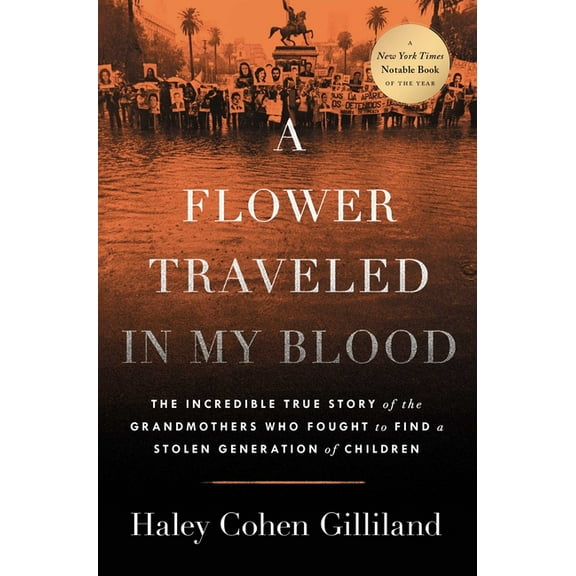
A Flower Traveled in My Blood: The Incredible True Story of the Grandmothers Who Fought to Find a Stolen Generation of C, (Hardcover) $14.50
 $1450current price $14.50
A Flower Traveled in My Blood: The Incredible True Story of the Grandmothers Who Fought to Find a Stolen Generation of C, (Hardcover)
25 out of 5 Stars. 2 reviewsErfurt Und Die Bauernaufstande Im XVI Jahrhundert (1903) (Paperback) $22.54
 $2254current price $22.54
Erfurt Und Die Bauernaufstande Im XVI Jahrhundert (1903) (Paperback)
Afghanistan : Aftermath of 9/11 $27.10
 $2710current price $27.10
Afghanistan : Aftermath of 9/11
Eden Undone: A True Story of Sex, Murder, and Utopia at the Dawn of World War II, (Paperback) $17.68
 $1768current price $17.68
Eden Undone: A True Story of Sex, Murder, and Utopia at the Dawn of World War II, (Paperback)
Customer ratings & reviews
0 ratings|0 reviews
This item does not have any reviews yet
