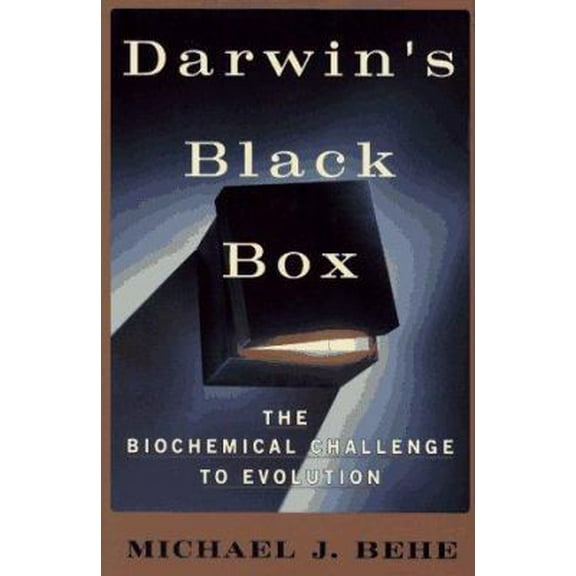
Darwin's Black Box helped to launch the Intelligent Design movement: the argument that nature exhibits evidence of design, beyond Darwinian randomness. Today, with the movement stronger than ever, Michael J. Behe updates the book with an important new Afterword on the state of the debate. --Time Naming Darwin's Black Box to the National Review's list of the 100 most important nonfiction works of the twentieth century, George Gilder wrote that it "overthrows Darwin at the end of the twentieth century in the same way that quantum theory overthrew Newton at the beginning." Discussing the book in The New Yorker in May 2005, H. Allen Orr said of Behe, "he is the most prominent of the small circle of scientists working on intelligent design, and his arguments are by far the best known." From one end of the spectrum to the other, Darwin's Black Box has established itself as the key text in the Intelligent Design movement--the one argument that must be addressed in order to determine whether Darwinian evolution is sufficient to explain life as we know it, or not. For this edition, Behe has written a major new Afterword tracing the state of the debate in the decade since it began. It is his first major new statement on the subject and will be welcomed by the thousands who wish to continue this intense debate.
Publishers Weekly,Charles Darwin's theory of life's evolution through natural selection and random mutation fails to account for the origin of astonishingly complex biomolecular systems, argues Behe, associate professor of biochemistry at Lehigh University. In this spirited, witty critique of neo-Darwinian thinking, he focuses on five phenomena: blood clotting; cilia, oar-like bundles of fibers; the human immune system; transport of materials within the cell; and the synthesis of nucleotides, building blocks of DNA. In each case, he finds systems that are irreducibly complex���no gradual, step-by-step, Darwinian route led to their creation. As an alternative explanation, Behe infers that complex biochemical systems (i.e., life) were designed by an intelligent agent, whether God, extraterrestrials or a universal force. He notes that Francis Crick, co-discoverer of DNA's double-helix structure, proposed that life began when aliens from another planet sent a rocket ship containing spores to seed Earth. Perhaps Behe's plea for incorporating a "theory of intelligent design" into mainstream biology will spark interest. Illustrated. Translation and U.K. rights: Simon & Schuster. (Aug.) (c) Copyright PWxyz, LLC. All rights reserved