

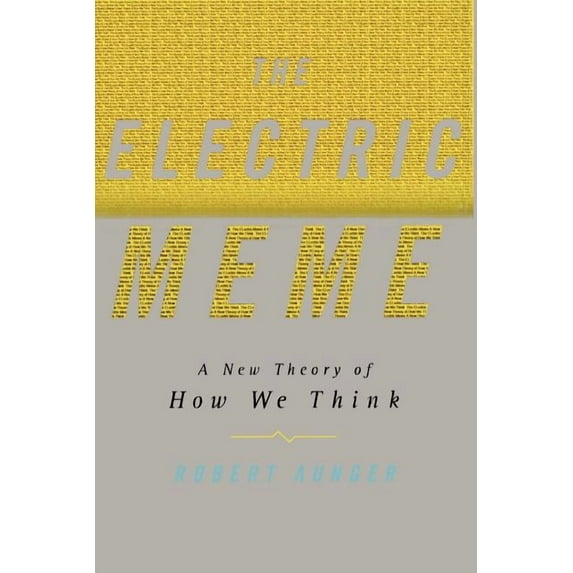
Hero image 0 of The Electric Meme : A New Theory of How We Think (Paperback), 0 of 1
The Electric Meme : A New Theory of How We Think (Paperback)
(No ratings yet)
Key item features
From biology to culture to the new new economy, the buzzword on everyone's lips is "meme." How do animals learn things? How does human culture evolve? How does viral marketing work? The answer to these disparate questions and even to what is the nature of thought itself is, simply, the meme. For decades researchers have been convinced that memes were The Next Big Thing for the understanding of society and ourselves. But no one has so far been able to define what they are. Until now.
Here, for the first time, Robert Aunger outlines what a meme physically is, how memes originated, how they developed, and how they have made our brains into their survival systems. They are thoughts. They are parasites. They are in control. A meme is a distinct pattern of electrical charges in a node in our brains that reproduces a thousand times faster than a bacterium. Memes have found ways to leap from one brain to another. A number of them are being replicated in your brain as you read this paragraph.
In 1976 the biologist Richard Dawkins suggested that all animals -- including humans -- are puppets and that genes hold the strings. That is, we are robots serving as life support for the genes that control us. And all they want to do is replicate themselves. But then, we do lots of things that don't seem to help genes replicate. We decide not to have children, we waste our time doing dangerous things like mountain climbing, or boring things like reading, or stupid things like smoking that don't seem to help genes get copied into the next generation. We do all sorts of cultural things for reasons that don't seem to have anything to do with genes. Fashions in sports, books, clothes, ideas, politics, lifestyles come and go and give our lives meaning, so how can we be gene robots?
Dawkins recognized that something else was going on. We communicate with one another and we get ideas, and these ideas seem to have a life of their own. Maybe there was something called memes that were like thought genes. Maybe our bodies were gene robots and our minds were meme robots. That would mean that what we think is not the result of our own creativity, but rather the result of the evolutionary flow of memes as they wash through us.
What is the biological reality of an idea with a life of its own? What is a thought gene? It's a meme. And no one before Robert Aunger has established what it physically must be. This elegant, paradigm-shifting analysis identifies how memes replicate in our brains, how they evolved, and how they use artifacts like books and photographs and advertisements to get from one brain to another. Destined to inflame arguments about free will, open doors to new ways of sharing our thoughts, and provide a revolutionary explanation of consciousness, The Electric Meme will change the way each of us thinks about our minds, our cultures, and our daily choices.
Here, for the first time, Robert Aunger outlines what a meme physically is, how memes originated, how they developed, and how they have made our brains into their survival systems. They are thoughts. They are parasites. They are in control. A meme is a distinct pattern of electrical charges in a node in our brains that reproduces a thousand times faster than a bacterium. Memes have found ways to leap from one brain to another. A number of them are being replicated in your brain as you read this paragraph.
In 1976 the biologist Richard Dawkins suggested that all animals -- including humans -- are puppets and that genes hold the strings. That is, we are robots serving as life support for the genes that control us. And all they want to do is replicate themselves. But then, we do lots of things that don't seem to help genes replicate. We decide not to have children, we waste our time doing dangerous things like mountain climbing, or boring things like reading, or stupid things like smoking that don't seem to help genes get copied into the next generation. We do all sorts of cultural things for reasons that don't seem to have anything to do with genes. Fashions in sports, books, clothes, ideas, politics, lifestyles come and go and give our lives meaning, so how can we be gene robots?
Dawkins recognized that something else was going on. We communicate with one another and we get ideas, and these ideas seem to have a life of their own. Maybe there was something called memes that were like thought genes. Maybe our bodies were gene robots and our minds were meme robots. That would mean that what we think is not the result of our own creativity, but rather the result of the evolutionary flow of memes as they wash through us.
What is the biological reality of an idea with a life of its own? What is a thought gene? It's a meme. And no one before Robert Aunger has established what it physically must be. This elegant, paradigm-shifting analysis identifies how memes replicate in our brains, how they evolved, and how they use artifacts like books and photographs and advertisements to get from one brain to another. Destined to inflame arguments about free will, open doors to new ways of sharing our thoughts, and provide a revolutionary explanation of consciousness, The Electric Meme will change the way each of us thinks about our minds, our cultures, and our daily choices.
Specs
- Book formatPaperback
- Fiction/nonfictionNon-Fiction
- Pub date2010-07-13
- Pages400
- SubgenrePsychology
- EditionReprint
Current price is USD$24.99
Price when purchased online
 Free 90-day returns
How do you want your item?
Try 30 days of Free Shipping with Walmart+! Choose plan at checkout.
Columbus, 43215
Arrives by Tue, Apr 7
Sold and shipped by Walmart.com

Free 90-day returns

This item is gift eligible
Other sellers
$22.94
+Free shippingShipping, arrives by Fri, Apr 10 to Columbus, 43215
Sold and shipped by Alibris Books
Free 30-day returns

Get free delivery, shipping and more*
*Restrictions apply Try Walmart+ now
About this item
Product details
From biology to culture to the new new economy, the buzzword on everyone's lips is "meme." How do animals learn things? How does human culture evolve? How does viral marketing work? The answer to these disparate questions and even to what is the nature of thought itself is, simply, the meme. For decades researchers have been convinced that memes were The Next Big Thing for the understanding of society and ourselves. But no one has so far been able to define what they are. Until now. Here, for the first time, Robert Aunger outlines what a meme physically is, how memes originated, how they developed, and how they have made our brains into their survival systems. They are thoughts. They are parasites. They are in control. A meme is a distinct pattern of electrical charges in a node in our brains that reproduces a thousand times faster than a bacterium. Memes have found ways to leap from one brain to another. A number of them are being replicated in your brain as you read this paragraph. In 1976 the biologist Richard Dawkins suggested that all animals -- including humans -- are puppets and that genes hold the strings. That is, we are robots serving as life support for the genes that control us. And all they want to do is replicate themselves. But then, we do lots of things that don't seem to help genes replicate. We decide not to have children, we waste our time doing dangerous things like mountain climbing, or boring things like reading, or stupid things like smoking that don't seem to help genes get copied into the next generation. We do all sorts of cultural things for reasons that don't seem to have anything to do with genes. Fashions in sports, books, clothes, ideas, politics, lifestyles come and go and give our lives meaning, so how can we be gene robots? Dawkins recognized that something else was going on. We communicate with one another and we get ideas, and these ideas seem to have a life of their own. Maybe there was something called memes that were like thought genes. Maybe our bodies were gene robots and our minds were meme robots. That would mean that what we think is not the result of our own creativity, but rather the result of the evolutionary flow of memes as they wash through us. What is the biological reality of an idea with a life of its own? What is a thought gene? It's a meme. And no one before Robert Aunger has established what it physically must be. This elegant, paradigm-shifting analysis identifies how memes replicate in our brains, how they evolved, and how they use artifacts like books and photographs and advertisements to get from one brain to another. Destined to inflame arguments about free will, open doors to new ways of sharing our thoughts, and provide a revolutionary explanation of consciousness, The Electric Meme will change the way each of us thinks about our minds, our cultures, and our daily choices.
From biology to culture to the new new economy, the buzzword on everyone's lips is "meme." How do animals learn things? How does human culture evolve? How does viral marketing work? The answer to these disparate questions and even to what is the nature of thought itself is, simply, the meme. For decades researchers have been convinced that memes were The Next Big Thing for the understanding of society and ourselves. But no one has so far been able to define what they are. Until now.
Here, for the first time, Robert Aunger outlines what a meme physically is, how memes originated, how they developed, and how they have made our brains into their survival systems. They are thoughts. They are parasites. They are in control. A meme is a distinct pattern of electrical charges in a node in our brains that reproduces a thousand times faster than a bacterium. Memes have found ways to leap from one brain to another. A number of them are being replicated in your brain as you read this paragraph.
In 1976 the biologist Richard Dawkins suggested that all animals -- including humans -- are puppets and that genes hold the strings. That is, we are robots serving as life support for the genes that control us. And all they want to do is replicate themselves. But then, we do lots of things that don't seem to help genes replicate. We decide not to have children, we waste our time doing dangerous things like mountain climbing, or boring things like reading, or stupid things like smoking that don't seem to help genes get copied into the next generation. We do all sorts of cultural things for reasons that don't seem to have anything to do with genes. Fashions in sports, books, clothes, ideas, politics, lifestyles come and go and give our lives meaning, so how can we be gene robots?
Dawkins recognized that something else was going on. We communicate with one another and we get ideas, and these ideas seem to have a life of their own. Maybe there was something called memes that were like thought genes. Maybe our bodies were gene robots and our minds were meme robots. That would mean that what we think is not the result of our own creativity, but rather the result of the evolutionary flow of memes as they wash through us.
What is the biological reality of an idea with a life of its own? What is a thought gene? It's a meme. And no one before Robert Aunger has established what it physically must be. This elegant, paradigm-shifting analysis identifies how memes replicate in our brains, how they evolved, and how they use artifacts like books and photographs and advertisements to get from one brain to another. Destined to inflame arguments about free will, open doors to new ways of sharing our thoughts, and provide a revolutionary explanation of consciousness, The Electric Meme will change the way each of us thinks about our minds, our cultures, and our daily choices.
Here, for the first time, Robert Aunger outlines what a meme physically is, how memes originated, how they developed, and how they have made our brains into their survival systems. They are thoughts. They are parasites. They are in control. A meme is a distinct pattern of electrical charges in a node in our brains that reproduces a thousand times faster than a bacterium. Memes have found ways to leap from one brain to another. A number of them are being replicated in your brain as you read this paragraph.
In 1976 the biologist Richard Dawkins suggested that all animals -- including humans -- are puppets and that genes hold the strings. That is, we are robots serving as life support for the genes that control us. And all they want to do is replicate themselves. But then, we do lots of things that don't seem to help genes replicate. We decide not to have children, we waste our time doing dangerous things like mountain climbing, or boring things like reading, or stupid things like smoking that don't seem to help genes get copied into the next generation. We do all sorts of cultural things for reasons that don't seem to have anything to do with genes. Fashions in sports, books, clothes, ideas, politics, lifestyles come and go and give our lives meaning, so how can we be gene robots?
Dawkins recognized that something else was going on. We communicate with one another and we get ideas, and these ideas seem to have a life of their own. Maybe there was something called memes that were like thought genes. Maybe our bodies were gene robots and our minds were meme robots. That would mean that what we think is not the result of our own creativity, but rather the result of the evolutionary flow of memes as they wash through us.
What is the biological reality of an idea with a life of its own? What is a thought gene? It's a meme. And no one before Robert Aunger has established what it physically must be. This elegant, paradigm-shifting analysis identifies how memes replicate in our brains, how they evolved, and how they use artifacts like books and photographs and advertisements to get from one brain to another. Destined to inflame arguments about free will, open doors to new ways of sharing our thoughts, and provide a revolutionary explanation of consciousness, The Electric Meme will change the way each of us thinks about our minds, our cultures, and our daily choices.
info:
We aim to show you accurate product information. Manufacturers, suppliers and others provide what you see here, and we have not verified it.
Specifications
Book format
Paperback
Fiction/nonfiction
Non-Fiction
Genre
Health, Mind & Body, Political & Social Sciences
Pub date
2010-07-13
Warranty
Warranty information
Please be aware that the warranty terms on items offered for sale by third party Marketplace sellers may differ from those displayed in this section (if any). To confirm warranty terms on an item offered for sale by a third party Marketplace seller, please use the 'Contact seller' feature on the third party Marketplace seller's information page and request the item's warranty terms prior to purchase.
Similar items you might like
Based on what customers bought
Student to Student The PhD Experience: An Insider's Guide, Book 1, (Paperback) $32.35
 $3235current price $32.35
Student to Student The PhD Experience: An Insider's Guide, Book 1, (Paperback)
Best seller I m Dead Now What, Book, (Paperback) $16.07
Best seller $1607current price $16.07
I m Dead Now What, Book, (Paperback)
2524.6 out of 5 Stars. 252 reviewsSelf Seeking: Finding a Modern Teacher of Advaita, (Paperback) $25.06
 $2506current price $25.06
Self Seeking: Finding a Modern Teacher of Advaita, (Paperback)
The Flourishing Student - 2nd Edition: A Practical Guide to Promote Mental Fitness, Wellbeing and Resilience in Higher E, (Paperback) $24.66
 $2466current price $24.66
The Flourishing Student - 2nd Edition: A Practical Guide to Promote Mental Fitness, Wellbeing and Resilience in Higher E, (Paperback)
The Epistemology of the Cyrenaic School, (Paperback) $25.01
 $2501current price $25.01
The Epistemology of the Cyrenaic School, (Paperback)
Special Correspondent (Paperback) $24.95
 $2495current price $24.95
Special Correspondent (Paperback)
eXPerience Life - STUDY MASTER, (Paperback) $29.65
 $2965current price $29.65
eXPerience Life - STUDY MASTER, (Paperback)
Running with the Pack (Paperback) $15.92 Was $17.70
 $1592current price $15.92, Was $17.70$17.70
Running with the Pack (Paperback)
Dissertation sur un préjugé très pernicieux (Paperback) $11.95
 $1195current price $11.95
Dissertation sur un préjugé très pernicieux (Paperback)
Thompsonville Book Two 1900-1977, (Paperback) $24.99
 $2499current price $24.99
Thompsonville Book Two 1900-1977, (Paperback)
Thompsonville Book One 1763-1900, (Paperback) $24.99
 $2499current price $24.99
Thompsonville Book One 1763-1900, (Paperback)
Bligh's & Lane's Theory of Seepage (Paperback) $34.14
 $3414current price $34.14
Bligh's & Lane's Theory of Seepage (Paperback)
Halls of Honor: College Men in the Old South, (Paperback) $27.98
 $2798current price $27.98
Halls of Honor: College Men in the Old South, (Paperback)
Theory of Knowledge, an Introduction, (Paperback) $21.59
 $2159current price $21.59
Theory of Knowledge, an Introduction, (Paperback)
Confound That Boy: A manual of book-keeping and office routine, (Paperback) $19.90
 $1990current price $19.90
Confound That Boy: A manual of book-keeping and office routine, (Paperback)
Academic Presenting and Presentations - Teacher's Book (Paperback) $20.37
 $2037current price $20.37
Academic Presenting and Presentations - Teacher's Book (Paperback)
Ideas in Context Early Modern Liberalism, Book 48, (Paperback) $21.79
 $2179current price $21.79
Ideas in Context Early Modern Liberalism, Book 48, (Paperback)

Customer ratings & reviews
0 ratings|0 reviews
This item does not have any reviews yet

Related pages
- Game Choice Consequence
- How Heavy Is A Shot Put In Middle School
- Domino Effect
- Genre Featured Categories Jimmy Ortega
- Genre Featured Categories Shay Roman
- Private Games
- Gambling
- Reality TV, Game & Talk Shows Books
- Trivia Reference Books
- Humor Literary Criticism Books
- Business Biographies & Memoirs
- Disability Sports Books