

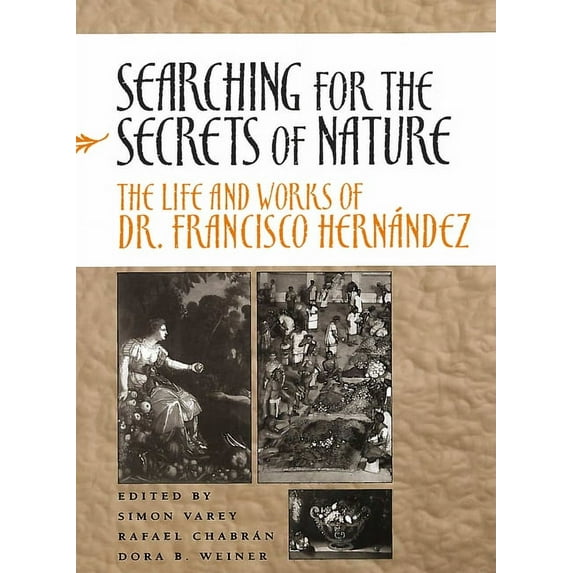
Hero image 0 of Searching for the Secrets of Nature : The Life and Works of Dr. Francisco Hernández (Hardcover), 0 of 1
Searching for the Secrets of Nature : The Life and Works of Dr. Francisco Hernández (Hardcover)
(No ratings yet)
Key item features
This collection of essays by historians, historians of science and medicine, and literary and textual scholars—from the United States, Canada, Mexico, and Spain—analyzes the achievements of Dr. Francisco Hernández (1515-87) in the history of medicine and science in Europe and the Americas. Celebrated in his own day as one of Spain's leading physicians and naturalists, he is now best remembered for his monumental work on the native plants and materia medica of central Mexico.
Sent to New Spain in 1570 by King Philip II to research and describe the natural history of the region, to assess the medical usefulness of the natural resources, and to gather ethnographic materials for an anthropological history, Hernández was the first trained scientist to undertake scientific work in the New World. For seven years he gathered information throughout the Valley of Mexico, learning Nahuatl, recording local medical customs, studying indigenous medicines, and writing down all his observations. The result was The Natural History of New Spain, written in Latin, which consisted of six folio volumes filled with descriptions of over 3,000 plants previously unknown in Europe (along with descriptions of a much smaller number of animals and minerals) and ten folio volumes of paintings by Mexican artists illustrating the plants and animals he described.
Hernández died before he could publish his Natural History, and the materials were placed in the Escorial, where they were extensively consulted, copied, abstracted, and translated by generations of scientists, medical specialists, and natural philosophers before they were destroyed by fire in 1671. Hernández's work was still regarded as authoritative on a number of New World botanical topics as late as the nineteenth century, and his writings remain in use in popular form in Mexico today.
The sixteen essays in this volume treat the most important aspects of Hernández's experience, including his education, his heterodox beliefs, and the state of medicine in both Spain and New Spain during his era. Other essays show the dissemination of the knowledge Hernández accumulated, including his contributions to European botany and materia medica, his relationship to Spanish Baroque painting, the "globalization" of his work in the eighteenth century, and his place in nineteenth-century debates among Spanish scientists.
Sent to New Spain in 1570 by King Philip II to research and describe the natural history of the region, to assess the medical usefulness of the natural resources, and to gather ethnographic materials for an anthropological history, Hernández was the first trained scientist to undertake scientific work in the New World. For seven years he gathered information throughout the Valley of Mexico, learning Nahuatl, recording local medical customs, studying indigenous medicines, and writing down all his observations. The result was The Natural History of New Spain, written in Latin, which consisted of six folio volumes filled with descriptions of over 3,000 plants previously unknown in Europe (along with descriptions of a much smaller number of animals and minerals) and ten folio volumes of paintings by Mexican artists illustrating the plants and animals he described.
Hernández died before he could publish his Natural History, and the materials were placed in the Escorial, where they were extensively consulted, copied, abstracted, and translated by generations of scientists, medical specialists, and natural philosophers before they were destroyed by fire in 1671. Hernández's work was still regarded as authoritative on a number of New World botanical topics as late as the nineteenth century, and his writings remain in use in popular form in Mexico today.
The sixteen essays in this volume treat the most important aspects of Hernández's experience, including his education, his heterodox beliefs, and the state of medicine in both Spain and New Spain during his era. Other essays show the dissemination of the knowledge Hernández accumulated, including his contributions to European botany and materia medica, his relationship to Spanish Baroque painting, the "globalization" of his work in the eighteenth century, and his place in nineteenth-century debates among Spanish scientists.
Specs
- Book formatHardcover
- Fiction/nonfictionNon-Fiction
- GenreHistory
- Publication dateJanuary, 2002
- Pages248
- Edition1st Edition
Current price is USD$85.01
Price when purchased online
- Free shipping
 Free 30-day returns
How do you want your item?
Ships to
Arrives between May 20 - May 23
|
Sold and shipped by Alibris Books
4.568721643981852 stars out of 5, based on 11241 seller reviews(4.6)11241 seller reviews

Free 30-day returns
Other sellers
$92.49
+Free shippingShipping, arrives by Wed, May 20 to Columbus, 43215
Sold and shipped by thebookpros
Free 30-day returns
About this item
Product details
This collection of essays by historians, historians of science and medicine, and literary and textual scholars from several countries analyzes the achievements of Dr. Francisco Hernández (1515-87), author of the monumental The Natural History of New Spain, in the history of medicine and science in Europe and the Americas.
This collection of essays by historians, historians of science and medicine, and literary and textual scholars—from the United States, Canada, Mexico, and Spain—analyzes the achievements of Dr. Francisco Hernández (1515-87) in the history of medicine and science in Europe and the Americas. Celebrated in his own day as one of Spain's leading physicians and naturalists, he is now best remembered for his monumental work on the native plants and materia medica of central Mexico.
Sent to New Spain in 1570 by King Philip II to research and describe the natural history of the region, to assess the medical usefulness of the natural resources, and to gather ethnographic materials for an anthropological history, Hernández was the first trained scientist to undertake scientific work in the New World. For seven years he gathered information throughout the Valley of Mexico, learning Nahuatl, recording local medical customs, studying indigenous medicines, and writing down all his observations. The result was The Natural History of New Spain, written in Latin, which consisted of six folio volumes filled with descriptions of over 3,000 plants previously unknown in Europe (along with descriptions of a much smaller number of animals and minerals) and ten folio volumes of paintings by Mexican artists illustrating the plants and animals he described.
Hernández died before he could publish his Natural History, and the materials were placed in the Escorial, where they were extensively consulted, copied, abstracted, and translated by generations of scientists, medical specialists, and natural philosophers before they were destroyed by fire in 1671. Hernández's work was still regarded as authoritative on a number of New World botanical topics as late as the nineteenth century, and his writings remain in use in popular form in Mexico today.
The sixteen essays in this volume treat the most important aspects of Hernández's experience, including his education, his heterodox beliefs, and the state of medicine in both Spain and New Spain during his era. Other essays show the dissemination of the knowledge Hernández accumulated, including his contributions to European botany and materia medica, his relationship to Spanish Baroque painting, the "globalization" of his work in the eighteenth century, and his place in nineteenth-century debates among Spanish scientists.
Sent to New Spain in 1570 by King Philip II to research and describe the natural history of the region, to assess the medical usefulness of the natural resources, and to gather ethnographic materials for an anthropological history, Hernández was the first trained scientist to undertake scientific work in the New World. For seven years he gathered information throughout the Valley of Mexico, learning Nahuatl, recording local medical customs, studying indigenous medicines, and writing down all his observations. The result was The Natural History of New Spain, written in Latin, which consisted of six folio volumes filled with descriptions of over 3,000 plants previously unknown in Europe (along with descriptions of a much smaller number of animals and minerals) and ten folio volumes of paintings by Mexican artists illustrating the plants and animals he described.
Hernández died before he could publish his Natural History, and the materials were placed in the Escorial, where they were extensively consulted, copied, abstracted, and translated by generations of scientists, medical specialists, and natural philosophers before they were destroyed by fire in 1671. Hernández's work was still regarded as authoritative on a number of New World botanical topics as late as the nineteenth century, and his writings remain in use in popular form in Mexico today.
The sixteen essays in this volume treat the most important aspects of Hernández's experience, including his education, his heterodox beliefs, and the state of medicine in both Spain and New Spain during his era. Other essays show the dissemination of the knowledge Hernández accumulated, including his contributions to European botany and materia medica, his relationship to Spanish Baroque painting, the "globalization" of his work in the eighteenth century, and his place in nineteenth-century debates among Spanish scientists.
info:
We aim to show you accurate product information. Manufacturers, suppliers and others provide what you see here, and we have not verified it.
Specifications
Book format
Hardcover
Fiction/nonfiction
Non-Fiction
Genre
History
Publication date
January, 2002
Warranty
Warranty information
Please be aware that the warranty terms on items offered for sale by third party Marketplace sellers may differ from those displayed in this section (if any). To confirm warranty terms on an item offered for sale by a third party Marketplace seller, please use the 'Contact seller' feature on the third party Marketplace seller's information page and request the item's warranty terms prior to purchase.
Similar items you might like
Based on what customers bought
Engendering Latin America: Mexican Karismata : The Baroque Vocation of Francisca de los Angeles, 1674-1744 (Hardcover) $76.26
 $7626current price $76.26
Engendering Latin America: Mexican Karismata : The Baroque Vocation of Francisca de los Angeles, 1674-1744 (Hardcover)
La Conquista De QuerÃ(c)taro, (Hardcover) $44.29
 $4429current price $44.29
La Conquista De QuerÃ(c)taro, (Hardcover)
Indigenous Culture and Change in Guerrero, Mexico, 7000 Bce to 1600 Ce, (Hardcover) $53.25
 $5325current price $53.25
Indigenous Culture and Change in Guerrero, Mexico, 7000 Bce to 1600 Ce, (Hardcover)
Revolutionary Women of Texas and Mexico: Portraits of Soldaderas, Saints, and Subversives, (Paperback) $11.00
 $1100current price $11.00
Revolutionary Women of Texas and Mexico: Portraits of Soldaderas, Saints, and Subversives, (Paperback)
New Directions in Latino American Cultur Centenary of the Famous 41: Sexuality and Social Control in Mexico,1901, (Paperback) $71.04
 $7104current price $71.04
New Directions in Latino American Cultur Centenary of the Famous 41: Sexuality and Social Control in Mexico,1901, (Paperback)
Tequila Wars: José Cuervo and the Bloody Struggle for the Spirit of Mexico, (Hardcover) $23.19
 $2319current price $23.19
Tequila Wars: José Cuervo and the Bloody Struggle for the Spirit of Mexico, (Hardcover)
Jaguar Books on Latin America Religious Culture in Modern Mexico, (Paperback) $55.99
 $5599current price $55.99
Jaguar Books on Latin America Religious Culture in Modern Mexico, (Paperback)
Decoding the Codex Borgia: Visual Symbols of Time and Space in Ancient Mexico, (Hardcover) $82.94
 $8294current price $82.94
Decoding the Codex Borgia: Visual Symbols of Time and Space in Ancient Mexico, (Hardcover)
Contemporary World Issues (Hardcover) The U.S.-Mexico Border: A Reference Handbook, (Hardcover) $71.30
 $7130current price $71.30
Contemporary World Issues (Hardcover) The U.S.-Mexico Border: A Reference Handbook, (Hardcover)
Routledge Advances in International Rela Understanding Mexico's Security Conundrum, (Hardcover) $58.39
 $5839current price $58.39
Routledge Advances in International Rela Understanding Mexico's Security Conundrum, (Hardcover)
Mesoamerican Osteobiographies: Revealing the Lives and Deaths of Ancient Individuals, (Hardcover) $71.28
 $7128current price $71.28
Mesoamerican Osteobiographies: Revealing the Lives and Deaths of Ancient Individuals, (Hardcover)
Framing Complexity in Formative Mesoamerica, (Hardcover) $89.01
 $8901current price $89.01
Framing Complexity in Formative Mesoamerica, (Hardcover)
A to Z Guides The A to Z of Ancient Mesoamerica, Book 140, (Paperback) $44.76
 $4476current price $44.76
A to Z Guides The A to Z of Ancient Mesoamerica, Book 140, (Paperback)
Series Chimalpahin Chimalpahin's Conquest: A Nahua Historian's Rewriting of Francisco Lopez de Gomara's La Conquista de Mexico, (Hardcover) $79.98
 $7998current price $79.98
Series Chimalpahin Chimalpahin's Conquest: A Nahua Historian's Rewriting of Francisco Lopez de Gomara's La Conquista de Mexico, (Hardcover)
Being Indian in Hueyapan, (Hardcover) $54.99
 $5499current price $54.99
Being Indian in Hueyapan, (Hardcover)
Landing Uphill: Seven Years at San Luis, (Hardcover) $40.02
 $4002current price $40.02
Landing Uphill: Seven Years at San Luis, (Hardcover)
Palenque: Recent Investigations at the Classic Maya Center, (Paperback) $77.45
 $7745current price $77.45
Palenque: Recent Investigations at the Classic Maya Center, (Paperback)
Stumbling Its Way through Mexico : The Early Years of the Communist International (Edition 1) (Hardcover) $40.54
 $4054current price $40.54
Stumbling Its Way through Mexico : The Early Years of the Communist International (Edition 1) (Hardcover)
Cambridge Latin American Studies Corruption and Justice in Colonial Mexico, 1650-1755, Book 113, (Paperback) $50.00
 $5000current price $50.00
Cambridge Latin American Studies Corruption and Justice in Colonial Mexico, 1650-1755, Book 113, (Paperback)
Customer ratings & reviews
0 ratings|0 reviews
This item does not have any reviews yet

Related pages
- Hispanic Population State
- Latino York
- People Ecuador
- The Hispanic Challenge
- Merengue Dominican Republic
- Argentina Jobs
- Mexico History Books
- Mexico People & Places Teen & Young Adult Books
- Hispanic & Latino United States Teen & Young Adult Books
- Literary Collections - Spanish & Portuguese
- Hispanic American Studies Books
- Hispanic American Poetry Books