

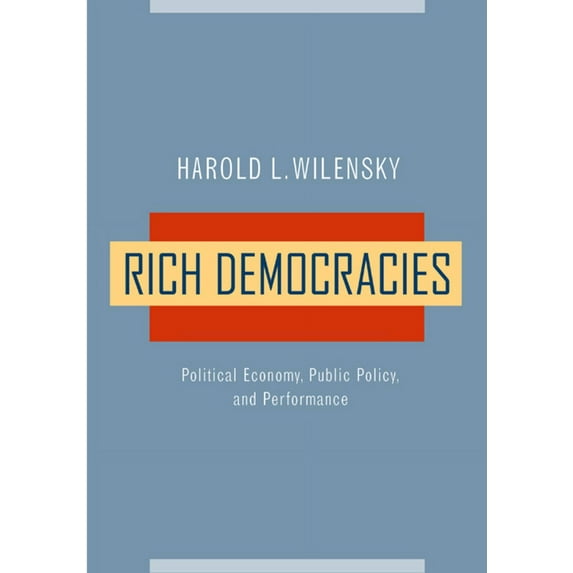
Hero image 0 of Rich Democracies : Political Economy, Public Policy, and Performance (Edition 1) (Paperback), 0 of 1
Rich Democracies : Political Economy, Public Policy, and Performance (Edition 1) (Paperback)
(No ratings yet)
Key item features
In this landmark work, the culmination of 30 years of systematic, comprehensive comparison of 19 rich democracies, Wilensky answers two basic questions: (1) What is distinctly modern about modern societies--in what ways are they becoming alike? (2) How do variations in types of political economy shape system performance? He specifies similarities and differences in the structure and interplay of government, political parties, the mass media, industry, labor, professions, agriculture, churches, and voluntary associations. He then demonstrates how differences in bargaining arrangements among these groups lead to contrasting policy profiles and patterns of taxing and spending, which in turn explain a large number of outcomes: economic performance, political legitimacy, equality, job security, safety and risk, real health, the reduction of poverty and environmental threats, and the effectiveness and fairness of regulatory regimes.
Drawing on quantitative data and case studies covering the last 50 years and more than 400 interviews he conducted with top decision-makers and advisors, Wilensky provides a richly detailed account of the common social, economic, and labor problems modern governments confront and their contrasting styles of conflict resolution. The result is new light on the likely paths of development of rich democracies as they become richer. Assessing alternative theories, Wilensky offers a powerful critique of such images of modern society as "post-industrial" or "high-tech," "the information age" or the alleged dominance of "globalization."
Because he systematically compares all of the rich democracies with at least three million population, Wilensky can specify what is truly exceptional about the United States, what it shares with Britain and Britain abroad (Canada, Australia, New Zealand) and what it shares with all or almost all of the West European democracies, Israel, and Japan. He gives careful attention to which successful social and labor policies are transferable across nations and which are not.
Rich Democracies will interest both scholars and practitioners. It combines the perspectives of political economy (the interplay of markets and politics) and political sociology (the social bases of politics). It will be especially useful in courses on comparative political economy, comparative politics, European politics, public policy, political sociology, the welfare state, American government, advanced industrial societies, and industrial relations.
Drawing on quantitative data and case studies covering the last 50 years and more than 400 interviews he conducted with top decision-makers and advisors, Wilensky provides a richly detailed account of the common social, economic, and labor problems modern governments confront and their contrasting styles of conflict resolution. The result is new light on the likely paths of development of rich democracies as they become richer. Assessing alternative theories, Wilensky offers a powerful critique of such images of modern society as "post-industrial" or "high-tech," "the information age" or the alleged dominance of "globalization."
Because he systematically compares all of the rich democracies with at least three million population, Wilensky can specify what is truly exceptional about the United States, what it shares with Britain and Britain abroad (Canada, Australia, New Zealand) and what it shares with all or almost all of the West European democracies, Israel, and Japan. He gives careful attention to which successful social and labor policies are transferable across nations and which are not.
Rich Democracies will interest both scholars and practitioners. It combines the perspectives of political economy (the interplay of markets and politics) and political sociology (the social bases of politics). It will be especially useful in courses on comparative political economy, comparative politics, European politics, public policy, political sociology, the welfare state, American government, advanced industrial societies, and industrial relations.
Specs
- Book formatPaperback
- Fiction/nonfictionNon-Fiction
- Pub date20020701
- Pages922
- Reading levelScholarly & Professional
- SubgenrePolitical Ideologies
Current price is USD$57.88
Price when purchased online
- Free shipping
 Free 90-day returns
How do you want your item?
Try 30 days of Free Shipping with Walmart+! Choose plan at checkout.
Columbus, 43215
Arrives by Tue, Apr 7
Sold and shipped by Walmart.com

Free 90-day returns

This item is gift eligible
More seller options (3)
Starting from $66.71

Get free delivery, shipping and more*
*Restrictions apply Try Walmart+ now
About this item
Product details
In this landmark work, the culmination of 30 years of systematic, comprehensive comparison of 19 rich democracies, Wilensky answers two basic questions: (1) What is distinctly modern about modern societies--in what ways are they becoming alike? (2) How do variations in types of political economy shape system performance? He specifies similarities and differences in the structure and interplay of government, political parties, the mass media, industry, labor, professions, agriculture, churches, and voluntary associations. He then demonstrates how differences in bargaining arrangements among these groups lead to contrasting policy profiles and patterns of taxing and spending, which in turn explain a large number of outcomes: economic performance, political legitimacy, equality, job security, safety and risk, real health, the reduction of poverty and environmental threats, and the effectiveness and fairness of regulatory regimes.
Drawing on quantitative data and case studies covering the last 50 years and more than 400 interviews he conducted with top decision-makers and advisors, Wilensky provides a richly detailed account of the common social, economic, and labor problems modern governments confront and their contrasting styles of conflict resolution. The result is new light on the likely paths of development of rich democracies as they become richer. Assessing alternative theories, Wilensky offers a powerful critique of such images of modern society as "post-industrial" or "high-tech," "the information age" or the alleged dominance of "globalization."
Because he systematically compares all of the rich democracies with at least three million population, Wilensky can specify what is truly exceptional about the United States, what it shares with Britain and Britain abroad (Canada, Australia, New Zealand) and what it shares with all or almost all of the West European democracies, Israel, and Japan. He gives careful attention to which successful social and labor policies are transferable across nations and which are not.
Rich Democracies will interest both scholars and practitioners. It combines the perspectives of political economy (the interplay of markets and politics) and political sociology (the social bases of politics). It will be especially useful in courses on comparative political economy, comparative politics, European politics, public policy, political sociology, the welfare state, American government, advanced industrial societies, and industrial relations.
Drawing on quantitative data and case studies covering the last 50 years and more than 400 interviews he conducted with top decision-makers and advisors, Wilensky provides a richly detailed account of the common social, economic, and labor problems modern governments confront and their contrasting styles of conflict resolution. The result is new light on the likely paths of development of rich democracies as they become richer. Assessing alternative theories, Wilensky offers a powerful critique of such images of modern society as "post-industrial" or "high-tech," "the information age" or the alleged dominance of "globalization."
Because he systematically compares all of the rich democracies with at least three million population, Wilensky can specify what is truly exceptional about the United States, what it shares with Britain and Britain abroad (Canada, Australia, New Zealand) and what it shares with all or almost all of the West European democracies, Israel, and Japan. He gives careful attention to which successful social and labor policies are transferable across nations and which are not.
Rich Democracies will interest both scholars and practitioners. It combines the perspectives of political economy (the interplay of markets and politics) and political sociology (the social bases of politics). It will be especially useful in courses on comparative political economy, comparative politics, European politics, public policy, political sociology, the welfare state, American government, advanced industrial societies, and industrial relations.
In this landmark work, the culmination of 30 years of systematic, comprehensive comparison of 19 rich democracies, Wilensky answers two basic questions: (1) What is distinctly modern about modern societies--in what ways are they becoming alike? (2) How do variations in types of political economy shape system performance? He specifies similarities and differences in the structure and interplay of government, political parties, the mass media, industry, labor, professions, agriculture, churches, and voluntary associations. He then demonstrates how differences in bargaining arrangements among these groups lead to contrasting policy profiles and patterns of taxing and spending, which in turn explain a large number of outcomes: economic performance, political legitimacy, equality, job security, safety and risk, real health, the reduction of poverty and environmental threats, and the effectiveness and fairness of regulatory regimes.
Drawing on quantitative data and case studies covering the last 50 years and more than 400 interviews he conducted with top decision-makers and advisors, Wilensky provides a richly detailed account of the common social, economic, and labor problems modern governments confront and their contrasting styles of conflict resolution. The result is new light on the likely paths of development of rich democracies as they become richer. Assessing alternative theories, Wilensky offers a powerful critique of such images of modern society as "post-industrial" or "high-tech," "the information age" or the alleged dominance of "globalization."
Because he systematically compares all of the rich democracies with at least three million population, Wilensky can specify what is truly exceptional about the United States, what it shares with Britain and Britain abroad (Canada, Australia, New Zealand) and what it shares with all or almost all of the West European democracies, Israel, and Japan. He gives careful attention to which successful social and labor policies are transferable across nations and which are not.
Rich Democracies will interest both scholars and practitioners. It combines the perspectives of political economy (the interplay of markets and politics) and political sociology (the social bases of politics). It will be especially useful in courses on comparative political economy, comparative politics, European politics, public policy, political sociology, the welfare state, American government, advanced industrial societies, and industrial relations.
Drawing on quantitative data and case studies covering the last 50 years and more than 400 interviews he conducted with top decision-makers and advisors, Wilensky provides a richly detailed account of the common social, economic, and labor problems modern governments confront and their contrasting styles of conflict resolution. The result is new light on the likely paths of development of rich democracies as they become richer. Assessing alternative theories, Wilensky offers a powerful critique of such images of modern society as "post-industrial" or "high-tech," "the information age" or the alleged dominance of "globalization."
Because he systematically compares all of the rich democracies with at least three million population, Wilensky can specify what is truly exceptional about the United States, what it shares with Britain and Britain abroad (Canada, Australia, New Zealand) and what it shares with all or almost all of the West European democracies, Israel, and Japan. He gives careful attention to which successful social and labor policies are transferable across nations and which are not.
Rich Democracies will interest both scholars and practitioners. It combines the perspectives of political economy (the interplay of markets and politics) and political sociology (the social bases of politics). It will be especially useful in courses on comparative political economy, comparative politics, European politics, public policy, political sociology, the welfare state, American government, advanced industrial societies, and industrial relations.
info:
We aim to show you accurate product information. Manufacturers, suppliers and others provide what you see here, and we have not verified it.
Specifications
Book format
Paperback
Fiction/nonfiction
Non-Fiction
Genre
Political & Social Sciences
Pub date
20020701
Warranty
Warranty information
Please be aware that the warranty terms on items offered for sale by third party Marketplace sellers may differ from those displayed in this section (if any). To confirm warranty terms on an item offered for sale by a third party Marketplace seller, please use the 'Contact seller' feature on the third party Marketplace seller's information page and request the item's warranty terms prior to purchase.
Similar items you might like
Based on what customers bought
American Political Economy in Global Perspective, (Paperback) $30.97
 $3097current price $30.97
American Political Economy in Global Perspective, (Paperback)
Economic Geography and Public Policy, (Paperback) $76.25
 $7625current price $76.25
Economic Geography and Public Policy, (Paperback)
Ripe Global Political Economy Cultural Political Economy, (Paperback) $73.05
 $7305current price $73.05
Ripe Global Political Economy Cultural Political Economy, (Paperback)
Latin American Political Economy: Financial Crisis And Political Change, (Paperback) $59.99
 $5999current price $59.99
Latin American Political Economy: Financial Crisis And Political Change, (Paperback)
Politics & Society, (Paperback) $79.63
 $7963current price $79.63
Politics & Society, (Paperback)
The Free Economy and the Strong State: The Politics of Thatcherism, (Paperback) $56.14
 $5614current price $56.14
The Free Economy and the Strong State: The Politics of Thatcherism, (Paperback)
A Comparative Political Economy of Industrial Capitalism, (Paperback) $54.99
 $5499current price $54.99
A Comparative Political Economy of Industrial Capitalism, (Paperback)
Economic Politics: The Costs of Democracy, (Paperback) $36.00
 $3600current price $36.00
Economic Politics: The Costs of Democracy, (Paperback)
American Business and Public Policy: The politics of foreign trade, (Paperback) $53.59
 $5359current price $53.59
American Business and Public Policy: The politics of foreign trade, (Paperback)
Political Economy: Past and Present: A Review of Leading Theories of Economic Policy, (Paperback) $54.99
 $5499current price $54.99
Political Economy: Past and Present: A Review of Leading Theories of Economic Policy, (Paperback)
American Governance and Public Policy The Political Economy of Special-Purpose Government, (Paperback) $56.48
 $5648current price $56.48
American Governance and Public Policy The Political Economy of Special-Purpose Government, (Paperback)
Government, Industry and Political Economy, (Paperback) $54.77
 $5477current price $54.77
Government, Industry and Political Economy, (Paperback)
Economic Policy Conference The Supply-Side Effects of Economic Policy, Book 1, (Paperback) $54.99
 $5499current price $54.99
Economic Policy Conference The Supply-Side Effects of Economic Policy, Book 1, (Paperback)
Theories Of Comparative Political Economy, (Paperback) $79.99
 $7999current price $79.99
Theories Of Comparative Political Economy, (Paperback)
Cornell Studies in Political Economy Democracy and Markets, (Paperback) $41.95
 $4195current price $41.95
Cornell Studies in Political Economy Democracy and Markets, (Paperback)
Business and Public Policy Political Economies of Energy Transition, (Paperback) $36.42
 $3642current price $36.42
Business and Public Policy Political Economies of Energy Transition, (Paperback)
Comparative Politics The Government Party: Political Dominance in Democracy, (Hardcover) $59.46
 $5946current price $59.46
Comparative Politics The Government Party: Political Dominance in Democracy, (Hardcover)
Cambridge Studies in Comparative Politic Presidentialism, Parliamentarism, and Democracy, (Hardcover) $47.96
 $4796current price $47.96
Cambridge Studies in Comparative Politic Presidentialism, Parliamentarism, and Democracy, (Hardcover)
Contributions in Economics & Economic Hi Questioning Geopolitics: Political Projects in a Changing World-System, (Paperback) $54.90
 $5490current price $54.90
Contributions in Economics & Economic Hi Questioning Geopolitics: Political Projects in a Changing World-System, (Paperback)
Routledge Frontiers of Political Economy Inequality and Power: The Economics of Class, (Paperback) $71.18
 $7118current price $71.18
Routledge Frontiers of Political Economy Inequality and Power: The Economics of Class, (Paperback)
Customer ratings & reviews
0 ratings|0 reviews
This item does not have any reviews yet

Related pages
- Capitalism Environment
- Professor Of Political And Social Theory Gianfranco Poggi
- Socialist Economy
- Metapolitics
- Real Cler Politics
- Analyst
- Social Services & Welfare Policy Books
- Political Philosophy Books
- Communication Policy Books
- Media & Internet Political Process Books
- Post-Structuralism Philosophy Movement Books
- Structuralism Philosophy Movement Books