

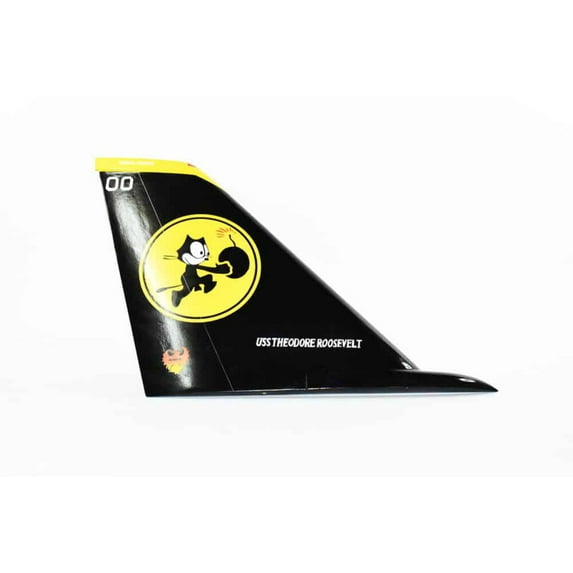
VF-31 Tomcatters F-14 Tail
Key item features
Specs
- BrandSquadron Nostalgia
- ThemeNaval Aviation
How do you want your item?
About this item
Product details
VF-31 Tomcatters Tail– One of the most iconic squadrons in Naval Aviation and a perfect collector’s piece. 20 inch solid wood tail that has been hand carved and painted.
The use of naval aviation insignia is a modern form of heraldry that dates back to the early period of naval aviation in the 1920’s and captures many proud moments of its history. The practice fosters a sense of pride, unit cohesion and contributes to high morale, esprit de corps and professionalism within the community. It also serves as an effective means of preserving a command’s tradition, continuity of purpose and recognition, as traced through its lineage. The following rules are provided to ensure that all command insignia and slogans are in keeping with the highest traditions of the proud naval aviation heritage.
Strike Fighter Squadron THREE ONE is the second oldest active US Navy squadron and boasts a proud, distinguished history. Its beginnings can be traced to the commissioning of the VF-1B Shooting Stars in July 1935, flying the Boeing F4B-4. Over the years while displaying the “Felix the Cat” mascot, the squadron has flown under the designations of VF-6 (1937-1943), VF-3 (1943-1948), VF-31 (1948-2006), and finally VFA-31 (2006-Present). It was in 1946, under the designation of VF-3, that “Felix the Cat” officially became the squadron mascot. In 1948, VF-3 was re-designated VF-31, and adopted the current title of Tomcatters. During its distinguished history, the Tomcatters have flown a multitude of venerable aircraft including the F4B-4, F3F-2, F4F-4, F6F, F8F-1, F9F-2, F2H, F3H, F-3B, F-4B, F-4J, F-14A, F-14D and F/A-18E.
Through the years the Tomcatters and their predecessors have served aboard the Navy’s finest aircraft carriers, including: USS Langley (CV-1); USS Lexington (CV-2); and the USS Enterprise (CV-6). In 1980 VF-31 and USS Saratoga (CV-60) concluded a 24-year period of continuous service together, the longest in naval history. Since that time, the Tomcatters have served aboard USS Carl Vinson (CVN-70), USS Abraham Lincoln (CVN-72), USS John C. Stennis (CVN-74), USS Theodore Roosevelt (CVN-73), and USS George H. W. Bush (CVN-77).
The tactical prowess of the Tomcatters is well documented as the squadron has served in every major conflict since its inception. The squadron was aboard USS Enterprise during the bombing of Pearl Harbor as well as the Battles of Wake Island, Marcus Island, Coral Sea, Midway, Guadalcanal, and the Eastern Solomons. The squadron has seen aerial combat over the Philippines, Formosa, Okinawa and China. In 1972, flying the F-4J Phantom, CDR Sam “Speed” Flynn, the Tomcatter XO, shot down a MIG-21 over North Vietnam. This accomplishment once again set the squadron above its peers by distinguishing VF-31 as the only Navy fighter squadron to achieve aerial victories in three wars – WWII, the Korean War, and the Vietnam War. Overall, the Tomcatters’ total combat experience includes fierce battles in virtually every theater of operation as well as regional conflicts all over the world.
In late 1996 VF-31 returned from a Western Pacific deployment aboard USS Carl Vinson (CVN-70), flying in support of Operations SOUTHERN WATCH and DESERT STRIKE over the Arabian Gulf and southern Iraq. Two years later, the Tomcatters would deploy again, this time aboard USS Abraham Lincoln (CVN-72), in support of Operation SOUTHERN WATCH.
Following the September 11, attacks the squadron was once again called to the fight, and deployed on CVN-72 in July 2002, operating over Afghanistan in support of Operation ENDURING FREEDOM, and again over the skies of Iraq supporting SOUTHERN WATCH. Shortly after their return home, VF-31, along with the rest of the battle group, was turned around on January 1, 2003 to ready the stage for the commencement of Operation IRAQI FREEDOM. Flying from the first night of combat over Baghdad to the last day of the short war, VF-31 was individually
