

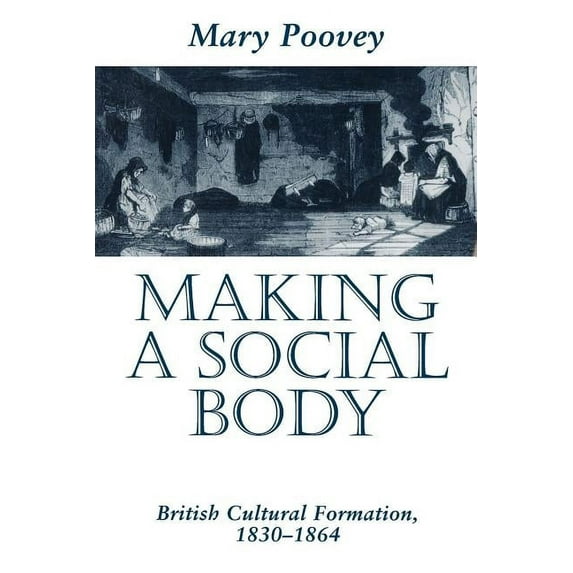
Hero image 0 of Making a Social Body : British Cultural Formation, 1830-1864 (Paperback), 0 of 1
Making a Social Body : British Cultural Formation, 1830-1864 (Paperback)
(No ratings yet)
Key item features
With much recent work in Victorian studies focused on gender and class differences, the homogenizing features of 19th-century culture have received relatively little attention. In Making a Social Body, Mary Poovey examines one of the conditions that made the development of a mass culture in Victorian Britain possible: the representation of the population as an aggregate—a social body. Drawing on both literature and social reform texts, she analyzes the organization of knowledge during this period and explores its role in the emergence of the idea of the social body.
Poovey illuminates the ways literary genres, such as the novel, and innovations in social thought, such as statistical thinking and anatomical realism, helped separate social concerns from the political and economic domains. She then discusses the influence of the social body concept on Victorian ideas about the role of the state, examining writings by James Phillips Kay, Thomas Chalmers, and Edwin Chadwick on regulating the poor. Analyzing the conflict between Kay's idea of the social body and Babbage's image of the social machine, she considers the implications of both models for the place of Victorian women. Poovey's provocative readings of Disraeli's Coningsby, Gaskell's Mary Barton, and Dickens's Our Mutual Friend show that the novel as a genre exposed the role gender played in contemporary discussions of poverty and wealth.
Making a Social Body argues that gender, race, and class should be considered in the context of broader concerns such as how social authority is distributed, how institutions formalize knowledge, and how truth is defined.
Poovey illuminates the ways literary genres, such as the novel, and innovations in social thought, such as statistical thinking and anatomical realism, helped separate social concerns from the political and economic domains. She then discusses the influence of the social body concept on Victorian ideas about the role of the state, examining writings by James Phillips Kay, Thomas Chalmers, and Edwin Chadwick on regulating the poor. Analyzing the conflict between Kay's idea of the social body and Babbage's image of the social machine, she considers the implications of both models for the place of Victorian women. Poovey's provocative readings of Disraeli's Coningsby, Gaskell's Mary Barton, and Dickens's Our Mutual Friend show that the novel as a genre exposed the role gender played in contemporary discussions of poverty and wealth.
Making a Social Body argues that gender, race, and class should be considered in the context of broader concerns such as how social authority is distributed, how institutions formalize knowledge, and how truth is defined.
Specs
- Book formatPaperback
- Fiction/nonfictionNon-Fiction
- GenreHistory
- Pub date19951115
- Pages266
- Reading levelUndergraduate
Current price is USD$19.56
Price when purchased online
 Free 90-day returns
How do you want your item?
Try 30 days of Free Shipping with Walmart+! Choose plan at checkout.
Columbus, 43215
Arrives by Fri, Apr 3
.Order within 13 hr 41 min
Sold and shipped by Walmart.com

Free 90-day returns

This item is gift eligible
More seller options (3)
Starting from $43.27

Get free delivery, shipping and more*
*Restrictions apply Try Walmart+ now
About this item
Product details
With much recent work in Victorian studies focused on gender and class differences, the homogenizing features of 19th-century culture have received relatively little attention. In Making a Social Body, Mary Poovey examines one of the conditions that made the development of a mass culture in Victorian Britain possible: the representation of the population as an aggregate--a social body. Drawing on both literature and social reform texts, she analyzes the organization of knowledge during this period and explores its role in the emergence of the idea of the social body. Poovey illuminates the ways literary genres, such as the novel, and innovations in social thought, such as statistical thinking and anatomical realism, helped separate social concerns from the political and economic domains. She then discusses the influence of the social body concept on Victorian ideas about the role of the state, examining writings by James Phillips Kay, Thomas Chalmers, and Edwin Chadwick on regulating the poor. Analyzing the conflict between Kay's idea of the social body and Babbage's image of the social machine, she considers the implications of both models for the place of Victorian women. Poovey's provocative readings of Disraeli's Coningsby, Gaskell's Mary Barton, and Dickens's Our Mutual Friend show that the novel as a genre exposed the role gender played in contemporary discussions of poverty and wealth. Making a Social Body argues that gender, race, and class should be considered in the context of broader concerns such as how social authority is distributed, how institutions formalize knowledge, and how truth is defined.
With much recent work in Victorian studies focused on gender and class differences, the homogenizing features of 19th-century culture have received relatively little attention. In Making a Social Body, Mary Poovey examines one of the conditions that made the development of a mass culture in Victorian Britain possible: the representation of the population as an aggregate—a social body. Drawing on both literature and social reform texts, she analyzes the organization of knowledge during this period and explores its role in the emergence of the idea of the social body.
Poovey illuminates the ways literary genres, such as the novel, and innovations in social thought, such as statistical thinking and anatomical realism, helped separate social concerns from the political and economic domains. She then discusses the influence of the social body concept on Victorian ideas about the role of the state, examining writings by James Phillips Kay, Thomas Chalmers, and Edwin Chadwick on regulating the poor. Analyzing the conflict between Kay's idea of the social body and Babbage's image of the social machine, she considers the implications of both models for the place of Victorian women. Poovey's provocative readings of Disraeli's Coningsby, Gaskell's Mary Barton, and Dickens's Our Mutual Friend show that the novel as a genre exposed the role gender played in contemporary discussions of poverty and wealth.
Making a Social Body argues that gender, race, and class should be considered in the context of broader concerns such as how social authority is distributed, how institutions formalize knowledge, and how truth is defined.
Poovey illuminates the ways literary genres, such as the novel, and innovations in social thought, such as statistical thinking and anatomical realism, helped separate social concerns from the political and economic domains. She then discusses the influence of the social body concept on Victorian ideas about the role of the state, examining writings by James Phillips Kay, Thomas Chalmers, and Edwin Chadwick on regulating the poor. Analyzing the conflict between Kay's idea of the social body and Babbage's image of the social machine, she considers the implications of both models for the place of Victorian women. Poovey's provocative readings of Disraeli's Coningsby, Gaskell's Mary Barton, and Dickens's Our Mutual Friend show that the novel as a genre exposed the role gender played in contemporary discussions of poverty and wealth.
Making a Social Body argues that gender, race, and class should be considered in the context of broader concerns such as how social authority is distributed, how institutions formalize knowledge, and how truth is defined.
info:
We aim to show you accurate product information. Manufacturers, suppliers and others provide what you see here, and we have not verified it.
Specifications
Book format
Paperback
Fiction/nonfiction
Non-Fiction
Genre
History
Pub date
19951115
Warranty
Warranty information
Please be aware that the warranty terms on items offered for sale by third party Marketplace sellers may differ from those displayed in this section (if any). To confirm warranty terms on an item offered for sale by a third party Marketplace seller, please use the 'Contact seller' feature on the third party Marketplace seller's information page and request the item's warranty terms prior to purchase.
Warnings
State Chemical Disclosure
None
Similar items you might like
Based on what customers bought
Cambridge Studies in Social and Cultural Outline of a Theory of Practice, Book 16, (Paperback) $11.76
 $1176current price $11.76
Cambridge Studies in Social and Cultural Outline of a Theory of Practice, Book 16, (Paperback)
Ultimate Questions, (Paperback) $9.99
 2 optionsAvailable in additional 2 options$999current price $9.99
Ultimate Questions, (Paperback)
Interlink Cultural Histories: Kingston : A Cultural History (Paperback) $14.60
 $1460current price $14.60
Interlink Cultural Histories: Kingston : A Cultural History (Paperback)
A Social Marginalia: Studies from the Cultural Hinterlands, (Paperback) $16.50
 $1650current price $16.50
A Social Marginalia: Studies from the Cultural Hinterlands, (Paperback)
Best seller I m Dead Now What, Book, (Paperback) $13.94 14.5 ¢/ea
Best seller $1394current price $13.9414.5 ¢/ea
I m Dead Now What, Book, (Paperback)
2524.6 out of 5 Stars. 252 reviewsSix Degrees of Education: From Teaching in Mumbai to Investment Research in New York, (Paperback) $8.95
 $895current price $8.95
Six Degrees of Education: From Teaching in Mumbai to Investment Research in New York, (Paperback)
King's College Lectures On Elocution (Paperback) $20.95
 $2095current price $20.95
King's College Lectures On Elocution (Paperback)
The Future of Academic Freedom (Paperback) $17.45
 $1745current price $17.45
The Future of Academic Freedom (Paperback)
A History of London in 50 Lives (Paperback) $17.43
 $1743current price $17.43
A History of London in 50 Lives (Paperback)
Cultural Hybridity (Paperback) $19.95
 $1995current price $19.95
Cultural Hybridity (Paperback)
Counterfeit Culture, (Paperback) $14.99
 $1499current price $14.99
Counterfeit Culture, (Paperback)
Suny Series, the Philosophy of Education The Moral Collapse of the University: Professionalism, Purity, and Alienation, (Paperback) $20.21
 $2021current price $20.21
Suny Series, the Philosophy of Education The Moral Collapse of the University: Professionalism, Purity, and Alienation, (Paperback)
The Irish Penny Journal, (Volume I) No. 24, December 12, 1840, (Paperback) $18.02
 $1802current price $18.02
The Irish Penny Journal, (Volume I) No. 24, December 12, 1840, (Paperback)
A Method of Teaching English to Foreigners (Paperback) $15.95
 $1595current price $15.95
A Method of Teaching English to Foreigners (Paperback)
Global Social Problems, (Paperback) $15.46 Was $20.63
 $1546current price $15.46, Was $20.63$20.63
Global Social Problems, (Paperback)
The Irish Penny Journal, (Volume I) No. 26, December 26, 1840, (Paperback) $18.02
 $1802current price $18.02
The Irish Penny Journal, (Volume I) No. 26, December 26, 1840, (Paperback)
Women in Culture and Society Uneven Developments: The Ideological Work of Gender in Mid-Victorian England, (Paperback) $32.47
 $3247current price $32.47
Women in Culture and Society Uneven Developments: The Ideological Work of Gender in Mid-Victorian England, (Paperback)
De L'organisation de L'enseignement Dans L'Université de Paris (Paperback) $20.95
 $2095current price $20.95
De L'organisation de L'enseignement Dans L'Université de Paris (Paperback)
Focus Philosophical Library: Athenian Funeral Orations (Edition 1) (Paperback) $14.44 Was $18.33
 $1444current price $14.44, Was $18.33$18.33
Focus Philosophical Library: Athenian Funeral Orations (Edition 1) (Paperback)
Some Trouble with Cows : Making Sense of Social Conflict (Edition 1) (Paperback) $19.92 Was $25.00
 $1992current price $19.92, Was $25.00$25.00
Some Trouble with Cows : Making Sense of Social Conflict (Edition 1) (Paperback)
Customer ratings & reviews
0 ratings|0 reviews
This item does not have any reviews yet
