

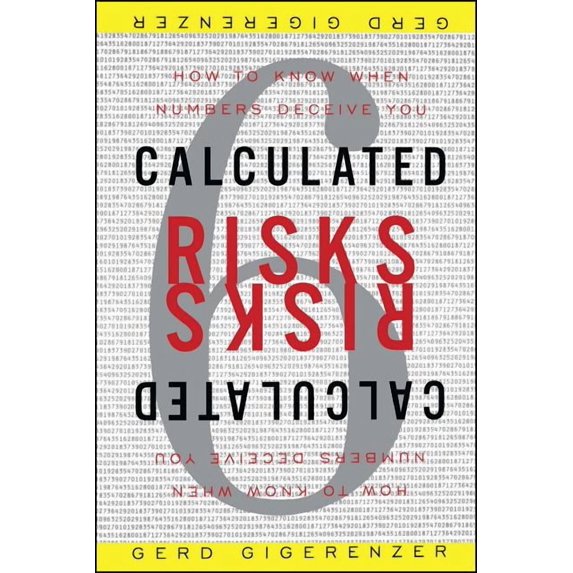
Hero image 0 of Calculated Risks: How to Know When Numbers Deceive You, (Paperback), 0 of 1
Calculated Risks: How to Know When Numbers Deceive You, (Paperback)
(No ratings yet)
Key item features
Publishers Weekly,If a woman aged 40 to 50 has breast cancer, nine times out of 10 it will show up on a mammogram. On the other hand, nine out of 10 suspicious mammograms turn out not to be cancer. Confused? So are many people who seek certainty through numbers, says Gigerenzer, a statistician and behavioral scientist. His book is a successful attempt to help innumerates (those who don't understand statistics), offering case studies of people who desperately need to understand statistics, including those working in AIDS counseling, DNA fingerprinting and domestic violence cases. Gigerenzer deftly intersperses math lessons explaining concepts like frequency and risk in layperson's terms with real-life stories involving doctors and detectives. One of his main themes is that even well-meaning, statistically astute professionals may be unable to communicate concepts such as statistical risk to innumerates. (He tells the true story of a psychiatrist who prescribes Prozac to a patient and warns him about potential side effects, saying, You have a 30 to 50 percent chance of developing a sexual problem. The patient worries that in anywhere from 30% to 50% of all his sexual encounters, he is going to have performance problems. But what the doctor really meant is that for every 10 people who take Prozac, three to five may experience sexual side effects, and many have no sexual side effects at all.) All innumerates buyers, sellers, students, professors, doctors, patients, lawyers and their clients, politicians, voters, writers and readers have something to learn from Gigerenzer's quirky yet understandable book. Agent, John Brockman. (June) Forecast: What's the probability of Gigerenzer's work becoming a bestseller? Let's just say it's hard to imagine a book about statistics flying off the shelves (although John Allen Paulos's Innumeracy was a bestseller just two years back). Still, if Gigerenzer gets enough publicity his book has an exposE, here's what those statistics really mean edge to it audiences might respond. (c) Copyright PWxyz, LLC. All rights reserved
Specs
- Book formatPaperback
- Fiction/nonfictionNon-Fiction
- GenreTextbooks
- Pub date2003-03-19
- Pages320
- Reading levelGeneral
Current price is USD$14.23
Price when purchased online
 Free 90-day returns
How do you want your item?
Try 30 days of Free Shipping with Walmart+! Choose plan at checkout.
Columbus, 43215
Arrives by Thu, Apr 9
Sold and shipped by Walmart.com

Free 90-day returns

This item is gift eligible
More seller options (4)
Starting from $22.17

Get free delivery, shipping and more*
*Restrictions apply Try Walmart+ now
About this item
Product details
At the beginning of the twentieth century, H. G. Wells predicted that statistical thinking would be as necessary for citizenship in a technological world as the ability to read and write. But in the twenty-first century, we are often overwhelmed by a baffling array of percentages and probabilities as we try to navigate in a world dominated by statistics.
Cognitive scientist Gerd Gigerenzer says that because we haven't learned statistical thinking, we don't understand risk and uncertainty. In order to assess risk -- everything from the risk of an automobile accident to the certainty or uncertainty of some common medical screening tests -- we need a basic understanding of statistics.
Astonishingly, doctors and lawyers don't understand risk any better than anyone else. Gigerenzer reports a study in which doctors were told the results of breast cancer screenings and then were asked to explain the risks of contracting breast cancer to a woman who received a positive result from a screening. The actual risk was small because the test gives many false positives. But nearly every physician in the study overstated the risk. Yet many people will have to make important health decisions based on such information and the interpretation of that information by their doctors.
Gigerenzer explains that a major obstacle to our understanding of numbers is that we live with an illusion of certainty. Many of us believe that HIV tests, DNA fingerprinting, and the growing number of genetic tests are absolutely certain. But even DNA evidence can produce spurious matches. We cling to our illusion of certainty because the medical industry, insurance companies, investment advisers, and election campaigns have become purveyors of certainty, marketing it like a commodity.
To avoid confusion, says Gigerenzer, we should rely on more understandable representations of risk, such as absolute risks. For example, it is said that a mammography screening reduces the risk of breast cancer by 25 percent. But in absolute risks, that means that out of every 1,000 women who do not participate in screening, 4 will die; while out of 1,000 women who do, 3 will die. A 25 percent risk reduction sounds much more significant than a benefit that 1 out of 1,000 women will reap.
This eye-opening book explains how we can overcome our ignorance of numbers and better understand the risks we may be taking with our money, our health, and our lives.
Cognitive scientist Gerd Gigerenzer says that because we haven't learned statistical thinking, we don't understand risk and uncertainty. In order to assess risk -- everything from the risk of an automobile accident to the certainty or uncertainty of some common medical screening tests -- we need a basic understanding of statistics.
Astonishingly, doctors and lawyers don't understand risk any better than anyone else. Gigerenzer reports a study in which doctors were told the results of breast cancer screenings and then were asked to explain the risks of contracting breast cancer to a woman who received a positive result from a screening. The actual risk was small because the test gives many false positives. But nearly every physician in the study overstated the risk. Yet many people will have to make important health decisions based on such information and the interpretation of that information by their doctors.
Gigerenzer explains that a major obstacle to our understanding of numbers is that we live with an illusion of certainty. Many of us believe that HIV tests, DNA fingerprinting, and the growing number of genetic tests are absolutely certain. But even DNA evidence can produce spurious matches. We cling to our illusion of certainty because the medical industry, insurance companies, investment advisers, and election campaigns have become purveyors of certainty, marketing it like a commodity.
To avoid confusion, says Gigerenzer, we should rely on more understandable representations of risk, such as absolute risks. For example, it is said that a mammography screening reduces the risk of breast cancer by 25 percent. But in absolute risks, that means that out of every 1,000 women who do not participate in screening, 4 will die; while out of 1,000 women who do, 3 will die. A 25 percent risk reduction sounds much more significant than a benefit that 1 out of 1,000 women will reap.
This eye-opening book explains how we can overcome our ignorance of numbers and better understand the risks we may be taking with our money, our health, and our lives.
Publishers Weekly,If a woman aged 40 to 50 has breast cancer, nine times out of 10 it will show up on a mammogram. On the other hand, nine out of 10 suspicious mammograms turn out not to be cancer. Confused? So are many people who seek certainty through numbers, says Gigerenzer, a statistician and behavioral scientist. His book is a successful attempt to help innumerates (those who don't understand statistics), offering case studies of people who desperately need to understand statistics, including those working in AIDS counseling, DNA fingerprinting and domestic violence cases. Gigerenzer deftly intersperses math lessons explaining concepts like frequency and risk in layperson's terms with real-life stories involving doctors and detectives. One of his main themes is that even well-meaning, statistically astute professionals may be unable to communicate concepts such as statistical risk to innumerates. (He tells the true story of a psychiatrist who prescribes Prozac to a patient and warns him about potential side effects, saying, You have a 30 to 50 percent chance of developing a sexual problem. The patient worries that in anywhere from 30% to 50% of all his sexual encounters, he is going to have performance problems. But what the doctor really meant is that for every 10 people who take Prozac, three to five may experience sexual side effects, and many have no sexual side effects at all.) All innumerates buyers, sellers, students, professors, doctors, patients, lawyers and their clients, politicians, voters, writers and readers have something to learn from Gigerenzer's quirky yet understandable book. Agent, John Brockman. (June) Forecast: What's the probability of Gigerenzer's work becoming a bestseller? Let's just say it's hard to imagine a book about statistics flying off the shelves (although John Allen Paulos's Innumeracy was a bestseller just two years back). Still, if Gigerenzer gets enough publicity his book has an exposE, here's what those statistics really mean edge to it audiences might respond. (c) Copyright PWxyz, LLC. All rights reserved
info:
We aim to show you accurate product information. Manufacturers, suppliers and others provide what you see here, and we have not verified it.
Specifications
Book format
Paperback
Fiction/nonfiction
Non-Fiction
Genre
Textbooks
Pub date
2003-03-19
Warranty
Warranty information
Please be aware that the warranty terms on items offered for sale by third party Marketplace sellers may differ from those displayed in this section (if any). To confirm warranty terms on an item offered for sale by a third party Marketplace seller, please use the 'Contact seller' feature on the third party Marketplace seller's information page and request the item's warranty terms prior to purchase.
Warnings
State Chemical Disclosure
No harmful chemicals
Similar items you might like
Based on what customers bought
Gerd Diet Cookbook for Seniors: The Comprehensive Guide to Healthy and Delicious Recipes to manage and reverse Acid Reflux (Paperback) $12.99
 $1299current price $12.99
Gerd Diet Cookbook for Seniors: The Comprehensive Guide to Healthy and Delicious Recipes to manage and reverse Acid Reflux (Paperback)
Ein kleiner Schlüssel, (Paperback) $12.99
 $1299current price $12.99
Ein kleiner Schlüssel, (Paperback)
GERD-Friendly Flavors: 98 Soothing Recipes for Acid Reflux Relief, (Paperback) $9.49
 $949current price $9.49
GERD-Friendly Flavors: 98 Soothing Recipes for Acid Reflux Relief, (Paperback)
Des Indications de la Gastro-Entérostomie Dans Les Cas de Tumeur de l'Estomac : N'Intéressant Pas Le Pylore (Paperback) $14.97
 $1497current price $14.97
Des Indications de la Gastro-Entérostomie Dans Les Cas de Tumeur de l'Estomac : N'Intéressant Pas Le Pylore (Paperback)
L'Atmosphère Est Un Engrais Complet (Paperback) $12.95
 $1295current price $12.95
L'Atmosphère Est Un Engrais Complet (Paperback)
Taking Risks: The Management of Uncertainty, (Paperback) $14.37
 $1437current price $14.37
Taking Risks: The Management of Uncertainty, (Paperback)
Philibert Des Angliers Ou Les Dangers d'Une Mauvaise Éducation. Tome 1 (Paperback) $19.70
 $1970current price $19.70
Philibert Des Angliers Ou Les Dangers d'Une Mauvaise Éducation. Tome 1 (Paperback)
It's All About You!: A guide to becoming more vulnerable, loving deeper & becoming a better YOU (Paperback) $14.95
 $1495current price $14.95
It's All About You!: A guide to becoming more vulnerable, loving deeper & becoming a better YOU (Paperback)
Offenders in Transition: Just Trying to Do Good: An Assessment of Health Risks and Concerns (Paperback) by Lee G Streetman $12.60
 $1260current price $12.60
Offenders in Transition: Just Trying to Do Good: An Assessment of Health Risks and Concerns (Paperback) by Lee G Streetman
Notizbuch für FKK-Freunde (Paperback) $11.90
 $1190current price $11.90
Notizbuch für FKK-Freunde (Paperback)
One Minute After You Die (25-Pack), (Paperback) $4.79
 $479current price $4.79
One Minute After You Die (25-Pack), (Paperback)
Risk and Reward: How Small Colleges Get Better Against the Odds, (Paperback) $12.99
 $1299current price $12.99
Risk and Reward: How Small Colleges Get Better Against the Odds, (Paperback)
Unconscious Branding - Paperback $11.59
 2 optionsAvailable in additional 2 options$1159current price $11.59
Unconscious Branding - Paperback
Nutrition during heartburn: E036 DIETETICS - Mouth and esophagus - Reflux, (Paperback) $16.69
 $1669current price $16.69
Nutrition during heartburn: E036 DIETETICS - Mouth and esophagus - Reflux, (Paperback)
Letters Never Sent, a global nomad's journey from hurt to healing, (Paperback) $16.99
 $1699current price $16.99
Letters Never Sent, a global nomad's journey from hurt to healing, (Paperback)
Twice Over a Man: A Fierce Memoir of an Orphan Boy Who Doggedly Determined a Finer Life, (Paperback) $18.95
 $1895current price $18.95
Twice Over a Man: A Fierce Memoir of an Orphan Boy Who Doggedly Determined a Finer Life, (Paperback)
Misericordia Dei, (Paperback) $13.95
 $1395current price $13.95
Misericordia Dei, (Paperback)
Colección TeologÃa BÃblica Y Sistemática PneumatologÃa: Doctrina del EspÃritu Santo 4, (Paperback) $10.59
 $1059current price $10.59
Colección TeologÃa BÃblica Y Sistemática PneumatologÃa: Doctrina del EspÃritu Santo 4, (Paperback)
One Korea? : Challenges and Prospects for Reunification (Paperback) $10.88
 $1088current price $10.88
One Korea? : Challenges and Prospects for Reunification (Paperback)

Customer ratings & reviews
0 ratings|0 reviews
This item does not have any reviews yet
