

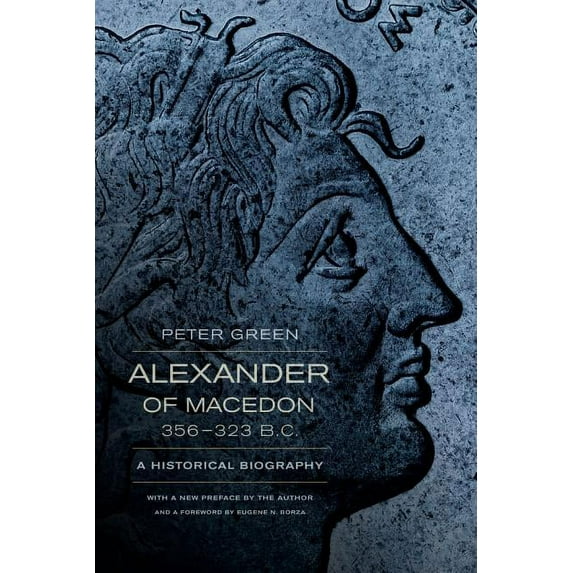
Hero image 0 of Alexander of Macedon, 356–323 B.C. : A Historical Biography (Edition 1) (Paperback), 0 of 1
Alexander of Macedon, 356–323 B.C. : A Historical Biography (Edition 1) (Paperback)
(No ratings yet)
Key item features
Until recently, popular biographers and most scholars viewed Alexander the Great as a genius with a plan, a romantic figure pursuing his vision of a united world. His dream was at times characterized as a benevolent interest in the brotherhood of man, sometimes as a brute interest in the exercise of power. Green, a Cambridge-trained classicist who is also a novelist, portrays Alexander as both a complex personality and a single-minded general, a man capable of such diverse expediencies as patricide or the massacre of civilians. Green describes his Alexander as "not only the most brilliant (and ambitious) field commander in history, but also supremely indifferent to all those administrative excellences and idealistic yearnings foisted upon him by later generations, especially those who found the conqueror, tout court, a little hard upon their liberal sensibilities."
This biography begins not with one of the universally known incidents of Alexander's life, but with an account of his father, Philip of Macedonia, whose many-territoried empire was the first on the continent of Europe to have an effectively centralized government and military. What Philip and Macedonia had to offer, Alexander made his own, but Philip and Macedonia also made Alexander form an important context for understanding Alexander himself. Yet his origins and training do not fully explain the man. After he was named hegemon of the Hellenic League, many philosophers came to congratulate Alexander, but one was conspicuous by his absence: Diogenes the Cynic, an ascetic who lived in a clay tub. Piqued and curious, Alexander himself visited the philosopher, who, when asked if there was anything Alexander could do for him, made the famous reply, "Don't stand between me and the sun." Alexander's courtiers jeered, but Alexander silenced them: "If I were not Alexander, I would be Diogenes." This remark was as unexpected in Alexander as it would be in a modern leader.
For the general reader, the book, redolent with gritty details and fully aware of Alexander's darker side, offers a gripping tale of Alexander's career. Full backnotes, fourteen maps, and chronological and genealogical tables serve readers with more specialized interests.
This biography begins not with one of the universally known incidents of Alexander's life, but with an account of his father, Philip of Macedonia, whose many-territoried empire was the first on the continent of Europe to have an effectively centralized government and military. What Philip and Macedonia had to offer, Alexander made his own, but Philip and Macedonia also made Alexander form an important context for understanding Alexander himself. Yet his origins and training do not fully explain the man. After he was named hegemon of the Hellenic League, many philosophers came to congratulate Alexander, but one was conspicuous by his absence: Diogenes the Cynic, an ascetic who lived in a clay tub. Piqued and curious, Alexander himself visited the philosopher, who, when asked if there was anything Alexander could do for him, made the famous reply, "Don't stand between me and the sun." Alexander's courtiers jeered, but Alexander silenced them: "If I were not Alexander, I would be Diogenes." This remark was as unexpected in Alexander as it would be in a modern leader.
For the general reader, the book, redolent with gritty details and fully aware of Alexander's darker side, offers a gripping tale of Alexander's career. Full backnotes, fourteen maps, and chronological and genealogical tables serve readers with more specialized interests.
Specs
- Book formatPaperback
- Fiction/nonfictionNon-Fiction
- GenreBiography & Memoirs
- Pub date20130108
- Pages672
- Reading levelGeneral
Current price is USD$29.95
Price when purchased online
 Free 90-day returns
How do you want your item?
Try 30 days of Free Shipping with Walmart+! Choose plan at checkout.
Columbus, 43215
Arrives by Wed, Apr 8
Sold and shipped by Walmart.com

Free 90-day returns

This item is gift eligible
More seller options (3)
Starting from $36.65

Get free delivery, shipping and more*
*Restrictions apply Try Walmart+ now
About this item
Product details
Until recently, popular biographers and most scholars viewed Alexander the Great as a genius with a plan, a romantic figure pursuing his vision of a united world. His dream was at times characterized as a benevolent interest in the brotherhood of man, sometimes as a brute interest in the exercise of power. Green, a Cambridge-trained classicist who is also a novelist, portrays Alexander as both a complex personality and a single-minded general, a man capable of such diverse expediencies as patricide or the massacre of civilians. Green describes his Alexander as "not only the most brilliant (and ambitious) field commander in history, but also supremely indifferent to all those administrative excellences and idealistic yearnings foisted upon him by later generations, especially those who found the conqueror, tout court, a little hard upon their liberal sensibilities."
This biography begins not with one of the universally known incidents of Alexander's life, but with an account of his father, Philip of Macedonia, whose many-territoried empire was the first on the continent of Europe to have an effectively centralized government and military. What Philip and Macedonia had to offer, Alexander made his own, but Philip and Macedonia also made Alexander form an important context for understanding Alexander himself. Yet his origins and training do not fully explain the man. After he was named hegemon of the Hellenic League, many philosophers came to congratulate Alexander, but one was conspicuous by his absence: Diogenes the Cynic, an ascetic who lived in a clay tub. Piqued and curious, Alexander himself visited the philosopher, who, when asked if there was anything Alexander could do for him, made the famous reply, "Don't stand between me and the sun." Alexander's courtiers jeered, but Alexander silenced them: "If I were not Alexander, I would be Diogenes." This remark was as unexpected in Alexander as it would be in a modern leader.
For the general reader, the book, redolent with gritty details and fully aware of Alexander's darker side, offers a gripping tale of Alexander's career. Full backnotes, fourteen maps, and chronological and genealogical tables serve readers with more specialized interests.
This biography begins not with one of the universally known incidents of Alexander's life, but with an account of his father, Philip of Macedonia, whose many-territoried empire was the first on the continent of Europe to have an effectively centralized government and military. What Philip and Macedonia had to offer, Alexander made his own, but Philip and Macedonia also made Alexander form an important context for understanding Alexander himself. Yet his origins and training do not fully explain the man. After he was named hegemon of the Hellenic League, many philosophers came to congratulate Alexander, but one was conspicuous by his absence: Diogenes the Cynic, an ascetic who lived in a clay tub. Piqued and curious, Alexander himself visited the philosopher, who, when asked if there was anything Alexander could do for him, made the famous reply, "Don't stand between me and the sun." Alexander's courtiers jeered, but Alexander silenced them: "If I were not Alexander, I would be Diogenes." This remark was as unexpected in Alexander as it would be in a modern leader.
For the general reader, the book, redolent with gritty details and fully aware of Alexander's darker side, offers a gripping tale of Alexander's career. Full backnotes, fourteen maps, and chronological and genealogical tables serve readers with more specialized interests.
Until recently, popular biographers and most scholars viewed Alexander the Great as a genius with a plan, a romantic figure pursuing his vision of a united world. His dream was at times characterized as a benevolent interest in the brotherhood of man, sometimes as a brute interest in the exercise of power. Green, a Cambridge-trained classicist who is also a novelist, portrays Alexander as both a complex personality and a single-minded general, a man capable of such diverse expediencies as patricide or the massacre of civilians. Green describes his Alexander as "not only the most brilliant (and ambitious) field commander in history, but also supremely indifferent to all those administrative excellences and idealistic yearnings foisted upon him by later generations, especially those who found the conqueror, tout court, a little hard upon their liberal sensibilities."
This biography begins not with one of the universally known incidents of Alexander's life, but with an account of his father, Philip of Macedonia, whose many-territoried empire was the first on the continent of Europe to have an effectively centralized government and military. What Philip and Macedonia had to offer, Alexander made his own, but Philip and Macedonia also made Alexander form an important context for understanding Alexander himself. Yet his origins and training do not fully explain the man. After he was named hegemon of the Hellenic League, many philosophers came to congratulate Alexander, but one was conspicuous by his absence: Diogenes the Cynic, an ascetic who lived in a clay tub. Piqued and curious, Alexander himself visited the philosopher, who, when asked if there was anything Alexander could do for him, made the famous reply, "Don't stand between me and the sun." Alexander's courtiers jeered, but Alexander silenced them: "If I were not Alexander, I would be Diogenes." This remark was as unexpected in Alexander as it would be in a modern leader.
For the general reader, the book, redolent with gritty details and fully aware of Alexander's darker side, offers a gripping tale of Alexander's career. Full backnotes, fourteen maps, and chronological and genealogical tables serve readers with more specialized interests.
This biography begins not with one of the universally known incidents of Alexander's life, but with an account of his father, Philip of Macedonia, whose many-territoried empire was the first on the continent of Europe to have an effectively centralized government and military. What Philip and Macedonia had to offer, Alexander made his own, but Philip and Macedonia also made Alexander form an important context for understanding Alexander himself. Yet his origins and training do not fully explain the man. After he was named hegemon of the Hellenic League, many philosophers came to congratulate Alexander, but one was conspicuous by his absence: Diogenes the Cynic, an ascetic who lived in a clay tub. Piqued and curious, Alexander himself visited the philosopher, who, when asked if there was anything Alexander could do for him, made the famous reply, "Don't stand between me and the sun." Alexander's courtiers jeered, but Alexander silenced them: "If I were not Alexander, I would be Diogenes." This remark was as unexpected in Alexander as it would be in a modern leader.
For the general reader, the book, redolent with gritty details and fully aware of Alexander's darker side, offers a gripping tale of Alexander's career. Full backnotes, fourteen maps, and chronological and genealogical tables serve readers with more specialized interests.
info:
We aim to show you accurate product information. Manufacturers, suppliers and others provide what you see here, and we have not verified it.
Specifications
Book format
Paperback
Fiction/nonfiction
Non-Fiction
Genre
Biography & Memoirs
Pub date
20130108
Warranty
Warranty information
Please be aware that the warranty terms on items offered for sale by third party Marketplace sellers may differ from those displayed in this section (if any). To confirm warranty terms on an item offered for sale by a third party Marketplace seller, please use the 'Contact seller' feature on the third party Marketplace seller's information page and request the item's warranty terms prior to purchase.
Similar items you might like
Based on what customers bought
Numbers: A Cultural History, (Paperback) $37.19
 $3719current price $37.19
Numbers: A Cultural History, (Paperback)
Grecia Para Todos (Paperback) $11.86
 $1186current price $11.86
Grecia Para Todos (Paperback)
Bloomsbury Sources in Ancient History Athenian Democracy: A Sourcebook, (Paperback) $44.95
 $4495current price $44.95
Bloomsbury Sources in Ancient History Athenian Democracy: A Sourcebook, (Paperback)
Classical Bearings: Interpreting Ancient History and Culture, (Paperback) $31.95
 $3195current price $31.95
Classical Bearings: Interpreting Ancient History and Culture, (Paperback)
A History of Sicily, 491-289 B.C, (Paperback) $20.95
 $2095current price $20.95
A History of Sicily, 491-289 B.C, (Paperback)
Philip and Alexander: Kings and Conquerors, (Hardcover) $27.34
 $2734current price $27.34
Philip and Alexander: Kings and Conquerors, (Hardcover)
The Secret History: New Large Print Edition, (Hardcover) $19.99 Was $22.99
 $1999current price $19.99, Was $22.99$22.99
The Secret History: New Large Print Edition, (Hardcover)
Pliny the Elder's World, (Paperback) $29.99
 $2999current price $29.99
Pliny the Elder's World, (Paperback)
Landmark The Landmark Herodotus: The Histories, (Paperback) $27.95
 $2795current price $27.95
Landmark The Landmark Herodotus: The Histories, (Paperback)
44.8 out of 5 Stars. 4 reviewsLactor Sourcebooks in Ancient History The Athenian Empire, Book 1, (Paperback) $20.99
 $2099current price $20.99
Lactor Sourcebooks in Ancient History The Athenian Empire, Book 1, (Paperback)
The Classical Art of Command: Eight Greek Generals Who Shaped the History of Warfare, (Paperback) $24.33
 $2433current price $24.33
The Classical Art of Command: Eight Greek Generals Who Shaped the History of Warfare, (Paperback)
Alexander the Great: The Unique History of Quintus Curtius, (Paperback) $27.61
 $2761current price $27.61
Alexander the Great: The Unique History of Quintus Curtius, (Paperback)
Pre-Owned History of the Peloponnesian War (Paperback) 0486437620 9780486437620 $8.47
 2 optionsAvailable in additional 2 options$847current price $8.47
Pre-Owned History of the Peloponnesian War (Paperback) 0486437620 9780486437620
Oeuvres des $29.95
 $2995current price $29.95
Oeuvres des
Histoire: Oeuvres Complètes de A.-F. Ozanam. T02 (Paperback) $29.95
 $2995current price $29.95
Histoire: Oeuvres Complètes de A.-F. Ozanam. T02 (Paperback)
Diodorus Siculus, Books 11-12.37.1: Greek History, 480-431 BC-the Alternative Version, (Paperback) $39.87
 $3987current price $39.87
Diodorus Siculus, Books 11-12.37.1: Greek History, 480-431 BC-the Alternative Version, (Paperback)
The History Of Herodotus (Complete): Translated Into English By G. C. Macaulay, (Paperback) $26.82
 $2682current price $26.82
The History Of Herodotus (Complete): Translated Into English By G. C. Macaulay, (Paperback)
Klio / Beihefte. Neue Folge The Quaestorship in the Roman Republic, Book 31, (Paperback) $31.31
 $3131current price $31.31
Klio / Beihefte. Neue Folge The Quaestorship in the Roman Republic, Book 31, (Paperback)


Customer ratings & reviews
0 ratings|0 reviews
This item does not have any reviews yet
