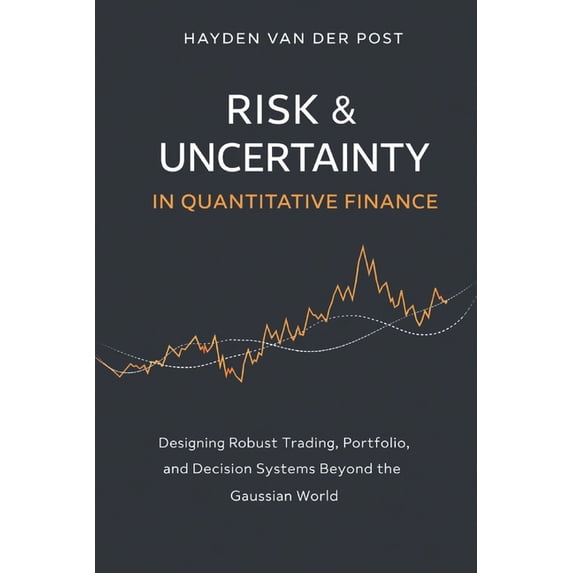
Reactive Publishing Most financial models assume markets behave nicely. They do not.
Returns are not normally distributed. Volatility clusters. Correlations spike under stress. Rare events dominate outcomes. And strategies that look statistically sound on paper routinely fail in live markets.
Risk & Uncertainty in Quantitative Finance is written for quantitative analysts, traders, portfolio managers, and technically minded investors who want to move beyond fragile Gaussian assumptions and design systems that survive real-world uncertainty.
Building on classical probability and statistics, this book focuses on how risk actually manifests in markets-and how to manage it when distributions are fat-tailed, regimes shift, and outcomes are path-dependent. Rather than treating risk as a static number, it shows how uncertainty evolves over time and how poor risk architecture, not bad signals, is the primary cause of blowups.
Inside, you will learn how to:
-
Model and reason about fat tails, extreme events, and asymmetric risk
-
Understand drawdowns, risk of ruin, and survival constraints in trading systems
-
Design position sizing frameworks that balance growth, volatility, and drawdown control
-
Recognize regime shifts, volatility clustering, and structural breaks before they invalidate models
-
Distinguish expected value from realized outcomes in path-dependent systems
-
Build portfolios and strategies that remain robust when assumptions fail
This book is not about chasing alpha or optimizing backtests. It is about designing decision systems that remain functional when markets behave badly, and knowing which risks matter, which do not, and which will eventually end you if ignored.
If you rely on statistical models, quantitative strategies, or systematic decision-making in financial markets, this book will change how you think about risk, and why survival, not precision, is the true objective of quantitative finance.