

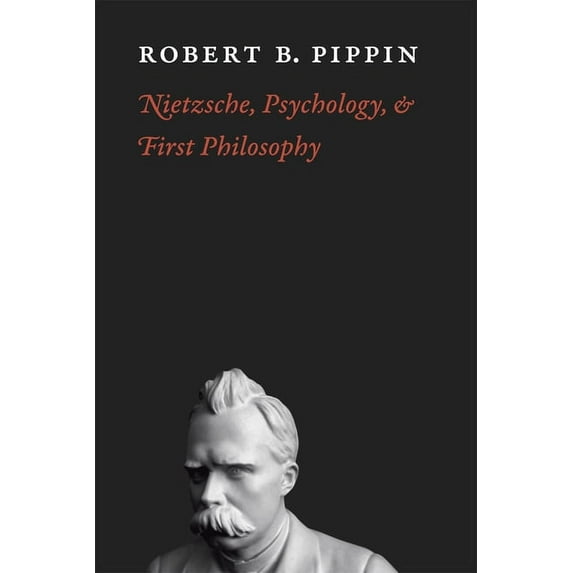
Nietzsche, Psychology, and First Philosophy (Paperback)
Key item features
Friedrich Nietzsche is one of the most elusive thinkers in the philosophical tradition. His highly unusual style and insistence on what remains hidden or unsaid in his writing make pinning him to a particular position tricky. Nonetheless, certain readings of his work have become standard and influential. In this major new interpretation of Nietzsche’s work, Robert B. Pippin challenges various traditional views of Nietzsche, taking him at his word when he says that his writing can best be understood as a kind of psychology.
Pippin traces this idea of Nietzsche as a psychologist to his admiration for the French moralists: La Rochefoucauld, Pascal, Stendhal, and especially Montaigne. In distinction from philosophers, Pippin shows, these writers avoided grand metaphysical theories in favor of reflections on life as lived and experienced. Aligning himself with this project, Nietzsche sought to make psychology “the queen of the sciences” and the “path to the fundamental problems.” Pippin contends that Nietzsche’s singular prose was an essential part of this goal, and so he organizes the book around four of Nietzsche’s most important images and metaphors: that truth could be a woman, that a science could be gay, that God could have died, and that an agent is as much one with his act as lightning is with its flash.
Expanded from a series of lectures Pippin delivered at the Collège de France, Nietzsche, Psychology, and First Philosophy offers a brilliant, novel, and accessible reading of this seminal thinker.
Specs
- Book formatPaperback
- Fiction/nonfictionNon-Fiction
- Pub date2011-12-15
- Pages160
- Edition1
- Original languagesEnglish
- Free shipping
 Free 30-day returns
How do you want your item?


About this item
Product details
Friedrich Nietzsche is one of the most elusive thinkers in the philosophical tradition. His highly unusual style and insistence on what remains hidden or unsaid in his writing make pinning him to a particular position tricky. Nonetheless, certain readings of his work have become standard and influential. In this major new interpretation of Nietzsche's work, Robert B. Pippin challenges various traditional views of Nietzsche, taking him at his word when he says that his writing can best be understood as a kind of psychology.
Pippin traces this idea of Nietzsche as a psychologist to his admiration for the French moralists: La Rochefoucauld, Pascal, Stendhal, and especially Montaigne. In distinction from philosophers, Pippin shows, these writers avoided grand metaphysical theories in favor of reflections on life as lived and experienced. Aligning himself with this project, Nietzsche sought to make psychology "the queen of the sciences" and the "path to the fundamental problems." Pippin contends that Nietzsche's singular prose was an essential part of this goal, and so he organizes the book around four of Nietzsche's most important images and metaphors: that truth could be a woman, that a science could be gay, that God could have died, and that an agent is as much one with his act as lightning is with its flash. Expanded from a series of lectures Pippin delivered at the Collège de France, Nietzsche, Psychology, and First Philosophy offers a brilliant, novel, and accessible reading of this seminal thinker.Friedrich Nietzsche is one of the most elusive thinkers in the philosophical tradition. His highly unusual style and insistence on what remains hidden or unsaid in his writing make pinning him to a particular position tricky. Nonetheless, certain readings of his work have become standard and influential. In this major new interpretation of Nietzsche’s work, Robert B. Pippin challenges various traditional views of Nietzsche, taking him at his word when he says that his writing can best be understood as a kind of psychology.
Pippin traces this idea of Nietzsche as a psychologist to his admiration for the French moralists: La Rochefoucauld, Pascal, Stendhal, and especially Montaigne. In distinction from philosophers, Pippin shows, these writers avoided grand metaphysical theories in favor of reflections on life as lived and experienced. Aligning himself with this project, Nietzsche sought to make psychology “the queen of the sciences” and the “path to the fundamental problems.” Pippin contends that Nietzsche’s singular prose was an essential part of this goal, and so he organizes the book around four of Nietzsche’s most important images and metaphors: that truth could be a woman, that a science could be gay, that God could have died, and that an agent is as much one with his act as lightning is with its flash.
Expanded from a series of lectures Pippin delivered at the Collège de France, Nietzsche, Psychology, and First Philosophy offers a brilliant, novel, and accessible reading of this seminal thinker.
Specifications
Book format
Fiction/nonfiction
Genre
Pub date
Warranty
Warranty information
Warnings
State Chemical Disclosure
Similar items you might like
Based on what customers bought
Modern European Philosophy Idealism as Modernism: Hegelian Variations, (Paperback) $34.21
 $3421current price $34.21
Modern European Philosophy Idealism as Modernism: Hegelian Variations, (Paperback)
The Culmination: Heidegger, German Idealism, and the Fate of Philosophy, (Hardcover) $32.07
 $3207current price $32.07
The Culmination: Heidegger, German Idealism, and the Fate of Philosophy, (Hardcover)
After the Beautiful: Hegel and the Philosophy of Pictorial Modernism, (Paperback) $22.00
 $2200current price $22.00
After the Beautiful: Hegel and the Philosophy of Pictorial Modernism, (Paperback)
Philosophie: Cours de Philosophie. Morale (Paperback) $29.86 Was $36.36
 $2986current price $29.86, Was $36.36$36.36
Philosophie: Cours de Philosophie. Morale (Paperback)
Cambridge Texts in the History of Philos Nietzsche: Thus Spoke Zarathustra, (Paperback) $30.00
 $3000current price $30.00
Cambridge Texts in the History of Philos Nietzsche: Thus Spoke Zarathustra, (Paperback)
Nietzsche, (Paperback) $10.83
 $1083current price $10.83
Nietzsche, (Paperback)
Nietzsche and Epicurus, (Paperback) $42.95
 $4295current price $42.95
Nietzsche and Epicurus, (Paperback)
Elements in the Philosophy of Friedrich Nietzsche on Virtue, (Paperback) $24.89
 $2489current price $24.89
Elements in the Philosophy of Friedrich Nietzsche on Virtue, (Paperback)
Beyond Good and Evil, (Paperback) $6.40
 $640current price $6.40
Beyond Good and Evil, (Paperback)
Thus Spoke Zarathustra & Beyong Good And Evil (2In1), (Paperback) $33.93
 $3393current price $33.93
Thus Spoke Zarathustra & Beyong Good And Evil (2In1), (Paperback)
Philosophie: Histoire de la Philosophie (Éd.1898) (Paperback) $34.89
 $3489current price $34.89
Philosophie: Histoire de la Philosophie (Éd.1898) (Paperback)
Philosophy of Finitude: Heidegger, Levinas and Nietzsche, (Paperback) $54.90
 $5490current price $54.90
Philosophy of Finitude: Heidegger, Levinas and Nietzsche, (Paperback)
Philosophie: Le Crépuscule d'Une Idole: Nietzsche, Nietzschéisme, Nietzschéens (Paperback) $27.85
 $2785current price $27.85
Philosophie: Le Crépuscule d'Une Idole: Nietzsche, Nietzschéisme, Nietzschéens (Paperback)
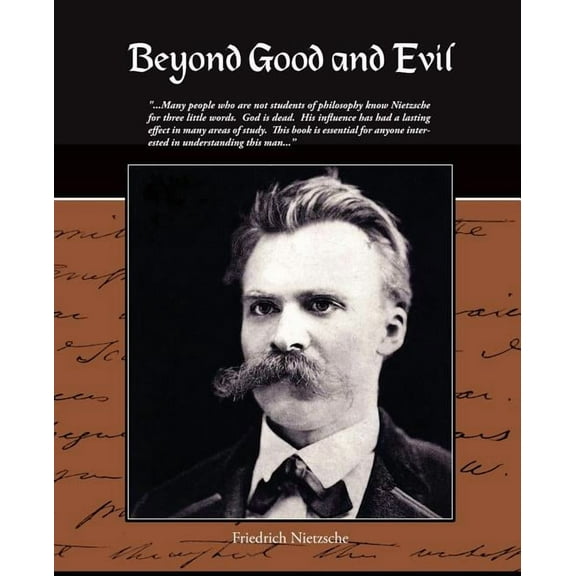
Beyond Good and Evil, (Paperback) $21.70
 $2170current price $21.70
Beyond Good and Evil, (Paperback)



Customer ratings & reviews

Related pages
- Jewish Literary Criticism Books
- Deconstruction Philosophy Movement Books
- Metaphysics Philosophy Books
- Empiricism Philosophy Movement Books
- Semiotics & Theory Literary Criticism Books
- Antiquities & Archaeology Books
- Epistles Horace
- Intelligent Design Creationism
- Chimerism
- Odyssey Focus On The Family
- Professor Of African And Islamic Archaeology Timothy Insoll
- Best Sellers In Transcendentalism Philosophy