

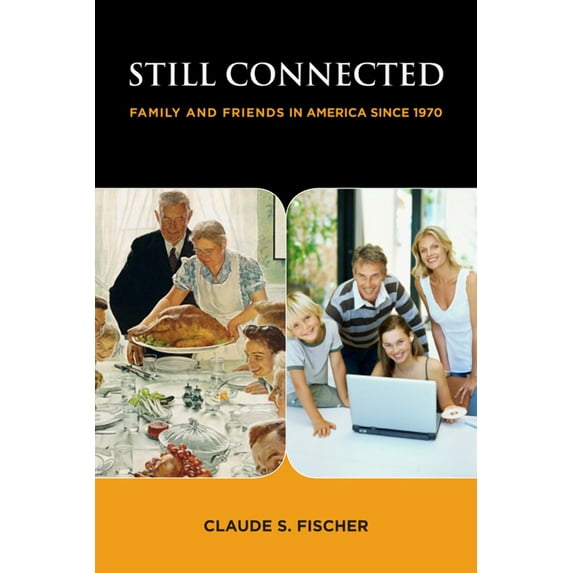
Hero image 0 of Still Connected : Family and Friends in America Since 1970 (Paperback), 0 of 1
Still Connected : Family and Friends in America Since 1970 (Paperback)
(No ratings yet)
Key item features
National news reports periodically proclaim that American life is lonelier than ever, and new books on the subject with titles like Bowling Alone generate considerable anxiety about the declining quality of Americans' social ties. Still Connected challenges such concerns by asking a simple yet significant question: have Americans' bonds with family and friends changed since the 1970s, and, if so, how? Noted sociologist Claude Fischer examines long-term trends in family ties and friendships and paints an insightful and ultimately reassuring portrait of Americans' personal relationships. Still Connected analyzes forty years of survey research to address whether and how Americans' personal ties have changed—their involvement with relatives, the number of friends they have and their contacts with those friends, the amount of practical and emotional support they are able to count on, and how emotionally tied they feel to these relationships. The book shows that Americans today have fewer relatives than they did forty years ago and that formal gatherings have declined over the decades—at least partially as a result of later marriages and more women in the work force. Yet neither the overall quantity of personal relationships nor, more importantly, the quality of those relationships has diminished. Americans' contact with relatives and friends, as well as their feelings of emotional connectedness, has changed relatively little since the 1970s. Although Americans are marrying later and single people feel lonely, few Americans report being socially isolated and the percentage who do has not really increased. Fischer maintains that this constancy testifies to the value Americans place on family and friends and to their willingness to adapt to changing circumstances in ways that sustain their social connections. For example, children now often have schedules as busy as their parents. Yet today's parents spend more quality time with their children than parents did forty years ago—although less in the form of organized home activities and more in the form of accompanying them to play dates or sports activities. And those family meals at home that seem to be disappearing? While survey research shows that families dine at home together less often, it also shows that they dine out together more often. Americans are fascinated by the quality of their relationships with family and friends and whether these bonds fray or remain stable over time. With so many voices heralding the demise of personal relationships, it's no wonder that confusion on this topic abounds. An engrossing and accessible social history, Still Connected brings a much-needed note of clarity to the discussion. Americans' personal ties, this book assures us, remain strong.
Specs
- Book formatPaperback
- Fiction/nonfictionNon-Fiction
- GenreNonfiction
- Pub date2011-01-01
- Pages176
- EditionIllustrated edition
Current price is USD$38.66
Price when purchased online
- Free shipping
 Free 30-day returns
How do you want your item?
Columbus, 43215
Arrives between Apr 16 - Apr 22
|
Sold and shipped by newbookdeals
4.557855626326964 stars out of 5, based on 1884 seller reviews(4.6)1884 seller reviews

Free 30-day returns
About this item
Product details
National news reports periodically proclaim that American life is lonelier than ever, and new books on the subject with titles like Bowling Alone generate considerable anxiety about the declining quality of Americans' social ties. Still Connected challenges such concerns by asking a simple yet significant question: have Americans' bonds with family and friends changed since the 1970s, and, if so, how? Noted sociologist Claude Fischer examines long-term trends in family ties and friendships and paints an insightful and ultimately reassuring portrait of Americans' personal relationships. Still Connected analyzes forty years of survey research to address whether and how Americans' personal ties have changed--their involvement with relatives, the number of friends they have and their contacts with those friends, the amount of practical and emotional support they are able to count on, and how emotionally tied they feel to these relationships. The book shows that Americans today have fewer relatives than they did forty years ago and that formal gatherings have declined over the decades--at least partially as a result of later marriages and more women in the work force. Yet neither the overall quantity of personal relationships nor, more importantly, the quality of those relationships has diminished. Americans' contact with relatives and friends, as well as their feelings of emotional connectedness, has changed relatively little since the 1970s. Although Americans are marrying later and single people feel lonely, few Americans report being socially isolated and the percentage who do has not really increased. Fischer maintains that this constancy testifies to the value Americans place on family and friends and to their willingness to adapt to changing circumstances in ways that sustain their social connections. For example, children now often have schedules as busy as their parents. Yet today's parents spend more quality time with their children than parents did forty years ago--although less in the form of organized home activities and more in the form of accompanying them to play dates or sports activities. And those family meals at home that seem to be disappearing? While survey research shows that families dine at home together less often, it also shows that they dine out together more often. Americans are fascinated by the quality of their relationships with family and friends and whether these bonds fray or remain stable over time. With so many voices heralding the demise of personal relationships, it's no wonder that confusion on this topic abounds. An engrossing and accessible social history, Still Connected brings a much-needed note of clarity to the discussion. Americans' personal ties, this book assures us, remain strong.
National news reports periodically proclaim that American life is lonelier than ever, and new books on the subject with titles like Bowling Alone generate considerable anxiety about the declining quality of Americans' social ties. Still Connected challenges such concerns by asking a simple yet significant question: have Americans' bonds with family and friends changed since the 1970s, and, if so, how? Noted sociologist Claude Fischer examines long-term trends in family ties and friendships and paints an insightful and ultimately reassuring portrait of Americans' personal relationships. Still Connected analyzes forty years of survey research to address whether and how Americans' personal ties have changed—their involvement with relatives, the number of friends they have and their contacts with those friends, the amount of practical and emotional support they are able to count on, and how emotionally tied they feel to these relationships. The book shows that Americans today have fewer relatives than they did forty years ago and that formal gatherings have declined over the decades—at least partially as a result of later marriages and more women in the work force. Yet neither the overall quantity of personal relationships nor, more importantly, the quality of those relationships has diminished. Americans' contact with relatives and friends, as well as their feelings of emotional connectedness, has changed relatively little since the 1970s. Although Americans are marrying later and single people feel lonely, few Americans report being socially isolated and the percentage who do has not really increased. Fischer maintains that this constancy testifies to the value Americans place on family and friends and to their willingness to adapt to changing circumstances in ways that sustain their social connections. For example, children now often have schedules as busy as their parents. Yet today's parents spend more quality time with their children than parents did forty years ago—although less in the form of organized home activities and more in the form of accompanying them to play dates or sports activities. And those family meals at home that seem to be disappearing? While survey research shows that families dine at home together less often, it also shows that they dine out together more often. Americans are fascinated by the quality of their relationships with family and friends and whether these bonds fray or remain stable over time. With so many voices heralding the demise of personal relationships, it's no wonder that confusion on this topic abounds. An engrossing and accessible social history, Still Connected brings a much-needed note of clarity to the discussion. Americans' personal ties, this book assures us, remain strong.
info:
We aim to show you accurate product information. Manufacturers, suppliers and others provide what you see here, and we have not verified it.
Specifications
Book format
Paperback
Fiction/nonfiction
Non-Fiction
Genre
Nonfiction
Pub date
2011-01-01
Warranty
Warranty information
Please be aware that the warranty terms on items offered for sale by third party Marketplace sellers may differ from those displayed in this section (if any). To confirm warranty terms on an item offered for sale by a third party Marketplace seller, please use the 'Contact seller' feature on the third party Marketplace seller's information page and request the item's warranty terms prior to purchase.
Similar items you might like
Based on what customers bought
Made in America: A Social History of American Culture and Character, (Paperback) $30.83
 $3083current price $30.83
Made in America: A Social History of American Culture and Character, (Paperback)
America Calling: A Social History of the Telephone to 1940, (Paperback) $38.80
 $3880current price $38.80
America Calling: A Social History of the Telephone to 1940, (Paperback)
Ryan Holiday 3 Books Collection Set - Non Fiction - Paperback $35.99
 $3599current price $35.99
Ryan Holiday 3 Books Collection Set - Non Fiction - Paperback
An American Half Century, (Paperback) $38.85
 $3885current price $38.85
An American Half Century, (Paperback)
The Trouble with America: Why the System Is Breaking Down, (Paperback) $47.39
 $4739current price $47.39
The Trouble with America: Why the System Is Breaking Down, (Paperback)
Hardings: History of the Harding Family, (Paperback) $24.95
 $2495current price $24.95
Hardings: History of the Harding Family, (Paperback)
La motivation au travail (Paperback) $29.59
 $2959current price $29.59
La motivation au travail (Paperback)
The Keim And Allied Families In America And Europe, (Paperback) $31.28
 $3128current price $31.28
The Keim And Allied Families In America And Europe, (Paperback)
L'Homme parano, (Paperback) $35.77
 $3577current price $35.77
L'Homme parano, (Paperback)
Old Kittery And Her Families, (Paperback) $35.84 Was $40.82
 $3584current price $35.84, Was $40.82$40.82
Old Kittery And Her Families, (Paperback)
Forty Years of German-American Political Relations (Hardcover) $36.95
 $3695current price $36.95
Forty Years of German-American Political Relations (Hardcover)
Italy, (Paperback) $30.48
 $3048current price $30.48
Italy, (Paperback)
Ethnopolitical Entrepreneurs: Outsiders Inside Armenian Los Angeles, (Paperback) $33.43
 $3343current price $33.43
Ethnopolitical Entrepreneurs: Outsiders Inside Armenian Los Angeles, (Paperback)
The Doane Family (Paperback) $31.07
 $3107current price $31.07
The Doane Family (Paperback)
The Indo-European Language Family, (Paperback) $32.99
 $3299current price $32.99
The Indo-European Language Family, (Paperback)
Transculturalismes, (Paperback) $29.39
 $2939current price $29.39
Transculturalismes, (Paperback)
The Swiss Origin of the Burkholder Family of America., (Hardcover) $31.07
 $3107current price $31.07
The Swiss Origin of the Burkholder Family of America., (Hardcover)
Family Business Management, (Paperback) $24.47
 $2447current price $24.47
Family Business Management, (Paperback)
American Fast Food, (Paperback) $28.27
 $2827current price $28.27
American Fast Food, (Paperback)
Why the United States Lacks a National Health Insurance Program, (Paperback) $38.89
 $3889current price $38.89
Why the United States Lacks a National Health Insurance Program, (Paperback)
Customer ratings & reviews
0 ratings|0 reviews
This item does not have any reviews yet

Related pages
- Remembered Things
- I Ll Show Myself Essays Midlife Motherhood
- I Want Live America
- Happened Worlds Fair
- Things Fall Apart Chinua Achebe
- Everything Happens
- People with Disabilities Biographies & Memoirs
- Manners & Etiquette Social Themes Teen & Young Adult Books
- Cultural, Ethnic & Regional
- Celebrity & Popular Culture
- Black Humor
- Homelessness & Poverty Kids' Books