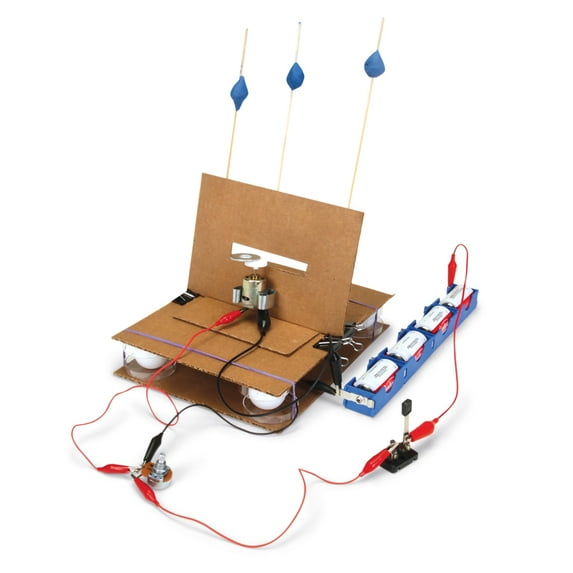
Build a shake table in the classroom and explore how technological advances allow scientists to gather data on earthquakes to work to mitigate the damage. In this series of 3 investigations, students explain why some buildings are impacted in earthquakes, but others remain intact. They collect evidence on how buildings respond to different frequencies of shaking, build a model shake table and building, and build a dampener to improve the stability of their buildings. _x000D_Curriculum Connection _x000D_While designed for a stand-alone earth science course, this series of activities could be incorporated into a high school physics course. _x000D_Time Requirements _x000D_Teacher prep, approximately 30 minutes. Completing the activities, approximately 1 week (135 minutes). _x000D_Digital Resources _x000D_Includes 1-year access to digital resources that support 3-dimensional instruction for NGSS. Digital resources may include a teacher manual and student guide, pre-lab activities and setup videos, phenomenon videos, simulations, and post-lab analysis and assessments. _x000D_Performance Expectation(s) _x000D_HS-ESS3-1. Construct an explanation based on evidence for how the availability of natural resources, occurrence of natural hazards, and changes in climate have influenced human activity. _x000D_Crosscutting Concepts _x000D_Influence of Science, Engineering, and Technology on Society and the Natural World _x000D_Disciplinary Core Ideas _x000D_ESS3.B: Natural Hazards _x000D_Science and Engineering Practices _x000D_Developing and Using Models _x000D_Prerequisite Knowledge and Skills _x000D_Students should be familiar with the concepts of seismic waves and the properties of waves in general, such as frequency, period, amplitude, and wave speed.




 CHOKING HAZARD - Children Under 3