

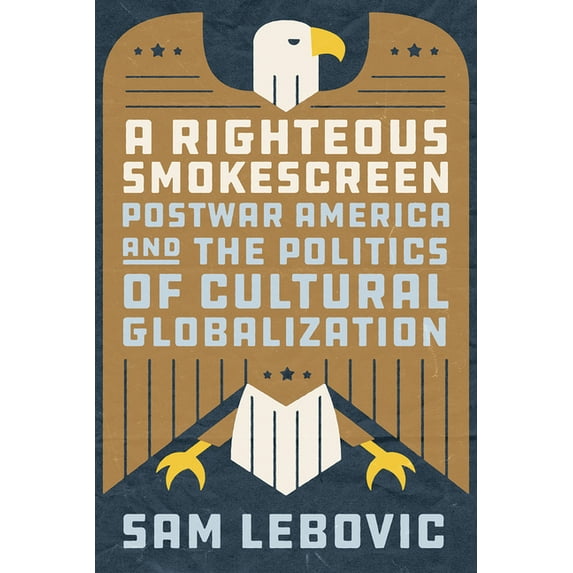
A Righteous Smokescreen : Postwar America and the Politics of Cultural Globalization (Edition 1) (Hardcover)
(No ratings yet)
Key item features
An examination of how the postwar United States twisted its ideal of “the free flow of information” into a one-sided export of values and a tool with global consequences.
When the dust settled after World War II, the United States stood as the world’s unquestionably pre-eminent military and economic power. In the decades that followed, the country exerted its dominant force in less visible but equally powerful ways, too, spreading its trade protocols, its media, and—perhaps most importantly—its alleged values. In A Righteous Smokescreen, Sam Lebovic homes in on one of the most prominent, yet ethereal, of those professed values: the free flow of information. This trope was seen as capturing what was most liberal about America’s self-declared leadership of the free world. But as Lebovic makes clear, even though diplomats and public figures trumpeted the importance of widespread cultural exchange, these transmissions flowed in only one direction: outward from the United States. Though other countries did try to promote their own cultural visions, Lebovic shows that the US moved to marginalize or block those visions outright, highlighting the shallowness of American commitments to multilateral institutions, the depth of its unstated devotion to cultural and economic supremacy, and its surprising hostility to importing foreign cultures. His book uncovers the unexpectedly profound global consequences buried in such ostensibly mundane matters as visa and passport policy, international educational funding, and land purchases for embassies. Even more crucially, A Righteous Smokescreen does nothing less than reveal that globalization was not the inevitable consequence of cultural convergence or the natural outcome of putatively free flows of information—it was always political to its core.
When the dust settled after World War II, the United States stood as the world’s unquestionably pre-eminent military and economic power. In the decades that followed, the country exerted its dominant force in less visible but equally powerful ways, too, spreading its trade protocols, its media, and—perhaps most importantly—its alleged values. In A Righteous Smokescreen, Sam Lebovic homes in on one of the most prominent, yet ethereal, of those professed values: the free flow of information. This trope was seen as capturing what was most liberal about America’s self-declared leadership of the free world. But as Lebovic makes clear, even though diplomats and public figures trumpeted the importance of widespread cultural exchange, these transmissions flowed in only one direction: outward from the United States. Though other countries did try to promote their own cultural visions, Lebovic shows that the US moved to marginalize or block those visions outright, highlighting the shallowness of American commitments to multilateral institutions, the depth of its unstated devotion to cultural and economic supremacy, and its surprising hostility to importing foreign cultures. His book uncovers the unexpectedly profound global consequences buried in such ostensibly mundane matters as visa and passport policy, international educational funding, and land purchases for embassies. Even more crucially, A Righteous Smokescreen does nothing less than reveal that globalization was not the inevitable consequence of cultural convergence or the natural outcome of putatively free flows of information—it was always political to its core.
Specs
- Book formatHardcover
- Fiction/nonfictionNon-Fiction
- GenreHistory
- Publication dateMay, 2022
- Pages272
- Edition1
Current price is USD$34.94
Price when purchased online
- Free shipping
 Free 30-day returns
How do you want your item?
Ships to
Arrives between May 28 - Jun 4
|
Sold and shipped by newbookdeals
4.559735638027453 stars out of 5, based on 1967 seller reviews(4.6)1967 seller reviews

Free 30-day returns
More seller options (1)
Starting from $51.77
About this item
Product details
An examination of how the postwar United States twisted its ideal of "the free flow of information" into a one-sided export of values and a tool with global consequences. When the dust settled after World War II, the United States stood as the world's unquestionably pre-eminent military and economic power. In the decades that followed, the country exerted its dominant force in less visible but equally powerful ways, too, spreading its trade protocols, its media, and-perhaps most importantly-its alleged values. In A Righteous Smokescreen, Sam Lebovic homes in on one of the most prominent, yet ethereal, of those professed values: the free flow of information. This trope was seen as capturing what was most liberal about America's self-declared leadership of the free world. But as Lebovic makes clear, even though diplomats and public figures trumpeted the importance of widespread cultural exchange, these transmissions flowed in only one direction: outward from the United States. Though other countries did try to promote their own cultural visions, Lebovic shows that the US moved to marginalize or block those visions outright, highlighting the shallowness of American commitments to multilateral institutions, the depth of its unstated devotion to cultural and economic supremacy, and its surprising hostility to importing foreign cultures. His book uncovers the unexpectedly profound global consequences buried in such ostensibly mundane matters as visa and passport policy, international educational funding, and land purchases for embassies. Even more crucially, A Righteous Smokescreen does nothing less than reveal that globalization was not the inevitable consequence of cultural convergence or the natural outcome of putatively free flows of information-it was always political to its core.
An examination of how the postwar United States twisted its ideal of “the free flow of information” into a one-sided export of values and a tool with global consequences.
When the dust settled after World War II, the United States stood as the world’s unquestionably pre-eminent military and economic power. In the decades that followed, the country exerted its dominant force in less visible but equally powerful ways, too, spreading its trade protocols, its media, and—perhaps most importantly—its alleged values. In A Righteous Smokescreen, Sam Lebovic homes in on one of the most prominent, yet ethereal, of those professed values: the free flow of information. This trope was seen as capturing what was most liberal about America’s self-declared leadership of the free world. But as Lebovic makes clear, even though diplomats and public figures trumpeted the importance of widespread cultural exchange, these transmissions flowed in only one direction: outward from the United States. Though other countries did try to promote their own cultural visions, Lebovic shows that the US moved to marginalize or block those visions outright, highlighting the shallowness of American commitments to multilateral institutions, the depth of its unstated devotion to cultural and economic supremacy, and its surprising hostility to importing foreign cultures. His book uncovers the unexpectedly profound global consequences buried in such ostensibly mundane matters as visa and passport policy, international educational funding, and land purchases for embassies. Even more crucially, A Righteous Smokescreen does nothing less than reveal that globalization was not the inevitable consequence of cultural convergence or the natural outcome of putatively free flows of information—it was always political to its core.
When the dust settled after World War II, the United States stood as the world’s unquestionably pre-eminent military and economic power. In the decades that followed, the country exerted its dominant force in less visible but equally powerful ways, too, spreading its trade protocols, its media, and—perhaps most importantly—its alleged values. In A Righteous Smokescreen, Sam Lebovic homes in on one of the most prominent, yet ethereal, of those professed values: the free flow of information. This trope was seen as capturing what was most liberal about America’s self-declared leadership of the free world. But as Lebovic makes clear, even though diplomats and public figures trumpeted the importance of widespread cultural exchange, these transmissions flowed in only one direction: outward from the United States. Though other countries did try to promote their own cultural visions, Lebovic shows that the US moved to marginalize or block those visions outright, highlighting the shallowness of American commitments to multilateral institutions, the depth of its unstated devotion to cultural and economic supremacy, and its surprising hostility to importing foreign cultures. His book uncovers the unexpectedly profound global consequences buried in such ostensibly mundane matters as visa and passport policy, international educational funding, and land purchases for embassies. Even more crucially, A Righteous Smokescreen does nothing less than reveal that globalization was not the inevitable consequence of cultural convergence or the natural outcome of putatively free flows of information—it was always political to its core.
info:
We aim to show you accurate product information. Manufacturers, suppliers and others provide what you see here, and we have not verified it.
Specifications
Book format
Hardcover
Fiction/nonfiction
Non-Fiction
Genre
History
Publication date
May, 2022
Warranty
Warranty information
Please be aware that the warranty terms on items offered for sale by third party Marketplace sellers may differ from those displayed in this section (if any). To confirm warranty terms on an item offered for sale by a third party Marketplace seller, please use the 'Contact seller' feature on the third party Marketplace seller's information page and request the item's warranty terms prior to purchase.
Warnings
State Chemical Disclosure
None
Similar items you might like
Based on what customers bought
Imagining Globalization: Language, Identities, and Boundaries, (Hardcover) $56.14
 $5614current price $56.14
Imagining Globalization: Language, Identities, and Boundaries, (Hardcover)
Books of n Wisdom Documents of Freedom Boxed Set ( 250 Edition), (Hardcover) $36.99
 $3699current price $36.99
Books of n Wisdom Documents of Freedom Boxed Set ( 250 Edition), (Hardcover)
Post-Yugoslavia: New Cultural and Political Perspectives, (Hardcover) $56.14
 $5614current price $56.14
Post-Yugoslavia: New Cultural and Political Perspectives, (Hardcover)
The Invisible Coup: How American Elites and Foreign Powers Use Immigration As a Weapon (Hardcover) $15.51 Was $17.43
 $1551current price $15.51, Was $17.43$17.43
The Invisible Coup: How American Elites and Foreign Powers Use Immigration As a Weapon (Hardcover)
264.9 out of 5 Stars. 26 reviewsThe Culture War: A Political Framework for the New Right., (Hardcover) $23.98
 $2398current price $23.98
The Culture War: A Political Framework for the New Right., (Hardcover)
Best seller Black AF History: The un-Whitewashed Story of America (Hardcover) $20.99 Was $32.50
Best seller $2099current price $20.99, Was $32.50$32.50
Black AF History: The un-Whitewashed Story of America (Hardcover)
1484.7 out of 5 Stars. 148 reviewsPolitics and Public Policy: Anthropocene Geopolitics: Globalization, Security, Sustainability (Paperback) $21.68
 $2168current price $21.68
Politics and Public Policy: Anthropocene Geopolitics: Globalization, Security, Sustainability (Paperback)
Cultural Inquiry Materialism and Politics, Book 20, (Hardcover) $31.32
 $3132current price $31.32
Cultural Inquiry Materialism and Politics, Book 20, (Hardcover)
Best seller 1929: Inside the Greatest Crash in Wall Street History--And How It Shattered a Nation (Hardcover) $20.59
Best seller $2059current price $20.59
1929: Inside the Greatest Crash in Wall Street History--And How It Shattered a Nation (Hardcover)
434.8 out of 5 Stars. 43 reviewsNext Realignment: Why America's Parties Are Crumbling and What Happens Next, (Hardcover) $22.42
 $2242current price $22.42
Next Realignment: Why America's Parties Are Crumbling and What Happens Next, (Hardcover)
Incrementalism and Policymaking in the USA: Adaptations for a Partisan Age, (Hardcover) $34.94
 $3494current price $34.94
Incrementalism and Policymaking in the USA: Adaptations for a Partisan Age, (Hardcover)
Comparative Politics in a Globalizing World (Paperback) $31.21
 $3121current price $31.21
Comparative Politics in a Globalizing World (Paperback)
This Country of Ours: The Story of the United States of America (Hardcover), (Hardcover) $34.54
 $3454current price $34.54
This Country of Ours: The Story of the United States of America (Hardcover), (Hardcover)
In Praise of Empires: Globalization and Order, (Hardcover) $44.88
 $4488current price $44.88
In Praise of Empires: Globalization and Order, (Hardcover)
Geopolitics of Globalization: Networked Americas, (Paperback) $18.47
 $1847current price $18.47
Geopolitics of Globalization: Networked Americas, (Paperback)
Neoliberalism, Media and the Political, (Hardcover) $56.14
 $5614current price $56.14
Neoliberalism, Media and the Political, (Hardcover)
American Political Thought Randolph Bourne and the Politics of Cultural Radicalism, (Paperback) $40.00
 $4000current price $40.00
American Political Thought Randolph Bourne and the Politics of Cultural Radicalism, (Paperback)
Globalization and the Perceptions of American Workers (Paperback) $31.24
 $3124current price $31.24
Globalization and the Perceptions of American Workers (Paperback)
American Prophecy: Race and Redemption in American Political Culture, (Paperback) $26.42
 $2642current price $26.42
American Prophecy: Race and Redemption in American Political Culture, (Paperback)
The Dows or Dowse Family in America, (Hardcover) $38.95
 $3895current price $38.95
The Dows or Dowse Family in America, (Hardcover)
15 out of 5 Stars. 1 reviews
Customer ratings & reviews
0 ratings|0 reviews
This item does not have any reviews yet
