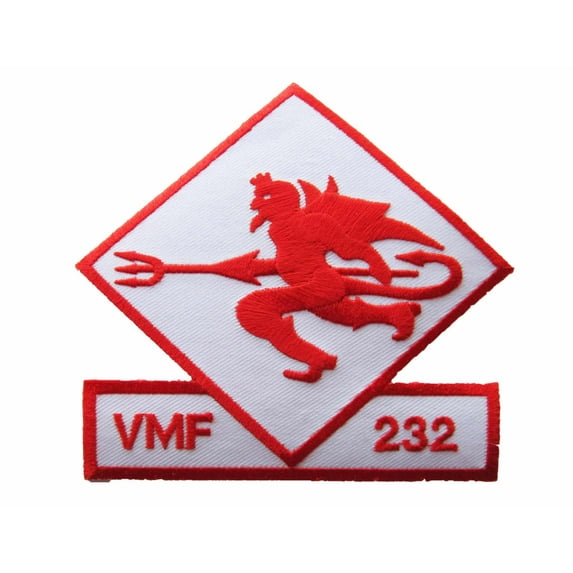
VMF-232 Red Devils Patch– Sew On
Marines and collectors! Enjoy this beautifully embroidered VMF-232 Red Devils Patch. You’ll be able to display this patch proudly!
- 4 inch
- US Veteran-Owned Business
- Embroidered / Sew On
- Reproduction
Marine Fighter Attack Squadron 232 (VMFA-232) is a United States Marine Corps F/A-18 Hornet squadron. Nicknamed the “Red Devils”, the squadron is based at Marine Corps Air Station Miramar, California and fall under the command of Marine Aircraft Group 11 (MAG-11) and the 3rd Marine Aircraft Wing (3rd MAW). The Red Devils are the oldest and most decorated fighter squadron in the Marine Corps.
History
The early years
VMFA-232 can trace its lineage back to VF-3M, which was commissioned on September 1, 1925, at Naval Air Station San Diego, California.[1] Originally equipped with Vought VE-7s, the squadron received three of the new Boeing FB-1s in the first part of 1926, allowing them to operate one division of modern aircraft while retaining the older VE-7s for training purposes. With the civil war in China threatening American interests, it was decided to deploy U.S. forces and in November and December 1926, seven additional FB-1s were transferred to VF-3M from VF-1M and VF-2M on the east coast, bringing the squadron’s complement to 10 FB-1s. As diplomacy and planning was taking place on the international level, the squadron concentrated on familiarizing itself with their new aircraft and training the influx of new pilots.
On April 7, 1927, VF-3M departed San Diego bound for China on the transport USS Henderson, but upon arrival, no airfield was available for operations. After waiting in the Philippines for almost two months, the squadron returned to China and eventually operated from airfields at Tientsin and Hsin-Ho, where they supported the 3rd Brigade. Shortly after setting up camp and starting flight operations, the squadron was redesignated VF-10M on July 1, 1927, the first of many changes in designation caused by the reorganization of naval aviation assets. The mission to China demonstrated that Marine Aviation was vital to the expeditionary role Marine forces were called on to perform and the squadron performed photography, mapping and reconnaissance missions while deployed. Another change in designation occurred while the squadron was still in China, when on July 1, 1928, the squadron was redesignated VF-6M. With its mission in China completed, the squadron withdrew on October 3, 1928, arriving back at San Diego on October 31, 1928, after stops at Guam and Hawaii.
With its return to San Diego, most of the squadron’s personnel were transferred to other units and the next year was spent re-organizing and training new personnel as they arrived. In addition to new pilots, several Boeing FB-5s were assigned to the squadron in 1929, the last of the in-line aircraft to be used by Marine squadrons. On July 1, 1930 the squadron was again re-designated, this time reverting to VF-10M, but the most noticeable change was the replacement of the FB-5s with Curtiss F6C-4s, the first radial engine fighters the squadron would be assigned. The squadron would operate the F6C-4s for over two years and be awarded the Herbert H. Schiff Cup for aviation safety before they were replaced by factory-fresh Boeing F4B-4s in late 1932, the most advanced biplane fighter in service at that time.
In 1932, it was determined that Marine Aviation should be provided with two light bombing squadrons, and on July 1, 1933, VF-10M became VB-4M, and was re-equipped with Boeing F4B-3s, a move considered a step back by members of the squadron. Participation in the Los Angeles National Air Races and annual Fleet Exercises were part of the routine that marked the squadron’s activity in the early 1930s. In 1935, the squadron received 16 Great Lakes BG-1s, large two-place dive bombers that would equip the squadron for over f

 Pickup or delivery?