

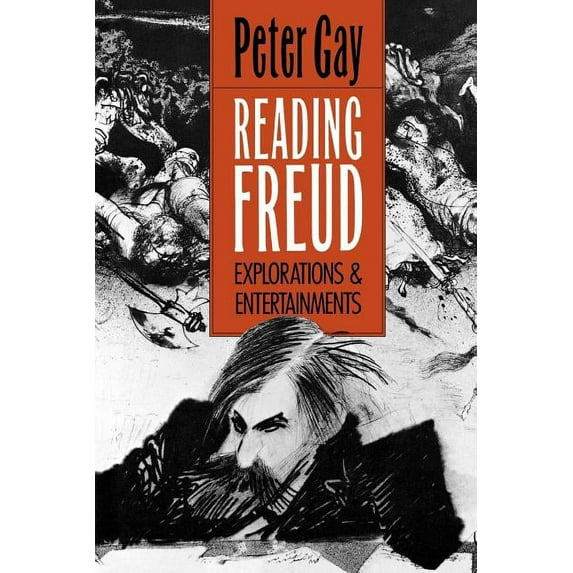
Hero image 0 of Reading Freud : Explorations and Entertainments (Paperback), 0 of 1
Reading Freud : Explorations and Entertainments (Paperback)
(No ratings yet)
Key item features
“As every biographer of Freud must ruefully acknowledge, Freud, that great unriddler of mysteries, left behind some intriguing private mysteries of his own. It was because I hoped to solve some of these mysteries that the stratagem of finding my way to Freud by indirections commended itself to me.” –Peter Gay
In this book, the eminent cultural historian and Freud scholar Peter Gay presents a series of essays in which he tries to “reduce the blank spots on the map we now have of Freud’s mind.” Engaging as well as illuminating, the essays range from reflections on Freud and Shakespeare to Gay’s controversial spoof review of Freud’s The Interpretation of Dreams.
The book begins with “Freud and the Man from Stratford,” in which Gay describes Freud’s fascination with the theory that the Earl of Oxford was the real author of the plays attributed to Shakespeare and speculates on the reasons for Freud’s belief. “Six Names in Search of an interpretation” considers Freud’s choices of names for his six children and what they revealed about his Jewishness, his love of science, and his ambivalent feelings toward his father. “Freud on Freedom” deals with the issue of determinism and free will in Freud’s work. “Reading Freud through Freud’s Reading” analyzes ten “good” books Freud identified in response to a questionnaire.
The second half of the book, entitled “Entertainments,” includes an essay on “Serious Jests” that cites some vintage Jewish jokes frequently recounted by Freud and points out how these chestnuts illustrate not only psychoanalytic concepts but the anti-Semitism that permeated Freud’s Vienna; the “review” of The Interpretation of Dreams, published in Harper’s in 1981; “A Gentile Science?” which is a “report” on the work of one Sigmund Oberhufer, a fictitious Austrian doctor said to have “invented” psychoanalysis; and “The Dog That Did Not Bark in the Night,” Gay’s account of the newly accessible correspondence between Freud and his sister-in-law Minna Bernays, who some writers claim was his lover. The essays, some of them published for the first time or expanded from their original versions, are accompanied by informative introductions.
In this book, the eminent cultural historian and Freud scholar Peter Gay presents a series of essays in which he tries to “reduce the blank spots on the map we now have of Freud’s mind.” Engaging as well as illuminating, the essays range from reflections on Freud and Shakespeare to Gay’s controversial spoof review of Freud’s The Interpretation of Dreams.
The book begins with “Freud and the Man from Stratford,” in which Gay describes Freud’s fascination with the theory that the Earl of Oxford was the real author of the plays attributed to Shakespeare and speculates on the reasons for Freud’s belief. “Six Names in Search of an interpretation” considers Freud’s choices of names for his six children and what they revealed about his Jewishness, his love of science, and his ambivalent feelings toward his father. “Freud on Freedom” deals with the issue of determinism and free will in Freud’s work. “Reading Freud through Freud’s Reading” analyzes ten “good” books Freud identified in response to a questionnaire.
The second half of the book, entitled “Entertainments,” includes an essay on “Serious Jests” that cites some vintage Jewish jokes frequently recounted by Freud and points out how these chestnuts illustrate not only psychoanalytic concepts but the anti-Semitism that permeated Freud’s Vienna; the “review” of The Interpretation of Dreams, published in Harper’s in 1981; “A Gentile Science?” which is a “report” on the work of one Sigmund Oberhufer, a fictitious Austrian doctor said to have “invented” psychoanalysis; and “The Dog That Did Not Bark in the Night,” Gay’s account of the newly accessible correspondence between Freud and his sister-in-law Minna Bernays, who some writers claim was his lover. The essays, some of them published for the first time or expanded from their original versions, are accompanied by informative introductions.
Specs
- Book formatPaperback
- Fiction/nonfictionNon-Fiction
- GenreBiography & Memoirs
- Publication dateJuly, 1991
- Pages240
- SubgenreGeneral
Current price is USD$34.00
Price when purchased online
 Free 90-day returns
How do you want your item?
Try 30 days for just $1! Choose a plan at checkout.
Ships to
Arrives by Thu, May 21
Sold and shipped by Walmart.com

Free 90-day returns

This item is gift eligible
More seller options (2)
Starting from $43.27

Try 30 days of Walmart+ for just $1!
T&C apply. Claim offer now
About this item
Product details
"As every biographer of Freud must ruefully acknowledge, Freud, that great unriddler of mysteries, left behind some intriguing private mysteries of his own. It was because I hoped to solve some of these mysteries that the stratagem of finding my way to Freud by indirections commended itself to me." -Peter Gay
In this book, the eminent cultural historian and Freud scholar Peter Gay presents a series of essays in which he tries to "reduce the blank spots on the map we now have of Freud's mind." Engaging as well as illuminating, the essays range from reflections on Freud and Shakespeare to Gay's controversial spoof review of Freud's The Interpretation of Dreams.
The book begins with "Freud and the Man from Stratford," in which Gay describes Freud's fascination with the theory that the Earl of Oxford was the real author of the plays attributed to Shakespeare and speculates on the reasons for Freud's belief. "Six Names in Search of an interpretation" considers Freud's choices of names for his six children and what they revealed about his Jewishness, his love of science, and his ambivalent feelings toward his father. "Freud on Freedom" deals with the issue of determinism and free will in Freud's work. "Reading Freud through Freud's Reading" analyzes ten "good" books Freud identified in response to a questionnaire.
The second half of the book, entitled "Entertainments," includes an essay on "Serious Jests" that cites some vintage Jewish jokes frequently recounted by Freud and points out how these chestnuts illustrate not only psychoanalytic concepts but the anti-Semitism that permeated Freud's Vienna; the "review" of The Interpretation of Dreams, published in Harper's in 1981; "A Gentile Science?" which is a "report" on the work of one Sigmund Oberhufer, a fictitious Austrian doctor said to have "invented" psychoanalysis; and "The Dog That Did Not Bark in the Night," Gay's account of the newly accessible correspondence between Freud and his sister-in-law Minna Bernays, who some writers claim was his lover. The essays, some of them published for the first time or expanded from their original versions, are accompanied by informative introductions.
In this book, the eminent cultural historian and Freud scholar Peter Gay presents a series of essays in which he tries to "reduce the blank spots on the map we now have of Freud's mind." Engaging as well as illuminating, the essays range from reflections on Freud and Shakespeare to Gay's controversial spoof review of Freud's The Interpretation of Dreams.
The book begins with "Freud and the Man from Stratford," in which Gay describes Freud's fascination with the theory that the Earl of Oxford was the real author of the plays attributed to Shakespeare and speculates on the reasons for Freud's belief. "Six Names in Search of an interpretation" considers Freud's choices of names for his six children and what they revealed about his Jewishness, his love of science, and his ambivalent feelings toward his father. "Freud on Freedom" deals with the issue of determinism and free will in Freud's work. "Reading Freud through Freud's Reading" analyzes ten "good" books Freud identified in response to a questionnaire.
The second half of the book, entitled "Entertainments," includes an essay on "Serious Jests" that cites some vintage Jewish jokes frequently recounted by Freud and points out how these chestnuts illustrate not only psychoanalytic concepts but the anti-Semitism that permeated Freud's Vienna; the "review" of The Interpretation of Dreams, published in Harper's in 1981; "A Gentile Science?" which is a "report" on the work of one Sigmund Oberhufer, a fictitious Austrian doctor said to have "invented" psychoanalysis; and "The Dog That Did Not Bark in the Night," Gay's account of the newly accessible correspondence between Freud and his sister-in-law Minna Bernays, who some writers claim was his lover. The essays, some of them published for the first time or expanded from their original versions, are accompanied by informative introductions.
“As every biographer of Freud must ruefully acknowledge, Freud, that great unriddler of mysteries, left behind some intriguing private mysteries of his own. It was because I hoped to solve some of these mysteries that the stratagem of finding my way to Freud by indirections commended itself to me.” –Peter Gay
In this book, the eminent cultural historian and Freud scholar Peter Gay presents a series of essays in which he tries to “reduce the blank spots on the map we now have of Freud’s mind.” Engaging as well as illuminating, the essays range from reflections on Freud and Shakespeare to Gay’s controversial spoof review of Freud’s The Interpretation of Dreams.
The book begins with “Freud and the Man from Stratford,” in which Gay describes Freud’s fascination with the theory that the Earl of Oxford was the real author of the plays attributed to Shakespeare and speculates on the reasons for Freud’s belief. “Six Names in Search of an interpretation” considers Freud’s choices of names for his six children and what they revealed about his Jewishness, his love of science, and his ambivalent feelings toward his father. “Freud on Freedom” deals with the issue of determinism and free will in Freud’s work. “Reading Freud through Freud’s Reading” analyzes ten “good” books Freud identified in response to a questionnaire.
The second half of the book, entitled “Entertainments,” includes an essay on “Serious Jests” that cites some vintage Jewish jokes frequently recounted by Freud and points out how these chestnuts illustrate not only psychoanalytic concepts but the anti-Semitism that permeated Freud’s Vienna; the “review” of The Interpretation of Dreams, published in Harper’s in 1981; “A Gentile Science?” which is a “report” on the work of one Sigmund Oberhufer, a fictitious Austrian doctor said to have “invented” psychoanalysis; and “The Dog That Did Not Bark in the Night,” Gay’s account of the newly accessible correspondence between Freud and his sister-in-law Minna Bernays, who some writers claim was his lover. The essays, some of them published for the first time or expanded from their original versions, are accompanied by informative introductions.
In this book, the eminent cultural historian and Freud scholar Peter Gay presents a series of essays in which he tries to “reduce the blank spots on the map we now have of Freud’s mind.” Engaging as well as illuminating, the essays range from reflections on Freud and Shakespeare to Gay’s controversial spoof review of Freud’s The Interpretation of Dreams.
The book begins with “Freud and the Man from Stratford,” in which Gay describes Freud’s fascination with the theory that the Earl of Oxford was the real author of the plays attributed to Shakespeare and speculates on the reasons for Freud’s belief. “Six Names in Search of an interpretation” considers Freud’s choices of names for his six children and what they revealed about his Jewishness, his love of science, and his ambivalent feelings toward his father. “Freud on Freedom” deals with the issue of determinism and free will in Freud’s work. “Reading Freud through Freud’s Reading” analyzes ten “good” books Freud identified in response to a questionnaire.
The second half of the book, entitled “Entertainments,” includes an essay on “Serious Jests” that cites some vintage Jewish jokes frequently recounted by Freud and points out how these chestnuts illustrate not only psychoanalytic concepts but the anti-Semitism that permeated Freud’s Vienna; the “review” of The Interpretation of Dreams, published in Harper’s in 1981; “A Gentile Science?” which is a “report” on the work of one Sigmund Oberhufer, a fictitious Austrian doctor said to have “invented” psychoanalysis; and “The Dog That Did Not Bark in the Night,” Gay’s account of the newly accessible correspondence between Freud and his sister-in-law Minna Bernays, who some writers claim was his lover. The essays, some of them published for the first time or expanded from their original versions, are accompanied by informative introductions.
info:
We aim to show you accurate product information. Manufacturers, suppliers and others provide what you see here, and we have not verified it.
Specifications
Book format
Paperback
Fiction/nonfiction
Non-Fiction
Genre
Biography & Memoirs
Publication date
July, 1991
Warranty
Warranty information
Please be aware that the warranty terms on items offered for sale by third party Marketplace sellers may differ from those displayed in this section (if any). To confirm warranty terms on an item offered for sale by a third party Marketplace seller, please use the 'Contact seller' feature on the third party Marketplace seller's information page and request the item's warranty terms prior to purchase.
Customer ratings & reviews
0 ratings|0 reviews
This item does not have any reviews yet

Related pages
- Greener Future
- Collapsed Building
- Apologia Physical Science 4th Edition
- Mercantile Building
- 1612 Project
- Build Your Kingdom
- Fire Science Technology & Engineering Books
- Enology & Viticulture Books
- Individual Architects & Firms Books
- Public, Commercial & Industrial Books
- Flood Control Technology & Engineering Books
- Military Science Books