

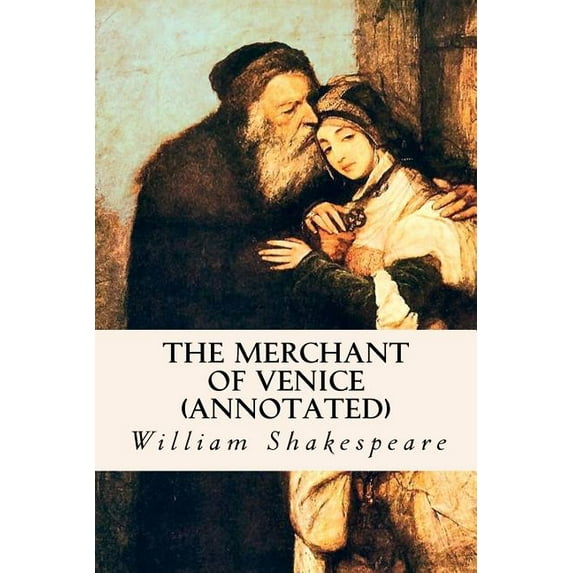
The Merchant of Venice (annotated) (Paperback)
(No ratings yet)
Key item features
The Merchant of Venice (annotated) (Paperback)
Specs
- Book formatPaperback
- Fiction/nonfictionNon-Fiction
- GenreLiterature & Fiction
- Publication dateMarch, 2016
- Pages108
- SubgenreDrama
Current price is USDNow $6.87
You save $2.34
was $9.21$9.21
You save$2.34
Price when purchased online
 Free 30-day returns
How do you want your item?
Ships to
Arrives by Thu, May 21
|Shipping fee $7.98

Sold and shipped by Best Prices & Service
4.350746268656716 stars out of 5, based on 268 seller reviews(4.4)268 seller reviews

Free 30-day returns
About this item
Product details
The Merchant of Venice is a 16th-century comedic play by William Shakespeare in which a merchant in Venice must default on a large loan provided by a Jewish moneylender. It is believed to have been written between 1596 and 1599. Though classified as a comedy in the First Folio and sharing certain aspects with Shakespeare's other romantic comedies, the play is most remembered for its dramatic scenes, and it is best known for Shylock and the famous "Hath not a Jew eyes?" speech on humanity. Also notable is Portia's speech about "the quality of mercy". Critic Harold Bloom listed it among Shakespeare's great comedies. Bassanio, a young Venetian of noble rank, wishes to woo the beautiful and wealthy heiress Portia of Belmont. Having squandered his estate, he needs 3,000 ducats to subsidise his expenditures as a suitor. Bassanio approaches his friend Antonio, a wealthy merchant of Venice who has previously and repeatedly bailed him out. Antonio agrees, but since he is cash-poor - his ships and merchandise are busy at sea to Tripolis, the Indies, Mexico and England - he promises to cover a bond if Bassanio can find a lender, so Bassanio turns to the Jewish moneylender Shylock and names Antonio as the loan's guarantor. Antonio has already antagonized Shylock through his outspoken antisemitism, and because Antonio's habit of lending money without interest forces Shylock to charge lower rates. Shylock is at first reluctant to grant the loan, citing abuse he has suffered at Antonio's hand. He finally agrees to lend the sum to Bassanio without interest upon one condition: if Antonio is unable to repay it at the specified date, Shylock may take a pound of Antonio's flesh. Bassanio does not want Antonio to accept such a risky condition; Antonio is surprised by what he sees as the moneylender's generosity (no "usance" - interest - is asked for), and he signs the contract. With money at hand, Bassanio leaves for Belmont with his friend Gratiano, who has asked to accompany him. Gratiano is a likeable young man, but is often flippant, overly talkative, and tactless. Bassanio warns his companion to exercise self-control, and the two leave for Belmont. English society in the Elizabethan era has been described as "judeophobic". English Jews had been expelled under Edward I in 1290 and were not permitted to return until 1656 under the rule of Oliver Cromwell. In Venice and in some other places, Jews were required to wear a red hat at all times in public to make sure that they were easily identified, and had to live in a ghetto protected by Christian guards. Shakespeare's play may be seen as a continuation of this tradition. The title page of the Quarto indicates that the play was sometimes known as The Jew of Venice in its day, which suggests that it was seen as similar to Marlowe's The Jew of Malta. One interpretation of the play's structure is that Shakespeare meant to contrast the mercy of the main Christian characters with the vengefulness of a Jew, who lacks the religious grace to comprehend mercy. Similarly, it is possible that Shakespeare meant Shylock's forced conversion to Christianity to be a "happy ending" for the character, as, to a Christian audience, it saves his soul and allows him to enter Heaven.[11] Regardless of what Shakespeare's authorial intent may have been, the play has been made use of by antisemites throughout the play's history. The Nazis used the usurious Shylock for their propaganda. Shortly after Kristallnacht in 1938, The Merchant of Venice was broadcast for propagandistic ends over the German airwaves. Productions of the play followed in Lübeck (1938), Berlin (1940), and elsewhere within the Nazi territory. Many modern readers and theatregoers have read the play as a plea for tolerance, noting that Shylock is a sympathetic character. They cite as evidence that Shylock's "trial" at the end of the play is a mockery of justice, with Portia acting as a judge when she has no right to do so.
The Merchant of Venice (annotated) (Paperback)
info:
We aim to show you accurate product information. Manufacturers, suppliers and others provide what you see here, and we have not verified it.
Specifications
Book format
Paperback
Fiction/nonfiction
Non-Fiction
Genre
Literature & Fiction
Publication date
March, 2016
Warranty
Warranty information
Please be aware that the warranty terms on items offered for sale by third party Marketplace sellers may differ from those displayed in this section (if any). To confirm warranty terms on an item offered for sale by a third party Marketplace seller, please use the 'Contact seller' feature on the third party Marketplace seller's information page and request the item's warranty terms prior to purchase.
Customer ratings & reviews
0 ratings|0 reviews
This item does not have any reviews yet
