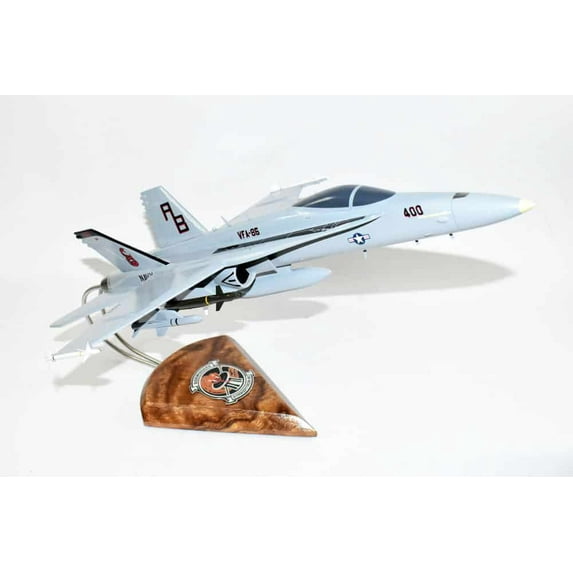
VFA-86 Sidewinders USS America 1989 FA-18C Model Fly with the VFA-86 Sidewinders USS America 1989 in this hand-crafted F/A-18C model. Each piece is carved from wood and hand-painted to provide a piece you'll love! Length - 18 inches Made from Mahogany US Naval Aviator Owned Business The product is not intended to be used by children 12 years and younger. By CDR. John Leenhouts, USN - U.S. DefenseImagery [1] photo VIRIN: DN-SC-89-05116 [2], Strike Fighter Squadron 86 (VFA-86) is a strike fighter squadron of the United States Navy based at Naval Air Station Lemoore, California. The squadron is nicknamed Sidewinders, leading to the call sign Winder. The unit currently flies the F/A-18E Super Hornet and is assigned to Carrier Air Wing Seven, tail code AG. History 1950s Reserve Fighter Squadron 921 (VF-921) was called to active duty from NAS St. Louis on 1 February 1951, for the Korean War flying the F4U-4 Corsair. VF-921 was assigned to Carrier Air Wing Eight and deployed to the Mediterranean Sea aboard USS Tarawa, in 1951–52. On 4 February 1953, the squadron was redesignated Fighter Squadron 84 (VF-84), while deployed to Naval Station Guantanamo Bay, Cuba aboard USS Antietam. In June 1953, the squadron briefly flew the F8F-2 Bearcat in preparation for transition to the F9F-5 Panther in November 1953. The squadron's current "Sidewinder" name and insignia were adopted in April 1954. Flying the Panther, VF-84 was again deployed to the Mediterranean Sea aboard USS Lake Champlain from September 1954 to April 1955. On 1 July 1955 the squadron began flying the F7U-3M Cutlass, was redesignated Attack Squadron 86 (VA-86), and conducted extensive evaluation of the AIM-7 Sparrow missile. VA-86 was deployed with the F7U only for the shakedown cruise of USS Forrestal, being assigned to Air Task Group 181. From May 1957 until 1967, the squadron was assigned to Carrier Air Wing Seven, being equipped with various marks of the A4D/A-4 Skyhawk. Between September 1958 and March 1959, VA-86 was deployed aboard USS Randolph, before CVW-7 was reassigned to the recently commissioned USS Independence. 1960s In April 1961 VA-86 operated from USS Independence near Guantanamo Bay, Cuba, during the Bay of Pigs Invasion. In November 1962, the squadron was assigned to Carrier Air Wing Three and embarked in USS Lexington during the Cuban Missile Crisis operating off the coast of Jacksonville, Florida. VA-86 was flying a mix of A-4Bs and A-4Cs, as the squadron was transitioning to the A-4C. In April–May 1963, VA-86 provided A-4C detachments aboard Atlantic Fleet anti-submarine carriers USS Essex, USS Randolph and USS Wasp. The aircraft were equipped with AIM-9 Sidewinder missiles to provide the carriers with anti-air warfare capability. From August 1963 to March 1964, VA-86 was again deployed with CVW-7 aboard USS Independence to the Mediterranean Sea. Following this deployment, the squadron transitioned to the A-4E. On 1 July 1965, the squadron conducted its first combat missions, flying from Independence against targets in South Vietnam. In 1966–67, VA-86 was back in the Mediterranean Sea aboard Independence. On 1 June 1967, VA-86 became the Navy's first operational Atlantic Fleet squadron to fly the A-7A Corsair II. VA-86 was reassigned to Carrier Air Wing Six and made another deployment to Vietnam aboard USS America. The squadron conducted its third South East Asia combat deployment aboard USS Coral Sea from September 1969 to July 1970 while being assigned to Carrier Air Wing Fifteen. In October 1970, VA-86 transitioned to the E model of the A-7. 1970s From 1971 to 1987, VA-86 was again assigned to CVW-8. In late spring of 1972, VA-86 was forced to transition to the A-7C due to unexpected problems with the A-7E's TF-41 engines. The squadron then deployed from June 1972 to March 1973 aboard USS America for a ten-month combat cruise, participating in several intense and lengthy bombing campaigns, including Operation Linebacker and Linebacker II in late-1972