

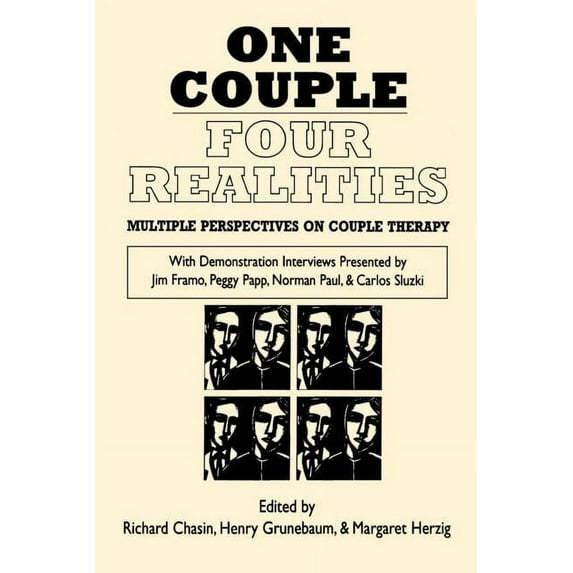
Hero image 0 of One Couple, Four Realities : Multiple Perspectives on Couple Therapy (Paperback), 0 of 1
One Couple, Four Realities : Multiple Perspectives on Couple Therapy (Paperback)
(No ratings yet)
Key item features
An outgrowth of an Harvard Medical School Couple Therapy Conference, this is the first book on couple and family therapy to combine a range of clinical theories with a single case discussion. At the conference, Jim Framo, Peggy Papp, Norman Paul, and Carlos Sluzki--therapists well-known for their differing styles and theoretical persuasions--described and explained the sessions they each conducted with the same couple. These sessions varied greatly: each has a distinctive focus; two included family of origin members; one involved a co-therapist. Later, other therapists, representing an even broader range of perspectives, discussed their viewpoints and speculated how they might have approached the same case.
In ONE COUPLE, FOUR REALITIES: MULTIPLE PERSPECTIVES ON COUPLE THERAPY, the experience of attending this conference is recreated and expanded. The reader is first given the same background information about the couple that was supplied to the interviewers and is then presented with edited transcripts and commentary by Framo, Papp, Paul, and Sluzki about their own sessions. Further perspectives and approaches to the case are provided by a number of other teachers of therapy. Thus, the reader is invited to view the couple from over a dozen different perspectives, including psychodynamic, object relations, systemic, behavioral, feminist, contextual, and eclectic orientations.
Perhaps the most fascinating perspective is provided by the couple, "Larry'' and "Jennifer,'' who, in the last section of the book, detail their reactions to the four demonstration sessions. Their stunningly candid and intelligent accounts, given soon after the original interviews, and then again six years later, provide a compelling conclusion to the book.
Most published cases are selected retrospectively to illustrate the power of the author's approach. By contrast, this couple was selected in advance: their case, ongoing at the time in a Boston clinic, seemed suitable for the demonstration interviews to be videotaped for the Harvard conference. The couple was bright and engaging. They and their families of origin were willing to participate. The interviewers agreed to document the sessions no matter how they turned out. This prospective method of case selection lent authenticity to the interviews, permitting the viewers, and now the reader, to witness clinical work as it might unfold in the office of any therapist.
This volume is not intended to and does not demonstrate the superiority of one approach over another. Each of the four demonstration interviews represents careful, conscientious work, and each leads to a different ``reality'' about the couple. Only in a volume such as this can one see in high relief what each approach brings to light and what each obscures.
All therapists interested in couples should find this book useful, as it stimulates readers to scrutinize their own theories and practices, consider how they might have approached Larry and Jennifer, and ponder what their own viewpoint may have caused them to overlook. Clinicians will appreciate the theoretical discussions and case analyses. The book is a natural supplemental text for courses in couple or family therapy. Teachers may learn much from the appendix which addresses ethical and therapeutic aspects of using videotaped demonstration interviews--important issues that have been neglected in the professional literature. The book may also have personal resonance for non-professionals interested in exploring the complexity of one couple's relationship. All will find ONE COUPLE, FOUR REALITIES accessible and thought-provoking. Through the lives of "Larry'' and "Jennifer,'' it addresses timeless and timely questions about the personal, familial, and cultural forces that create, shape, and strain the bonds that hold couples together.
In ONE COUPLE, FOUR REALITIES: MULTIPLE PERSPECTIVES ON COUPLE THERAPY, the experience of attending this conference is recreated and expanded. The reader is first given the same background information about the couple that was supplied to the interviewers and is then presented with edited transcripts and commentary by Framo, Papp, Paul, and Sluzki about their own sessions. Further perspectives and approaches to the case are provided by a number of other teachers of therapy. Thus, the reader is invited to view the couple from over a dozen different perspectives, including psychodynamic, object relations, systemic, behavioral, feminist, contextual, and eclectic orientations.
Perhaps the most fascinating perspective is provided by the couple, "Larry'' and "Jennifer,'' who, in the last section of the book, detail their reactions to the four demonstration sessions. Their stunningly candid and intelligent accounts, given soon after the original interviews, and then again six years later, provide a compelling conclusion to the book.
Most published cases are selected retrospectively to illustrate the power of the author's approach. By contrast, this couple was selected in advance: their case, ongoing at the time in a Boston clinic, seemed suitable for the demonstration interviews to be videotaped for the Harvard conference. The couple was bright and engaging. They and their families of origin were willing to participate. The interviewers agreed to document the sessions no matter how they turned out. This prospective method of case selection lent authenticity to the interviews, permitting the viewers, and now the reader, to witness clinical work as it might unfold in the office of any therapist.
This volume is not intended to and does not demonstrate the superiority of one approach over another. Each of the four demonstration interviews represents careful, conscientious work, and each leads to a different ``reality'' about the couple. Only in a volume such as this can one see in high relief what each approach brings to light and what each obscures.
All therapists interested in couples should find this book useful, as it stimulates readers to scrutinize their own theories and practices, consider how they might have approached Larry and Jennifer, and ponder what their own viewpoint may have caused them to overlook. Clinicians will appreciate the theoretical discussions and case analyses. The book is a natural supplemental text for courses in couple or family therapy. Teachers may learn much from the appendix which addresses ethical and therapeutic aspects of using videotaped demonstration interviews--important issues that have been neglected in the professional literature. The book may also have personal resonance for non-professionals interested in exploring the complexity of one couple's relationship. All will find ONE COUPLE, FOUR REALITIES accessible and thought-provoking. Through the lives of "Larry'' and "Jennifer,'' it addresses timeless and timely questions about the personal, familial, and cultural forces that create, shape, and strain the bonds that hold couples together.
Specs
- Book formatPaperback
- Fiction/nonfictionNon-Fiction
- Pub date1992-03-01
- Pages420
- SubgenrePsychotherapy
- Number in series0
Current price is USD$51.80
Price when purchased online
- Free shipping
 Free 30-day returns
How do you want your item?
Columbus, 43215
Arrives between Apr 20 - Apr 23
|
Sold and shipped by Alibris Books
4.565084084363096 stars out of 5, based on 10763 seller reviews(4.6)10763 seller reviews

Free 30-day returns
Other sellers
$56.99
+Free shippingShipping, arrives by Tue, Apr 21 to Columbus, 43215
Sold and shipped by thebookpros
Free 30-day returns
About this item
Product details
An outgrowth of an Harvard Medical School Couple Therapy Conference, this is the first book on couple and family therapy to combine a range of clinical theories with a single case discussion. At the conference, Jim Framo, Peggy Papp, Norman Paul, and Carlos Sluzki--therapists well-known for their differing styles and theoretical persuasions--described and explained the sessions they each conducted with the same couple. These sessions varied greatly: each has a distinctive focus; two included family of origin members; one involved a co-therapist. Later, other therapists, representing an even broader range of perspectives, discussed their viewpoints and speculated how they might have approached the same case. In ONE COUPLE, FOUR REALITIES: MULTIPLE PERSPECTIVES ON COUPLE THERAPY, the experience of attending this conference is recreated and expanded. The reader is first given the same background information about the couple that was supplied to the interviewers and is then presented with edited transcripts and commentary by Framo, Papp, Paul, and Sluzki about their own sessions. Further perspectives and approaches to the case are provided by a number of other teachers of therapy. Thus, the reader is invited to view the couple from over a dozen different perspectives, including psychodynamic, object relations, systemic, behavioral, feminist, contextual, and eclectic orientations. Perhaps the most fascinating perspective is provided by the couple, "Larry'' and "Jennifer, '' who, in the last section of the book, detail their reactions to the four demonstration sessions. Their stunningly candid and intelligent accounts, given soon after the original interviews, and then again six years later, provide a compelling conclusion to the book. Most published cases are selected retrospectively to illustrate the power of the author's approach. By contrast, this couple was selected in advance: their case, ongoing at the time in a Boston clinic, seemed suitable for the demonstration interviews to be videotaped for the Harvard conference. The couple was bright and engaging. They and their families of origin were willing to participate. The interviewers agreed to document the sessions no matter how they turned out. This prospective method of case selection lent authenticity to the interviews, permitting the viewers, and now the reader, to witness clinical work as it might unfold in the office of any therapist. This volume is not intended to and does not demonstrate the superiority of one approach over another. Each of the four demonstration interviews represents careful, conscientious work, and each leads to a different ``reality'' about the couple. Only in a volume such as this can one see in high relief what each approach brings to light and what each obscures. All therapists interested in couples should find this book useful, as it stimulates readers to scrutinize their own theories and practices, consider how they might have approached Larry and Jennifer, and ponder what their own viewpoint may have caused them to overlook. Clinicians will appreciate the theoretical discussions and case analyses. The book is a natural supplemental text for courses in couple or family therapy. Teachers may learn much from the appendix which addresses ethical and therapeutic aspects of using videotaped demonstration interviews--important issues that have been neglected in the professional literature. The book may also have personal resonance for non-professionals interested in exploring the complexity of one couple's relationship. All will find ONE COUPLE, FOUR REALITIES accessible and thought-provoking. Through the lives of "Larry'' and "Jennifer, '' it addresses timeless and timely questions about the personal, familial, and cultural forces
An outgrowth of an Harvard Medical School Couple Therapy Conference, this is the first book on couple and family therapy to combine a range of clinical theories with a single case discussion. At the conference, Jim Framo, Peggy Papp, Norman Paul, and Carlos Sluzki--therapists well-known for their differing styles and theoretical persuasions--described and explained the sessions they each conducted with the same couple. These sessions varied greatly: each has a distinctive focus; two included family of origin members; one involved a co-therapist. Later, other therapists, representing an even broader range of perspectives, discussed their viewpoints and speculated how they might have approached the same case.
In ONE COUPLE, FOUR REALITIES: MULTIPLE PERSPECTIVES ON COUPLE THERAPY, the experience of attending this conference is recreated and expanded. The reader is first given the same background information about the couple that was supplied to the interviewers and is then presented with edited transcripts and commentary by Framo, Papp, Paul, and Sluzki about their own sessions. Further perspectives and approaches to the case are provided by a number of other teachers of therapy. Thus, the reader is invited to view the couple from over a dozen different perspectives, including psychodynamic, object relations, systemic, behavioral, feminist, contextual, and eclectic orientations.
Perhaps the most fascinating perspective is provided by the couple, "Larry'' and "Jennifer,'' who, in the last section of the book, detail their reactions to the four demonstration sessions. Their stunningly candid and intelligent accounts, given soon after the original interviews, and then again six years later, provide a compelling conclusion to the book.
Most published cases are selected retrospectively to illustrate the power of the author's approach. By contrast, this couple was selected in advance: their case, ongoing at the time in a Boston clinic, seemed suitable for the demonstration interviews to be videotaped for the Harvard conference. The couple was bright and engaging. They and their families of origin were willing to participate. The interviewers agreed to document the sessions no matter how they turned out. This prospective method of case selection lent authenticity to the interviews, permitting the viewers, and now the reader, to witness clinical work as it might unfold in the office of any therapist.
This volume is not intended to and does not demonstrate the superiority of one approach over another. Each of the four demonstration interviews represents careful, conscientious work, and each leads to a different ``reality'' about the couple. Only in a volume such as this can one see in high relief what each approach brings to light and what each obscures.
All therapists interested in couples should find this book useful, as it stimulates readers to scrutinize their own theories and practices, consider how they might have approached Larry and Jennifer, and ponder what their own viewpoint may have caused them to overlook. Clinicians will appreciate the theoretical discussions and case analyses. The book is a natural supplemental text for courses in couple or family therapy. Teachers may learn much from the appendix which addresses ethical and therapeutic aspects of using videotaped demonstration interviews--important issues that have been neglected in the professional literature. The book may also have personal resonance for non-professionals interested in exploring the complexity of one couple's relationship. All will find ONE COUPLE, FOUR REALITIES accessible and thought-provoking. Through the lives of "Larry'' and "Jennifer,'' it addresses timeless and timely questions about the personal, familial, and cultural forces that create, shape, and strain the bonds that hold couples together.
In ONE COUPLE, FOUR REALITIES: MULTIPLE PERSPECTIVES ON COUPLE THERAPY, the experience of attending this conference is recreated and expanded. The reader is first given the same background information about the couple that was supplied to the interviewers and is then presented with edited transcripts and commentary by Framo, Papp, Paul, and Sluzki about their own sessions. Further perspectives and approaches to the case are provided by a number of other teachers of therapy. Thus, the reader is invited to view the couple from over a dozen different perspectives, including psychodynamic, object relations, systemic, behavioral, feminist, contextual, and eclectic orientations.
Perhaps the most fascinating perspective is provided by the couple, "Larry'' and "Jennifer,'' who, in the last section of the book, detail their reactions to the four demonstration sessions. Their stunningly candid and intelligent accounts, given soon after the original interviews, and then again six years later, provide a compelling conclusion to the book.
Most published cases are selected retrospectively to illustrate the power of the author's approach. By contrast, this couple was selected in advance: their case, ongoing at the time in a Boston clinic, seemed suitable for the demonstration interviews to be videotaped for the Harvard conference. The couple was bright and engaging. They and their families of origin were willing to participate. The interviewers agreed to document the sessions no matter how they turned out. This prospective method of case selection lent authenticity to the interviews, permitting the viewers, and now the reader, to witness clinical work as it might unfold in the office of any therapist.
This volume is not intended to and does not demonstrate the superiority of one approach over another. Each of the four demonstration interviews represents careful, conscientious work, and each leads to a different ``reality'' about the couple. Only in a volume such as this can one see in high relief what each approach brings to light and what each obscures.
All therapists interested in couples should find this book useful, as it stimulates readers to scrutinize their own theories and practices, consider how they might have approached Larry and Jennifer, and ponder what their own viewpoint may have caused them to overlook. Clinicians will appreciate the theoretical discussions and case analyses. The book is a natural supplemental text for courses in couple or family therapy. Teachers may learn much from the appendix which addresses ethical and therapeutic aspects of using videotaped demonstration interviews--important issues that have been neglected in the professional literature. The book may also have personal resonance for non-professionals interested in exploring the complexity of one couple's relationship. All will find ONE COUPLE, FOUR REALITIES accessible and thought-provoking. Through the lives of "Larry'' and "Jennifer,'' it addresses timeless and timely questions about the personal, familial, and cultural forces that create, shape, and strain the bonds that hold couples together.
info:
We aim to show you accurate product information. Manufacturers, suppliers and others provide what you see here, and we have not verified it.
Specifications
Book format
Paperback
Fiction/nonfiction
Non-Fiction
Genre
Political & Social Sciences
Pub date
1992-03-01
Warranty
Warranty information
Please be aware that the warranty terms on items offered for sale by third party Marketplace sellers may differ from those displayed in this section (if any). To confirm warranty terms on an item offered for sale by a third party Marketplace seller, please use the 'Contact seller' feature on the third party Marketplace seller's information page and request the item's warranty terms prior to purchase.
Warnings
State Chemical Disclosure
No harmful chemicals
Similar items you might like
Based on what customers bought
In 25+ people's carts Lights Out (Paperback) $8.90
In 25+ people's carts $890current price $8.90
Lights Out (Paperback)
2534.5 out of 5 Stars. 253 reviewsThe Phenomenology of Sex, Love, and Intimacy, (Paperback) $45.99
 $4599current price $45.99
The Phenomenology of Sex, Love, and Intimacy, (Paperback)
Close Relationships, (Paperback) $100.30
 $10030current price $100.30
Close Relationships, (Paperback)
Hochschultext Dampferzeugung: Verbrennung, Feuerung, Dampferzeuger, (Paperback) $56.39
 $5639current price $56.39
Hochschultext Dampferzeugung: Verbrennung, Feuerung, Dampferzeuger, (Paperback)
Great Sex for Hard Times, (Paperback) $22.20
 $2220current price $22.20
Great Sex for Hard Times, (Paperback)
Contemplative Beholding: A Way of Life and Love, (Paperback) $40.67
 $4067current price $40.67
Contemplative Beholding: A Way of Life and Love, (Paperback)
Marriage of Inconvenience (Paperback) $22.62
 $2262current price $22.62
Marriage of Inconvenience (Paperback)
Best seller The Coworker (Paperback) $9.46
Best seller $946current price $9.46
The Coworker (Paperback)
3314.8 out of 5 Stars. 331 reviewsThe Marriage Contract (Paperback) $30.75
 $3075current price $30.75
The Marriage Contract (Paperback)
Braving Uncertainty, (Paperback) $24.74
 $2474current price $24.74
Braving Uncertainty, (Paperback)
Love in Liquid Modernity: Rethinking Relationships, (Paperback) $9.99
 $999current price $9.99
Love in Liquid Modernity: Rethinking Relationships, (Paperback)
Last Chance Couple Therapy: Bringing Relationships Back from the Brink (Hardcover) $44.79
 $4479current price $44.79
Last Chance Couple Therapy: Bringing Relationships Back from the Brink (Hardcover)
The Philosophy of Love, Sex, and Relationships, (Paperback) $26.95
 $2695current price $26.95
The Philosophy of Love, Sex, and Relationships, (Paperback)
Case Conceptualization in Couple Therapy: Comparing and Contrasting Theories, (Paperback) $45.59
 $4559current price $45.59
Case Conceptualization in Couple Therapy: Comparing and Contrasting Theories, (Paperback)
Reach Out: Building Relationships That Actually Matter, (Paperback) $16.99
 $1699current price $16.99
Reach Out: Building Relationships That Actually Matter, (Paperback)
The Life and Times of Jim Bridger, (Paperback) $19.02
 $1902current price $19.02
The Life and Times of Jim Bridger, (Paperback)
28-4-22: My Perfect Partner, Opposites That Became One, (Paperback) $12.21
 $1221current price $12.21
28-4-22: My Perfect Partner, Opposites That Became One, (Paperback)
Couples Therapy: A Nontraditional Approach, (Paperback) $34.84
 $3484current price $34.84
Couples Therapy: A Nontraditional Approach, (Paperback)
THE FORGING OF US How Two Couples Transformed Crisis Into Connection, (Paperback) $19.99
 $1999current price $19.99
THE FORGING OF US How Two Couples Transformed Crisis Into Connection, (Paperback)

Customer ratings & reviews
0 ratings|0 reviews
This item does not have any reviews yet
