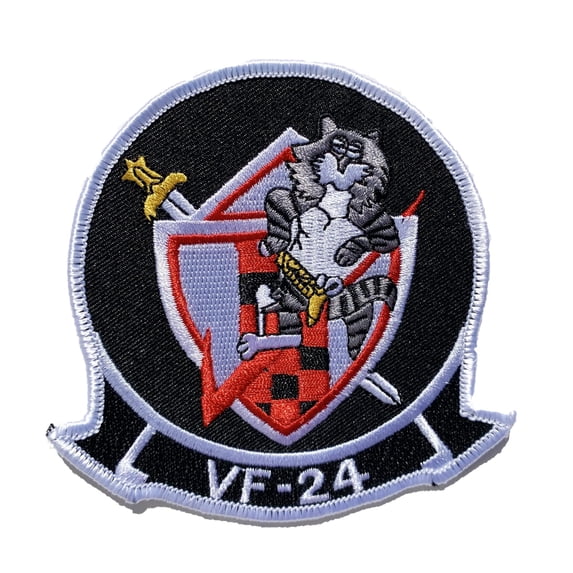
VF-24 Renegades Squadron Patch – Sew On Aviators! Are you looking for a high-quality patch you'll proudly wear or display? Look no further than the VF-24 Renegades Squadron Patch! 4.0 inch Embroidered US Naval Aviator Owned Business Sew On Plastic Backing increases rigidity, so the patch lasts longer and stays flat. Fighter Squadron 24 (VF-24), called the Fighting Renegades was a fighter squadron of the United States Navy. Originally established as Fighter Squadron 211 in June 1955, it was redesignated VF-24 on 9 March 1959 and disestablished on 31 August 1996. Background VF-211 was established in June 1955 at NAS Moffett Field. The unit flew the FJ-3 Fury aboard the USS Bon Homme Richard. The squadron transitioned to the F8U Crusader in 1957. History VF-24 made deployments to the Western Pacific aboard USS Midway, USS Bon Homme Richard and USS Hancock from 1959 to 1975. While on duty, the squadron earned the Presidential Unit Citation, Navy Unit Commendation (2 awards), Meritorious Unit Commendation (5 awards), Battle Efficiency Award (1972), Armed Forces Expeditionary Medal (3 awards), and Republic of Vietnam Campaign Medal. Vietnam War While deployed aboard Bon Homme Richard (Carrier Air Wing 21), Lieutenant Commander Bobby C. Lee and Lieutenant Phillip R. Wood became the first VF-24 pilots to shoot down MiG aircraft over North Vietnam on 19 May 1967. The MiGs were downed with AIM-9 Sidewinder air-to-air missiles. Then on 21 July 1967, Commander Marion H. Issacks (XO) and Lieutenant Commander Robert L. Kirkwood made the 3rd and 4th MiG kills for their Squadron with 20 mm guns and Sidewinder missiles. VF-24 became one of the Navy's first "Ace" squadrons. 1970s VF-24 made its last F-8 Crusader cruise aboard USS Hancock in 1975. Upon return to San Diego the Squadron transitioned to the F-14A Tomcat and received their first aircraft on 9 December 1975. VF-24 then changed the squadron name to "Fighting Renegades". During the rest of the 1970s and early 1990s, VF-24 deployed to the Western Pacific with USS Constellation. VF-24 won several awards: the Admiral Joseph Clifton Award, the Battle Efficiency “E”, the CNO Aviation Safety Award, and two Sea Service Deployment Awards. The Squadron clean record was completed with six years and 22.000 flight hours without an accident. 1980s Further records were made in 1980s. In 1983, VF-24 along with Carrier Air Wing Nine, was the assigned to the USS Ranger as part of Battle Group Echo. The first deployment by Central Americas operations and a WESTPAC which included 121 concurrent days of Indian Ocean Operations, the longest of any conventional powered aircraft carrier to date. The move to USS Ranger was because the Constellation had F/A-18 Hornet capability added and the Ranger cruise was nicknamed "DeathCruise '83/'84" due to the loss of 11 crewmen. In August 1984, VF-24 and its airwing began workups with the USS Kitty Hawk with another WESTPAC and Indian Ocean cruise in July 1985. In April 1986, VF-24 was called upon to execute Operation Coyote which involved positioning four fully mission capable F-14s, accompanying aircrew and over 150 maintenance personnel and necessary spare parts over 3,300 km (2,000 mi) away within 46 hours. From the time of execute order to go, aircraft were on deck in Adak, Alaska, in less than 30 hours. This fast paced, strategically significant mission continued for seven days, despite limited command and control assets and an extremely difficult environment at Adak. Mission intercepts, employing innovative planning and tactics, of Soviet reconnaissance aircraft were well beyond expected range and were determined to be an overwhelming success. In October 1986, VF-24 surpassed the 3 years foreign object damage (FOD) free mark; an accomplishment no other F-14 fighter squadron matched. VF-24 deployed in January 1987, aboard USS Kitty Hawk for a six-month around-the-world cruise. The Fighting Renegades were awarded the 1986 CNO Aviation Safety Award, completed ov