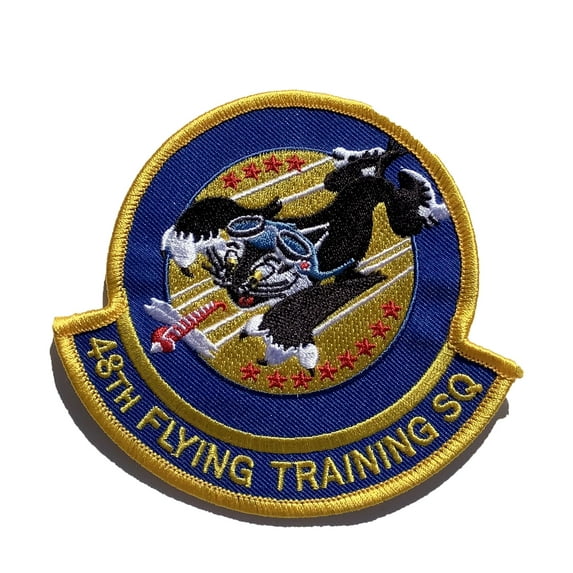
4 inch 48th Flying Training Squadron Patch – Sew On
The 48th Flying Training Squadron is part of the 14th Flying Training Wing based at Columbus Air Force Base, Mississippi. It operates T-1 Jayhawk aircraft conducting flight training. The squadron is one of the oldest in the Air Force, being formed during World War I as the 48th Aero Squadron on 4 August 1917.
Currently the squadron specializes in the tanker and airlift track of specialized undergraduate pilot training. Students receive at least 159 hours of flight instruction in the Raytheon T-1 Jayhawk where they learn air refueling procedures, tactical navigation, airdrop, and advanced navigation. Upon completion of this phase, students earn the aeronautical rating of pilot and receive their Air Force wings.[4]
World War I
The squadron’s origins date to 4 August 1917 with the formation of the 48th Aero Squadron at Kelly Field, Texas. It was organized into the first Aero construction squadron designated for deployment to the American Expeditionary Forces in France. After basic training at Kelly Field, the squadron was sent to the Aviation Concentration Center, Garden City, New York in mid-September 1917 for subsequent movement to France.[dubious – discuss] It embarked on the Cunard Liner SS Pannonia, suffering a stormy and unpleasant voyage across the Atlantic. It arrived at Liverpool, England on 29 October. After a few days in England, the squadron arrived at Rest Camp No. 2, Le Havre, France on 1 November.[5]
Formation of the 462d Aero Squadron, probably taken in Germany during the summer of 1919 just prior to its demobilization
The first meaningful work of the squadron was at the Third Aviation Instruction Center, Issoudun Aerodrome in Central France. It arrived on 3 November to help construct barracks and shops from lumber. It also erected hangars and did the necessary construction work to bring the airfield into an operational school for training pursuit (fighter) pilots. It also began work on six airfields to support the training school, building roads, putting up hangars, and installing water and electrical systems. A detachment of the squadron was sent to the Second Aviation Instruction Center, Tours Aerodrome. In doing this work, the squadron got the reputation of being one of the best, and fastest, all around construction squadrons in the AEF.[5]
In May 1918, the squadron was then reassigned to the First Army Air Service, and began constructing combat airfields to support the St. Mihiel Offensive. Throughout the year, it was moved from place to place, erecting hangars, constructing buildings and preparing airfields for use by Air Service planes. At Parois Aerodrome in the Meuse, it constructed 12 hangars and 23 barracks, the flying field being full of former trenches and shell holes that had to be filled in. During the Meuse-Argonne Offensive in early November, it moved to Buzancy to reconstruct a former German airfield that was littered with munitions and other hazardous materiel. However, the war ended on 11 November before the airfield could be put to use.[5]
After the armistice, the squadron was reassigned to the Third Army Air Service and moved to Trier Airdrome, Germany as part of the Army of Occupation. The former German Airfield there was prepared for seven American Aero Squadrons to use, which was done in less than a week. It then moved to Weißenthurm to construct another Aerodrome for Third Army. It remained in the Rhineland until the summer of 1919 until it was ordered, along with the Third Army Air Service to demobilized. After turning in all equipment at the 1st Air Depot at Colombey-les-Belles Aerodrome, the unit moved to a channel port where it boarded a troop ship, returning to the United States in August 1919. The men of the squadron were discharged and returned to civilian life.[5]
Inter-war period
The 48th School Squadron was activated in 1927 as part of the 11th School Group[dubious – discuss] at Kelly Fie