

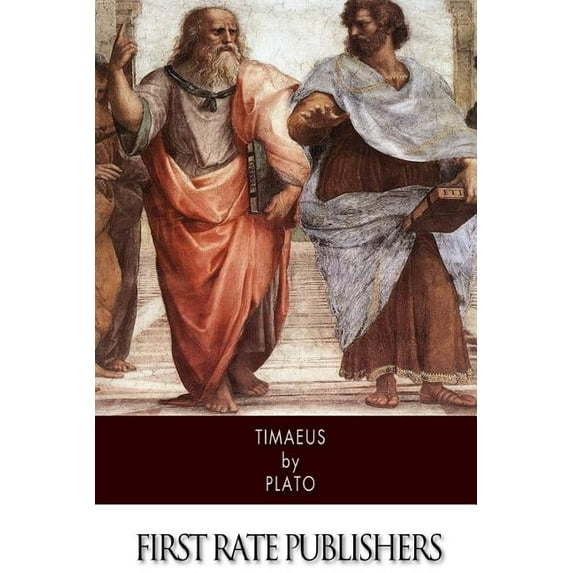
Timaeus
(No ratings yet)
Key item features
- Timaeus, (Paperback)
- Author: Createspace Independent Publishing Platform
- ISBN: 9781505227543
- Format: Paperback
- Publication Date: 2014-11-27
- Page Count: 126
Specs
- Book formatPaperback
- Fiction/nonfictionNon-Fiction
- Publication dateNovember, 2014
- Pages126
- Reading levelGeneral
- SubgenreHistory & Surveys
Current price is USD$5.99
Price when purchased online
 Free 90-day returns
How do you want your item?
Try 30 days for just $1! Choose a plan at checkout.
Ships to
Arrives by Sat, May 23
Sold and shipped by Walmart.com

Free 90-day returns

This item is gift eligible
More seller options (3)
Starting from $9.31

Try 30 days of Walmart+ for just $1!
T&C apply. Claim offer now
About this item
Product details
In 427 B.C., the Ancient Greek city-state of Athens was flourishing. Approximately 80 years earlier, the Athenians had formed the first self-representative democracy in history, the Peloponnesian War against Sparta had only just started, and Socrates was only beginning to lay the foundation of what would become Western philosophy. That year Plato was born to a wealthy family: with an uncle who was close friends with Socrates, Plato was seemingly destined to become a philosopher. By the end of his life, Plato had indeed become the foremost philosopher of his time, and perhaps the most famous philosopher in Western history. Like many males of the period, Plato served in the military and dreamed of a political career. And Plato did hold political office after the Peloponnesian War ended in 404 B.C., but around that time he also became a loyal follower of Socrates, who was teaching philosophy at an academy in Athens. None of Socrates' works survived antiquity, so most of what is known about him came from the writings of his followers, most notably Plato. What is known about Socrates is that he seemed to make a career out of philosophy, and Plato was intent on following in his footsteps. Yet for all of the influence of Socrates' life on Plato, it was Socrates' death around 399 B.C. that truly shaped him. Plato was so embittered by Socrates' trial in Athens that he completely soured on Athenian democracy, and he began to travel around the Mediterranean, studying topics like mathematics, honing his approach to philosophical thinking, and continuing to refine his philosophical beliefs. About a decade later, Plato returned to Athens and founded his famous Platonic Academy around 387 B.C., which he oversaw for 40 years until his death. One of Plato's philosophical beliefs was that writing down teachings was less valuable than passing them down orally, and several of Plato's writings are responses to previous writings of his, so Plato's personally held beliefs are hard to discern. However, Plato educated several subsequent philosophers, chief among them Aristotle, and his writings eventually formed the backbone of Western philosophy. Timaeus is one of Plato's dialogues, mostly in the form of a long monologue given by the title character, written circa 360 BC. The work puts forward speculation on the nature of the physical world and human beings. It is followed by the dialogue Critias. Speakers of the dialogue are Socrates, Timaeus of Locri, Hermocrates, and Critias. Some scholars believe that it is not the Critias of the Thirty Tyrants who is appearing in this dialogue, but his grandfather, who is also named Critias In the dialogues Timaeus and Critias, Plato discusses political philosophy and makes the first mention of the Lost City of Atlantis, which he described in Timaeus as "an island which was larger than Libya and Asia together." Plato continued, "Now in this island of Atlantis there existed a confederation of kings, of great and marvelous power, which held sway over all the island, and over many other islands also and parts of the continent." Plato wrote that Atlantis disappeared under the sea in a single day.
- Timaeus, (Paperback)
- Author: Createspace Independent Publishing Platform
- ISBN: 9781505227543
- Format: Paperback
- Publication Date: 2014-11-27
- Page Count: 126
info:
We aim to show you accurate product information. Manufacturers, suppliers and others provide what you see here, and we have not verified it.
Specifications
Book format
Paperback
Fiction/nonfiction
Non-Fiction
Genre
Political & Social Sciences
Publication date
November, 2014
Warranty
Warranty information
Please be aware that the warranty terms on items offered for sale by third party Marketplace sellers may differ from those displayed in this section (if any). To confirm warranty terms on an item offered for sale by a third party Marketplace seller, please use the 'Contact seller' feature on the third party Marketplace seller's information page and request the item's warranty terms prior to purchase.
Customer ratings & reviews
0 ratings|0 reviews
This item does not have any reviews yet
