

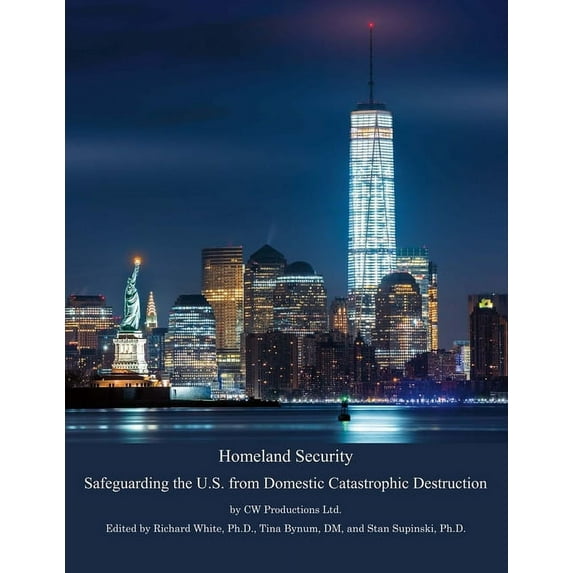
Hero image 0 of Homeland Security : Safeguarding the U.S. from Domestic Catastrophic Destruction (Paperback), 0 of 2
Homeland Security : Safeguarding the U.S. from Domestic Catastrophic Destruction (Paperback)
(No ratings yet)
Key item features
Welcome to the third edition of our textbook. As indicated by the new title, this edition is significantly different than the previous two, and accordingly stocked with mostly new material. Whereas the first two editions described “what” was being done in the name of homeland security, this one explains “why”. In keeping with our previous approach, we do not ascribe ourselves as “authors” but “editors” because the bulk of material is drawn directly from government documents, either primary sources or publicly available derivatives. Two of our foremost derivative sources were reports published by the Congressional Research Service (CRS) and Government Accountability Office (GAO). They have access to information, unclassified as it may be, well beyond the means of the general public. We would also like to acknowledge the many public websites that were also instrumental in completing this text. And while we were only “editors”, we think this book offers its own unique contributions to the field of homeland security. First, it delivers both a comprehensive yet concise treatment of a very broad subject spanning numerous separate fields, from national security to military operations to law enforcement to emergency management, to name only a few. Second, and most importantly, it offers insight into the exact nature of homeland security. Because it was brought to the forefront of national attention by an act of terrorism, homeland security has become confused with terrorism. While terrorism certainly remains a concern to homeland security, it is not the root concern. As we try to make eminently clear in this textbook, the homeland security concern predates 9/11, stemming back to the 1995 Tokyo Subway Attacks which saw the first employment of a weapon of mass destruction by non-state actors. As our title suggests, the homeland security concern is domestic catastrophic destruction. 9/11 demonstrated how it could be achieved by subverting critical infrastructure. Hurricane Katrina demonstrated how it could be accomplished without malicious intent. While we give due attention to the terrorist motive, we don’t give it the undue attention it has gained by becoming almost synonymous with homeland security. In this regard, we hope to set the record straight and make it clear what homeland security “is”, and what it “is not”. Homeland security is not terrorism, nor is it mass killings. While closely related, homeland security, terrorism, and mass killings are distinctly separate. We hope to demonstrate that in this book. More importantly, we hope to impart a clarity of understanding that will give you, the reader, a corresponding advantage in your academic and professional pursuits supported by this knowledge.
Specs
- Book formatPaperback
- Fiction/nonfictionNon-Fiction
- Pub date20160811
- Pages728
- Series titleHomeland Security
- Edition3rd Edition
Current price is USD$67.04
Price when purchased online
Out of stock
How do you want your item?
Out of stock
About this item
Product details
9781483574561. New condition. Trade paperback. Language: English. Pages: 728. Trade paperback (US). Glued binding. 728 p. Welcome to the third edition of our textbook. As indicated by the new title, this edition is significantly different than the previous two, and accordingly stocked with mostly new material. Whereas the first two editions described "what" was being done in the name of homeland security, this one explains "why". In keeping with our previous approach, we do not ascribe ourselves as "authors" but "editors" because the bulk of material is drawn directly from government documents, either primary sources or publicly available derivatives. Two of our foremost derivative sources were reports published by the Congressional Research Service (CRS) and Government Accountability Office (GAO). They have access to information, unclassified as it may be, well beyond the means of the general public. We would also like to acknowledge the many public websites that were also instrumental in completing this text. And while we were only "editors", we think this book offers its own unique contributions to the field of homeland security. First, it delivers both a comprehensive yet concise treatment of a very broad subject spanning numerous separate fields, from national security to military operations to law enforcement to emergency management, to name only a few. Second, and most importantly, it offers insight into the exact nature of homeland security. Because it was brought to the forefront of national attention by an act of terrorism, homeland security has become confused with terrorism. While terrorism certainly remains a concern to homeland security, it is not the root concern. As we try to make eminently clear in this textbook, the homeland security concern predates 9/11, stemming back to the 1995 Tokyo Subway Attacks which saw the first employment of a weapon of mass destruction by non-state actors. As our title suggests, the homeland security concern is domestic catastrophic destruction. 9/11 demonstrated how it could be achieved by subverting critical infrastructure. Hurricane Katrina demonstrated how it could be accomplished without malicious intent. While we give due attention to the terrorist motive, we don't give it the undue attention it has gained by becoming almost synonymous with homeland security. In this regard, we hope to set the record straight and make it clear what homeland security "is", and what it "is not". Homeland security is not terrorism, nor is it mass killings. While closely related, homeland security, terrorism, and mass killings are distinctly separate. We hope to demonstrate that in this book. More importantly, we hope to impart a clarity of understanding that will give you, the reader, a corresponding advantage in your academic and professional pursuits supported by this knowledge.
Welcome to the third edition of our textbook. As indicated by the new title, this edition is significantly different than the previous two, and accordingly stocked with mostly new material. Whereas the first two editions described “what” was being done in the name of homeland security, this one explains “why”. In keeping with our previous approach, we do not ascribe ourselves as “authors” but “editors” because the bulk of material is drawn directly from government documents, either primary sources or publicly available derivatives. Two of our foremost derivative sources were reports published by the Congressional Research Service (CRS) and Government Accountability Office (GAO). They have access to information, unclassified as it may be, well beyond the means of the general public. We would also like to acknowledge the many public websites that were also instrumental in completing this text. And while we were only “editors”, we think this book offers its own unique contributions to the field of homeland security. First, it delivers both a comprehensive yet concise treatment of a very broad subject spanning numerous separate fields, from national security to military operations to law enforcement to emergency management, to name only a few. Second, and most importantly, it offers insight into the exact nature of homeland security. Because it was brought to the forefront of national attention by an act of terrorism, homeland security has become confused with terrorism. While terrorism certainly remains a concern to homeland security, it is not the root concern. As we try to make eminently clear in this textbook, the homeland security concern predates 9/11, stemming back to the 1995 Tokyo Subway Attacks which saw the first employment of a weapon of mass destruction by non-state actors. As our title suggests, the homeland security concern is domestic catastrophic destruction. 9/11 demonstrated how it could be achieved by subverting critical infrastructure. Hurricane Katrina demonstrated how it could be accomplished without malicious intent. While we give due attention to the terrorist motive, we don’t give it the undue attention it has gained by becoming almost synonymous with homeland security. In this regard, we hope to set the record straight and make it clear what homeland security “is”, and what it “is not”. Homeland security is not terrorism, nor is it mass killings. While closely related, homeland security, terrorism, and mass killings are distinctly separate. We hope to demonstrate that in this book. More importantly, we hope to impart a clarity of understanding that will give you, the reader, a corresponding advantage in your academic and professional pursuits supported by this knowledge.
info:
We aim to show you accurate product information. Manufacturers, suppliers and others provide what you see here, and we have not verified it.
Specifications
Book format
Paperback
Fiction/nonfiction
Non-Fiction
Genre
Political & Social Sciences
Pub date
20160811
Warranty
Warranty information
Please be aware that the warranty terms on items offered for sale by third party Marketplace sellers may differ from those displayed in this section (if any). To confirm warranty terms on an item offered for sale by a third party Marketplace seller, please use the 'Contact seller' feature on the third party Marketplace seller's information page and request the item's warranty terms prior to purchase.
Similar items you might like
Based on what customers bought
U.S. Domestic and Transnational Terrorism: A Guide to Threats Without Borders, (Hardcover) $67.74
 $6774current price $67.74
U.S. Domestic and Transnational Terrorism: A Guide to Threats Without Borders, (Hardcover)
Valuing U.S. National Parks and Programs: America's Best Investment, (Paperback) $58.96
 $5896current price $58.96
Valuing U.S. National Parks and Programs: America's Best Investment, (Paperback)
Performance des projets de développement des circonscriptions au Kenya, (Paperback) $53.28
 $5328current price $53.28
Performance des projets de développement des circonscriptions au Kenya, (Paperback)
Historical Analysis of United States POW/MIA Repatriation and Remains Recovery, (Paperback) $57.95
 $5795current price $57.95
Historical Analysis of United States POW/MIA Repatriation and Remains Recovery, (Paperback)
Agroterrorism as a Potential Military Threat, (Paperback) $61.94
 $6194current price $61.94
Agroterrorism as a Potential Military Threat, (Paperback)
The Supreme Court in a Separation of Powers System: The Nation's Balance Wheel, (Paperback) $82.99
 $8299current price $82.99
The Supreme Court in a Separation of Powers System: The Nation's Balance Wheel, (Paperback)
Cass Series on Security Studies Power and the Purse: Economic Statecraft, Interdependence and National Security, (Paperback) $89.02
 $8902current price $89.02
Cass Series on Security Studies Power and the Purse: Economic Statecraft, Interdependence and National Security, (Paperback)
Applications of Information Systems to Homeland Security and Defense, (Hardcover) $66.26
 $6626current price $66.26
Applications of Information Systems to Homeland Security and Defense, (Hardcover)
Somalia Internal Conflict: A Threat to Security in the Horn of Africa, (Paperback) $25.08
 $2508current price $25.08
Somalia Internal Conflict: A Threat to Security in the Horn of Africa, (Paperback)
The Global Illusion of Citizen Protection: Transnational Threats and Human Security, (Paperback) $57.95
 $5795current price $57.95
The Global Illusion of Citizen Protection: Transnational Threats and Human Security, (Paperback)
New Advances in Crime and Social Harm Governing through Crime in South Africa: The Politics of Race and Class in Neoliberalizing Regimes, (Paperback) $72.99
 $7299current price $72.99
New Advances in Crime and Social Harm Governing through Crime in South Africa: The Politics of Race and Class in Neoliberalizing Regimes, (Paperback)
Conflict in the Horn of Africa: The Kenya-Somalia Border Problem 1941-2014, (Paperback) $77.45
 $7745current price $77.45
Conflict in the Horn of Africa: The Kenya-Somalia Border Problem 1941-2014, (Paperback)
Routledge Security in Asia China's Rise - Threat or Opportunity?, (Paperback) $62.99
 $6299current price $62.99
Routledge Security in Asia China's Rise - Threat or Opportunity?, (Paperback)
New Security Threats and Crises in Africa: Regional and International Perspectives, (Paperback) $60.29
 $6029current price $60.29
New Security Threats and Crises in Africa: Regional and International Perspectives, (Paperback)
Studies of the Americas Citizenship on the Margins: State Power, Security and Precariousness in 21st-Century Jamaica, (Paperback) $54.99
 $5499current price $54.99
Studies of the Americas Citizenship on the Margins: State Power, Security and Precariousness in 21st-Century Jamaica, (Paperback)
The U.S. Foreign Language Deficit: Strategies for Maintaining a Competitive Edge in a Globalized World, (Paperback) $56.14
 $5614current price $56.14
The U.S. Foreign Language Deficit: Strategies for Maintaining a Competitive Edge in a Globalized World, (Paperback)
Munk Global Affairs Stand on Guard: Reassessing Threats to Canada's National Security, (Paperback) $37.42
 $3742current price $37.42
Munk Global Affairs Stand on Guard: Reassessing Threats to Canada's National Security, (Paperback)
Root Cause Analysis (RCA) for the Improvement of Healthcare Systems and Patient Safety, (Paperback) $65.99
 $6599current price $65.99
Root Cause Analysis (RCA) for the Improvement of Healthcare Systems and Patient Safety, (Paperback)
Is America Safe?: Terrorism, Homeland Security, and Emergency Preparedness, (Paperback) $64.48
 $6448current price $64.48
Is America Safe?: Terrorism, Homeland Security, and Emergency Preparedness, (Paperback)
How to Think about Homeland Security How to Think about Homeland Security: Risk, Threats, and the New Normal: Volume 2, Book VOLUM, (Hardcover) $77.49
 $7749current price $77.49
How to Think about Homeland Security How to Think about Homeland Security: Risk, Threats, and the New Normal: Volume 2, Book VOLUM, (Hardcover)
Customer ratings & reviews
0 ratings|0 reviews
This item does not have any reviews yet
