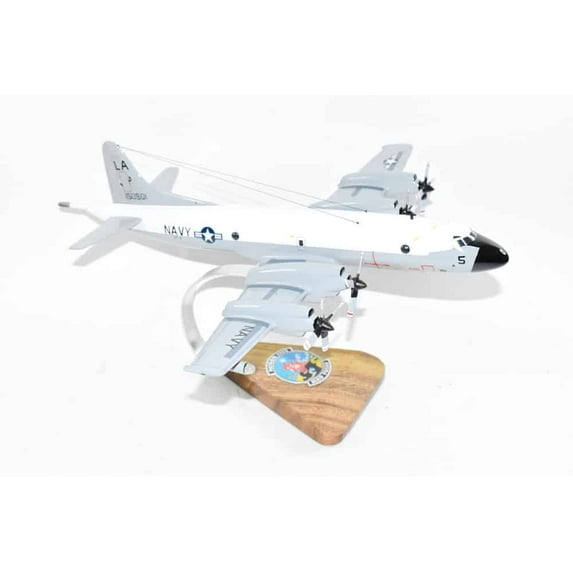
VP-5 Madfoxes P-3a (1967) Model Proudly display a VP-5 Madfoxes (1967) P-3a model and show your Naval Aviation legacy! Each model is carefully crafted from solid wood and meticulously painted to match vintage paint schemes. Length - 18 inches Width- 15 inches Made from Mahogany US Naval Aviator Owned Business Official Licensed by Lockheed Martin The product is not intended to be used by children 12 years and younger. LOCKHEED MARTIN®, associated emblems and logos, and body designs of vehicles are either registered trademarks or trademarks of Lockheed Martin Corporation in the USA and/or other jurisdictions, used under license by Squadron Nostalgia LLC. For over seven decades, the command now recognized as Patrol Squadron FIVE (VP-5) has served the cause of freedom. From ocean to ocean, the Sailors and aviators who comprised this squadron’s rolls helped build a record of Maritime Patrol Aviation (MPA) warfighting excellence and extraordinary professional achievement and service. Commissioned in 1937 and initially designated as VP-17, the Navy’s second oldest VP squadron flew and maintained the PM-1. In part because the squadron operated predominately out of Alaska and other Pacific Northwest sites, the first squadron patch depicted a seal balancing a bomb on its nose. In 1938, VP-17 transitioned to the new PBY-2 and continued to operate primarily in northern patrol zones. VP-17 changed designation to VP-42 in 1939 and two years later transitioned to the newer PBY-5. In 1942, the squadron again accepted a new aircraft, the amphibious-capable PBY-5A. During World War II, the squadron directly contributed to some of the earliest Allied victories in the Pacific theater. In February 1943, the Navy redesignated VP-42 as Bombing Squadron ONE THIRTY FIVE (VB-135) at Whidbey Island, Washington. Nicknamed the “Blind Fox” squadron reflecting the squadron’s method of flying “blind” through heavy weather, the squadron altered the patch to depict a fox riding a flying gas tank. In this classic patch, the blindfolded fox carried a bomb underneath one arm and with the opposite hand held a cane to assist in navigating through the clouds. This steely airmanship underpinned the squadron’s service in the “Kiska Blitz”, wherein Blind Foxes joined sister squadrons in persistent bombing of Kiska Harbor in advance of an anticipated August 1943 amphibious assault of Kiska Island in the Aleutians. Undeterred by enemy fire and extreme weather, squadron aviators typically approached the target area shrouded in clouds, executed a diving descent to release ordnance below the cloud deck, then raced back above the layer to escape ground fire. Operating from the Aleutian Island Amchitka, VB-135 flew 160 missions against the enemy, helping to hasten the Japanese abandonment of the island and obviate the need for a costly amphibious assault. In 1944, the squadron shifted to Attu Island to support photo-reconnaissance efforts aimed at unveiling Japanese activity in the Kurile Islands Following the war’s end, the squadron again received a new Lockheed aircraft, the PV-2 Harpoon. Peacetime brought significant force structure changes and in 1945, the Navy Department moved the squadron to Edenton, North Carolina, and then to Quonset Point, Rhode Island. Redesignated as VP-135 and then to Medium Patrol Squadron FIVE (VP-ML-5), the Blind Foxes relocated again in January 1947 to Roosevelt Roads, Puerto Rico, under operational control of Commander, Fleet Air Wing ELEVEN. In 1948, the squadron took inventory of its first Lockheed P2V Neptune, an aircraft equipped with Magnetic Anomaly Detection (MAD) equipment capable of detecting large magnetic objects underwater. The technology to detect submerged submarines through non-acoustic means facilitated a major capability leap in Anti-Submarine Warfare (ASW) and manifested itself not only in squadron operations but also in the evolution of the squadron name and patch. Designated as VP-5 in December 1948, the squadron becam