

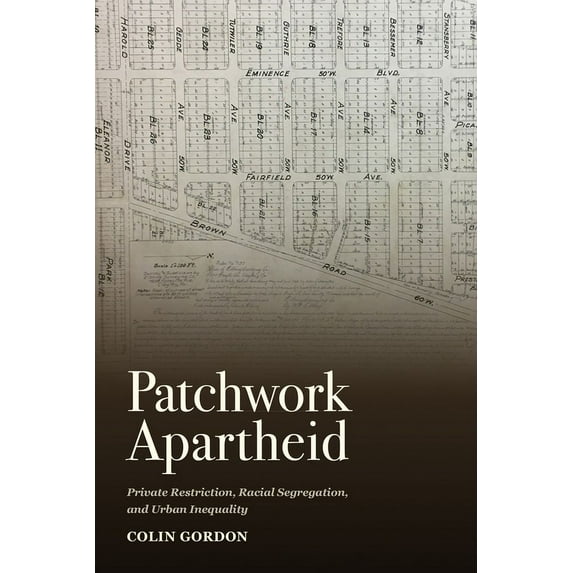
Hero image 0 of Patchwork Apartheid : Private Restriction, Racial Segregation, and Urban Inequality (Edition 1) (Paperback), 0 of 1
Patchwork Apartheid : Private Restriction, Racial Segregation, and Urban Inequality (Edition 1) (Paperback)
(No ratings yet)
Key item features
For the first half of the twentieth century, private agreements to impose racial restrictions on who could occupy property decisively shaped the development of American cities and the distribution of people within them. Racial restrictions on the right to buy, sell, or occupy property also effectively truncated the political, social, and economic citizenship of those targeted for exclusion. In Patchwork Apartheid, historian Colin Gordon examines the history of such restrictions and how their consequences reverberate today. Drawing on a unique record of property restrictions excavated from local property records in five Midwestern counties, Gordon documents the prevalence of private property restriction in the era before zoning and building codes were widely employed and before federal redlining sanctioned the segregation of American cities and suburbs. This record of private restriction—documented and mapped to the parcel level in Greater Minneapolis, Greater St. Louis, and two Iowa counties—reveals the racial segregation process both on the ground, in the strategic deployment of restrictions throughout transitional central city neighborhoods and suburbs, and in the broader social and legal construction of racial categories and racial boundaries.
Gordon also explores the role of other policies and practices in sustaining segregation. Enforcement of private racial restrictions was held unconstitutional in 1948, and such agreements were prohibited outright in 1968. But their premises and assumptions, and the segregation they had accomplished, were accommodated by local zoning and federal housing policies. Explicit racial restrictions were replaced by the deceptive business practices of real estate agents and developers, who characterized certain neighborhoods as white and desirable and others as black and undesirable, thereby hiding segregation behind the promotion of sound property investments, safe neighborhoods, and good schools. These practices were in turn replaced by local zoning, which systematically protected white neighborhoods while targeting “blighted” black neighborhoods for commercial and industrial redevelopment, and by a tangle of federal policies that reliably deferred to local and private interests with deep investments in local segregation. Private race restriction was thus a key element in the original segregation of American cities and a source of durable inequalities in housing wealth, housing opportunity, and economic mobility.
Patchwork Apartheid exhaustively documents the history of private restriction in urban settings and demonstrates its crucial role in the ideas and assumptions that have sustained racial segregation in the United States into the twenty-first century.
Gordon also explores the role of other policies and practices in sustaining segregation. Enforcement of private racial restrictions was held unconstitutional in 1948, and such agreements were prohibited outright in 1968. But their premises and assumptions, and the segregation they had accomplished, were accommodated by local zoning and federal housing policies. Explicit racial restrictions were replaced by the deceptive business practices of real estate agents and developers, who characterized certain neighborhoods as white and desirable and others as black and undesirable, thereby hiding segregation behind the promotion of sound property investments, safe neighborhoods, and good schools. These practices were in turn replaced by local zoning, which systematically protected white neighborhoods while targeting “blighted” black neighborhoods for commercial and industrial redevelopment, and by a tangle of federal policies that reliably deferred to local and private interests with deep investments in local segregation. Private race restriction was thus a key element in the original segregation of American cities and a source of durable inequalities in housing wealth, housing opportunity, and economic mobility.
Patchwork Apartheid exhaustively documents the history of private restriction in urban settings and demonstrates its crucial role in the ideas and assumptions that have sustained racial segregation in the United States into the twenty-first century.
Specs
- Book formatPaperback
- Fiction/nonfictionNon-Fiction
- Publication dateNovember, 2023
- Pages260
- Reading levelGrade 1, Grade 10, Grade 11, Grade 12, Grade 2, Grade 3, Grade 4, Grade 5, Grade 6, Grade 7, Grade 8, Grade 9, Kindergarten, Preschool
- Age range16 - 100 Years
Current price is USD$41.06
Price when purchased online
- Free shipping
 Free 30-day returns
How do you want your item?
Ships to
Arrives between Jun 1 - Jun 8
|
Sold and shipped by newbookdeals
4.5605676634566645 stars out of 5, based on 1973 seller reviews(4.6)1973 seller reviews

Free 30-day returns
About this item
Product details
For the first half of the twentieth century, private agreements to impose racial restrictions on who could occupy property decisively shaped the development of American cities and the distribution of people within them. Racial restrictions on the right to buy, sell, or occupy property also effectively truncated the political, social, and economic citizenship of those targeted for exclusion. In Patchwork Apartheid, historian Colin Gordon examines the history of such restrictions and how their consequences reverberate today. Drawing on a unique record of property restrictions excavated from local property records in five Midwestern counties, Gordon documents the prevalence of private property restriction in the era before zoning and building codes were widely employed and before federal redlining sanctioned the segregation of American cities and suburbs. This record of private restriction—documented and mapped to the parcel level in Greater Minneapolis, Greater St. Louis, and two Iowa counties—reveals the racial segregation process both on the ground, in the strategic deployment of restrictions throughout transitional central city neighborhoods and suburbs, and in the broader social and legal construction of racial categories and racial boundaries.
Gordon also explores the role of other policies and practices in sustaining segregation. Enforcement of private racial restrictions was held unconstitutional in 1948, and such agreements were prohibited outright in 1968. But their premises and assumptions, and the segregation they had accomplished, were accommodated by local zoning and federal housing policies. Explicit racial restrictions were replaced by the deceptive business practices of real estate agents and developers, who characterized certain neighborhoods as white and desirable and others as black and undesirable, thereby hiding segregation behind the promotion of sound property investments, safe neighborhoods, and good schools. These practices were in turn replaced by local zoning, which systematically protected white neighborhoods while targeting “blighted” black neighborhoods for commercial and industrial redevelopment, and by a tangle of federal policies that reliably deferred to local and private interests with deep investments in local segregation. Private race restriction was thus a key element in the original segregation of American cities and a source of durable inequalities in housing wealth, housing opportunity, and economic mobility.
Patchwork Apartheid exhaustively documents the history of private restriction in urban settings and demonstrates its crucial role in the ideas and assumptions that have sustained racial segregation in the United States into the twenty-first century.
Gordon also explores the role of other policies and practices in sustaining segregation. Enforcement of private racial restrictions was held unconstitutional in 1948, and such agreements were prohibited outright in 1968. But their premises and assumptions, and the segregation they had accomplished, were accommodated by local zoning and federal housing policies. Explicit racial restrictions were replaced by the deceptive business practices of real estate agents and developers, who characterized certain neighborhoods as white and desirable and others as black and undesirable, thereby hiding segregation behind the promotion of sound property investments, safe neighborhoods, and good schools. These practices were in turn replaced by local zoning, which systematically protected white neighborhoods while targeting “blighted” black neighborhoods for commercial and industrial redevelopment, and by a tangle of federal policies that reliably deferred to local and private interests with deep investments in local segregation. Private race restriction was thus a key element in the original segregation of American cities and a source of durable inequalities in housing wealth, housing opportunity, and economic mobility.
Patchwork Apartheid exhaustively documents the history of private restriction in urban settings and demonstrates its crucial role in the ideas and assumptions that have sustained racial segregation in the United States into the twenty-first century.
info:
We aim to show you accurate product information. Manufacturers, suppliers and others provide what you see here, and we have not verified it.
Specifications
Book format
Paperback
Fiction/nonfiction
Non-Fiction
Genre
Political & Social Sciences, History
Publication date
November, 2023
Warranty
Warranty information
Please be aware that the warranty terms on items offered for sale by third party Marketplace sellers may differ from those displayed in this section (if any). To confirm warranty terms on an item offered for sale by a third party Marketplace seller, please use the 'Contact seller' feature on the third party Marketplace seller's information page and request the item's warranty terms prior to purchase.
Similar items you might like
Based on what customers bought
Essential Documents of American History, Volume II: From Reconstruction to the Twenty-First Century, (Paperback) $19.03
 $1903current price $19.03
Essential Documents of American History, Volume II: From Reconstruction to the Twenty-First Century, (Paperback)
The Color of Law: A Forgotten History of How Our Government Segregated America, (Paperback) $11.39
 $1139current price $11.39
The Color of Law: A Forgotten History of How Our Government Segregated America, (Paperback)
234.7 out of 5 Stars. 23 reviewsFrom Popular Front to Cold War: The Interracial Left and the International Workers Order, 1930-1954, (Paperback) $36.95
 $3695current price $36.95
From Popular Front to Cold War: The Interracial Left and the International Workers Order, 1930-1954, (Paperback)
An Inconvenient Minority: The Attack on Asian American Excellence and the Fight for Meritocracy, (Paperback) $17.07 Was $18.99
 $1707current price $17.07, Was $18.99$18.99
An Inconvenient Minority: The Attack on Asian American Excellence and the Fight for Meritocracy, (Paperback)
The Everywhere Millionaire: Who Is Really Rich in America and How They Got There, (Hardcover) $28.88
 $2888current price $28.88
The Everywhere Millionaire: Who Is Really Rich in America and How They Got There, (Hardcover)
Early Modern Americas Black Self-Governance: The Making of Political Culture in Seventeenth-Century Lima, (Hardcover) $45.00
 $4500current price $45.00
Early Modern Americas Black Self-Governance: The Making of Political Culture in Seventeenth-Century Lima, (Hardcover)
Bill O'Reilly's Confronting Confronting America: What Has to Change, (Hardcover) $29.82
 $2982current price $29.82
Bill O'Reilly's Confronting Confronting America: What Has to Change, (Hardcover)
An Inquiry Into the Law of Negro Slavery in the United States of America, (Hardcover) $39.66
 $3966current price $39.66
An Inquiry Into the Law of Negro Slavery in the United States of America, (Hardcover)
Politics and Culture in Modern America Up South: Civil Rights and Black Power in Philadelphia, (Paperback) $39.95
 $3995current price $39.95
Politics and Culture in Modern America Up South: Civil Rights and Black Power in Philadelphia, (Paperback)
Apartheid of the Heart: Affirmative Action and Me, (Hardcover) $15.99
 $1599current price $15.99
Apartheid of the Heart: Affirmative Action and Me, (Hardcover)
Money, Lies, and God: Inside the Movement to Destroy American Democracy, (Hardcover) $10.30 Was $17.56
 $1030current price $10.30, Was $17.56$17.56
Money, Lies, and God: Inside the Movement to Destroy American Democracy, (Hardcover)
The West Philadelphia Billionaire Society, (Paperback) $18.87
 $1887current price $18.87
The West Philadelphia Billionaire Society, (Paperback)
Pre-Owned Injustice: How Politics and Fear Vanquished America's Justice Department Paperback $9.58 Was $16.77
 $958current price $9.58, Was $16.77$16.77
Pre-Owned Injustice: How Politics and Fear Vanquished America's Justice Department Paperback
Simon & Schuster Lincoln Library Lincoln's Greatest Speech: The Second Inaugural, (Paperback) $4.34
 $434current price $4.34
Simon & Schuster Lincoln Library Lincoln's Greatest Speech: The Second Inaugural, (Paperback)
Decision Points, (Hardcover) $4.94
 $494current price $4.94
Decision Points, (Hardcover)
594.9 out of 5 Stars. 59 reviewsOrdinary Whites in Apartheid Society: Social Histories of Accommodation, (Paperback) $40.00
 $4000current price $40.00
Ordinary Whites in Apartheid Society: Social Histories of Accommodation, (Paperback)
Politics and Culture in the Twentieth-Ce New Negro Politics in the Jim Crow South, Book 21, (Hardcover) $61.74
 $6174current price $61.74
Politics and Culture in the Twentieth-Ce New Negro Politics in the Jim Crow South, Book 21, (Hardcover)
Organizing Workers in the Shadow of Slavery: Global Inequality, Racial Boundaries, and the Rise of Unions in American an, (Paperback) $32.44
 $3244current price $32.44
Organizing Workers in the Shadow of Slavery: Global Inequality, Racial Boundaries, and the Rise of Unions in American an, (Paperback)
Nation Divided Words Colliding: The Debate Over Slavery and Black Exclusion in Nineteenth-Century America, (Paperback) $26.74
 $2674current price $26.74
Nation Divided Words Colliding: The Debate Over Slavery and Black Exclusion in Nineteenth-Century America, (Paperback)

Customer ratings & reviews
0 ratings|0 reviews
This item does not have any reviews yet

Related pages
- Short Bridges
- Gray People
- World Is What It Is
- Underground Railroad Quilt
- Mind State
- Browsing History
- Republic of South African History Books
- African American History Books
- General South African History Books
- Central African History Books
- Emigration & Immigration Social Themes Teen & Young Adult Books
- Women's History Month Nonfiction