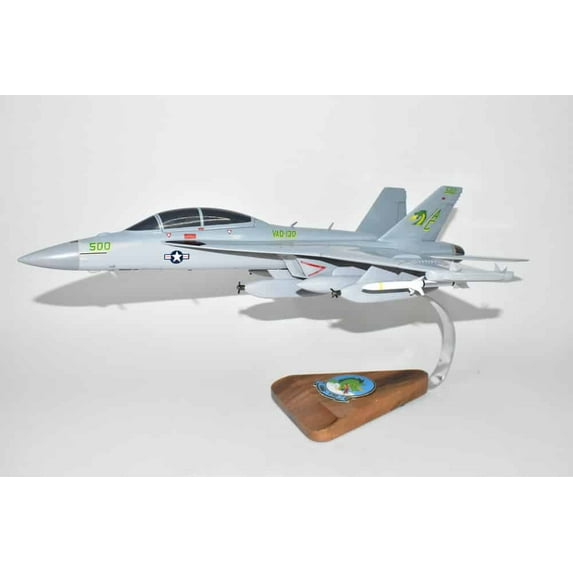
VAQ-130 Zappers EA-18G Growler Model
Fly with the VAQ-130 Zappers in this handcrafted EA-18G Growler Model. Each piece is carved from wood and handpainted to provide a piece you’ll love.
Length – 18 inches
Electronic Attack Squadron One Three Zero is the oldest electronic warfare squadron in the United States Navy. VAQ-130 adopted the nickname “Zappers” and the Zapper Dragon insignia when the squadron was originally commissioned as Carrier Early Warning Squadron THIRTEEN (VAW-13) flying AD-5Qs in 1959. On 1 October 1968, the command was re-designated VAQ-130 and placed under the operational control of Tactical Electronic Warfare Wing THIRTEEN (VAQW 13). After commissioning, the squadron supplied support detachments aboard all Pacific and Atlantic aircraft carriers. These detachments, flying the EAK-3B Skywarrior aircraft, provided sea and shore based forces with electronic countermeasures (ECM) and air-to-air refueling capabilities.
In March 1975, VAQ-130 was re-stationed at NAS Whidbey Island, Washington and transitioned to the EA-6B “Prowler” aircraft. In June of the same year, VAQ-130 joined Carrier Air Wing EIGHT aboard the USS NIMITZ (CVN 68) for a three and one-half month cruise to the Caribbean and North Atlantic where the Zappers were part of Nuclear Task Group SEVEN FIVE, formed to demonstrate the capability of the nuclear Navy to NATO allies. Because of the limited number of EA-6B squadrons in the Navy at the time, the Zappers, unlike most naval aviation squadrons, were assigned to a variety of carrier air wings and deployed on several different carriers, including the NIMITZ, FORRESTAL, INDEPENDENCE, and KITTY HAWK.
In 1977, VAQ-130 transitioned to the Improved Capability (ICAP) version of the EA-6B, bringing more sophisticated electronic warfare capabilities. In 1978, the squadron received the Chief of Naval Operations (CNO) Safety “S” Award after six years of mishap free flying.
In 1986, the Zappers completed transition to the Improved Capability II (ICAP II) version of the aircraft, which incorporated the ALQ-99 Tactical Jamming System and integrated the High-Speed Anti-Radiation Missile (HARM). The squadron deployed on an around-the-world cruise as part of Carrier Air Wing NINE aboard the USS KITTY HAWK (CV 63), in July 1987. In August 1987, VAQ-130 joined Carrier Air Wing THREE aboard the USS JOHN F. KENNEDY (CV 67) and deployed on their first Mediterranean cruise from August 1988 to February 1989. In 1988, the Zappers again won the Safety “S” Award.
In January 1990, the Zappers deployed for seven weeks to the Caribbean Sea for WESTLANT ’90, a mini-cruise for drug interdiction support. Later in August 1990, the squadron transitioned to the Block 86 version of ICAP II aircraft and accepted an additional aircraft to become a five-plane squadron. The squadron then immediately deployed on board USS JOHN F. KENNEDY to the Red Sea in support of Operation DESERT SHIELD/DESERT STORM, where it became the first prowler squadron to fire a HARM in combat. Subsequently, VAQ-130 was awarded the CNO Safety “S,” COMNAVAIRLANT Battle “E,” and the Admiral Arthur W. Radford award for 1990.
The Zappers deployed again to the Mediterranean in October 1992 in support of Operation PROVIDE PROMISE and the humanitarian relief efforts in Bosnia-Herzegovina. In June of 1993, the Zappers became the first U.S. Navy combat unit to have women assigned.
In October 1994, the Zappers deployed with Carrier Air Wing THREE aboard the USS EISENHOWER (CVN 69). After a brief stint in the Arabian Sea in support of Operation SOUTHERN WATCH, the Zappers participated in Operation DENY FLIGHT. During that deployment, the Zappers conducted three shore detachments to Aviano AB, Italy, to help provide continuous electronic warfare support to NATO and United Nations aircraft.
In August 1995, the Zappers departed early from