


The Correspondence of William James : William and Henry April 1905 - March 1908 (Hardcover)
Key item features
This eleventh volume of a projected twelve continues the series of William James’s correspondence with family, friends, and colleagues that began with volume 4. Consisting of some 500 letters, with an additional 650 letters calendared, volume 11 gives a complete accounting of James’s known correspondence from April 1905 through March 1908.
Several major professional events in James’s career occur during this period, including his California adventure—a semester of teaching at Stanford University in the spring of 1906 that is interrupted by the San Francisco earthquake on April 18. In the fall of that year, James delivers the Lowell Lectures on pragmatism. Also during this period, in 1908, he agrees to deliver the Hibbert Lectures at Oxford, which were to become A Pluralistic Universe. In 1907, after several years of a reduced teaching load, James retires from Harvard, giving his final course that January.
James has trouble concentrating on writing what he considers his great work in philosophy, a book setting out his metaphysics but with the central focus shifting now from radical empiricism to pluralism. And as criticism of pragmatism persists, he becomes more and more impatient with its critics, who in his view make no effort to understand this new philosophical movement.
He continues his correspondence with the first generation of professionally trained philosophers and psychologists in America, among whom are Dickinson Sergeant Miller, Charles Augustus Strong, Charles Montague Bakewell, Mary Whiton Calkins, Arthur Oncken Lovejoy, Ralph Barton Perry, and Horace Meyer Kallen, and remains in touch with friendly critics Francis Herbert Bradley and Josiah Royce as well as with philosophical allies Henri Bergson, Ferdinand Canning Scott Schiller, and Charles Peirce.
A number of correspondents make their first appearance in this volume. Marion Hamilton Carter, a muckraking journalist, acquaints James with some of the social problems of the South but also drags him into many futile sittings with mediums. Horace Fletcher, a nutritionist whose reforms became known as Fletcherism, gives James dietary advice. Alfred Hodder, a former student of James, embroils James in his complicated marital situation, and only Hodder’s death saves James from having to testify in court. Maxim Gorky, who on a visit to America scandalized some by presenting as his wife a woman to whom he was not married, makes a brief appearance as James praises his writing. Clifford Beers, a former patient in a mental hospital, receives moral and financial support from James and initiates a movement for the reform of mental hospitals.
Specs
- Book formatHardcover
- Fiction/nonfictionNon-Fiction
- Publication dateJuly, 2003
- Pages772
- Reading levelProfessional and Scholarly
- SubgenrePhilosophy
- Free shipping
 Free 90-day returns
How do you want your item?



Try 30 days of Walmart+ for just $1!
About this item
Product details
This eleventh volume of a projected twelve continues the series of William James's correspondence with family, friends, and colleagues that began with volume 4. Consisting of some 500 letters, with an additional 650 letters calendared, volume 11 gives a complete accounting of James's known correspondence from April 1905 through March 1908.
Several major professional events in James's career occur during this period, including his California adventure--a semester of teaching at Stanford University in the spring of 1906 that is interrupted by the San Francisco earthquake on April 18. In the fall of that year, James delivers the Lowell Lectures on pragmatism. Also during this period, in 1908, he agrees to deliver the Hibbert Lectures at Oxford, which were to become A Pluralistic Universe. In 1907, after several years of a reduced teaching load, James retires from Harvard, giving his final course that January.
James has trouble concentrating on writing what he considers his great work in philosophy, a book setting out his metaphysics but with the central focus shifting now from radical empiricism to pluralism. And as criticism of pragmatism persists, he becomes more and more impatient with its critics, who in his view make no effort to understand this new philosophical movement.
He continues his correspondence with the first generation of professionally trained philosophers and psychologists in America, among whom are Dickinson Sergeant Miller, Charles Augustus Strong, Charles Montague Bakewell, Mary Whiton Calkins, Arthur Oncken Lovejoy, Ralph Barton Perry, and Horace Meyer Kallen, and remains in touch with friendly critics Francis Herbert Bradley and Josiah Royce as well as with philosophical allies Henri Bergson, Ferdinand Canning Scott Schiller, and Charles Peirce.
A number of correspondents make their first appearance in this volume. Marion Hamilton Carter, a muckraking journalist, acquaints James with some of the social problems of the South but also drags him into many futile sittings with mediums. Horace Fletcher, a nutritionist whose reforms became known as Fletcherism, gives James dietary advice. Alfred Hodder, a former student of James, embroils James in his complicated marital situation, and only Hodder's death saves James from having to testify in court. Maxim Gorky, who on a visit to America scandalized some by presenting as his wife a woman to whom he was not married, makes a brief appearance as James praises his writing. Clifford Beers, a former patient in a mental hospital, receives moral and financial support from James and initiates a movement for the reform of mental hospitals.
This eleventh volume of a projected twelve continues the series of William James’s correspondence with family, friends, and colleagues that began with volume 4. Consisting of some 500 letters, with an additional 650 letters calendared, volume 11 gives a complete accounting of James’s known correspondence from April 1905 through March 1908.
Several major professional events in James’s career occur during this period, including his California adventure—a semester of teaching at Stanford University in the spring of 1906 that is interrupted by the San Francisco earthquake on April 18. In the fall of that year, James delivers the Lowell Lectures on pragmatism. Also during this period, in 1908, he agrees to deliver the Hibbert Lectures at Oxford, which were to become A Pluralistic Universe. In 1907, after several years of a reduced teaching load, James retires from Harvard, giving his final course that January.
James has trouble concentrating on writing what he considers his great work in philosophy, a book setting out his metaphysics but with the central focus shifting now from radical empiricism to pluralism. And as criticism of pragmatism persists, he becomes more and more impatient with its critics, who in his view make no effort to understand this new philosophical movement.
He continues his correspondence with the first generation of professionally trained philosophers and psychologists in America, among whom are Dickinson Sergeant Miller, Charles Augustus Strong, Charles Montague Bakewell, Mary Whiton Calkins, Arthur Oncken Lovejoy, Ralph Barton Perry, and Horace Meyer Kallen, and remains in touch with friendly critics Francis Herbert Bradley and Josiah Royce as well as with philosophical allies Henri Bergson, Ferdinand Canning Scott Schiller, and Charles Peirce.
A number of correspondents make their first appearance in this volume. Marion Hamilton Carter, a muckraking journalist, acquaints James with some of the social problems of the South but also drags him into many futile sittings with mediums. Horace Fletcher, a nutritionist whose reforms became known as Fletcherism, gives James dietary advice. Alfred Hodder, a former student of James, embroils James in his complicated marital situation, and only Hodder’s death saves James from having to testify in court. Maxim Gorky, who on a visit to America scandalized some by presenting as his wife a woman to whom he was not married, makes a brief appearance as James praises his writing. Clifford Beers, a former patient in a mental hospital, receives moral and financial support from James and initiates a movement for the reform of mental hospitals.
Specifications
Book format
Fiction/nonfiction
Genre
Publication date
Similar items you might like
Based on what customers bought
Cambridge Studies in the History of Psyc Hermann Lotze, (Hardcover) $154.00
 $15400current price $154.00
Cambridge Studies in the History of Psyc Hermann Lotze, (Hardcover)
William James, MD : Philosopher, Psychologist, Physician (Edition 1) (Hardcover) $103.02
 $10302current price $103.02
William James, MD : Philosopher, Psychologist, Physician (Edition 1) (Hardcover)
History of England From the Fall of Wolsey to the Death of Elizabeth, (Hardcover) $34.95 Was $54.81
 $3495current price $34.95, Was $54.81$54.81
History of England From the Fall of Wolsey to the Death of Elizabeth, (Hardcover)
The Correspondence of William James : William and Henry 1856-1877 (Hardcover) $113.05
 $11305current price $113.05
The Correspondence of William James : William and Henry 1856-1877 (Hardcover)
The British Army, Society and Soldiering in Ireland, 1699-1793, (Hardcover) $95.83
 $9583current price $95.83
The British Army, Society and Soldiering in Ireland, 1699-1793, (Hardcover)
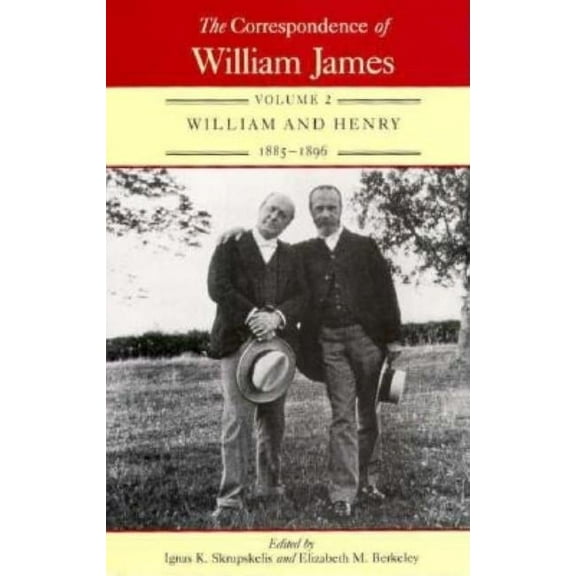
The Correspondence of William James : William and Henry 1885-1896 (Hardcover) $105.34
 $10534current price $105.34
The Correspondence of William James : William and Henry 1885-1896 (Hardcover)
Travels of William Bartram (Hardcover) $37.98
 $3798current price $37.98
Travels of William Bartram (Hardcover)
15 out of 5 Stars. 1 reviewsThree American Hegels: Henry C. Brokmeyer, Horace Williams, and John William Miller, (Hardcover) $114.24
 $11424current price $114.24
Three American Hegels: Henry C. Brokmeyer, Horace Williams, and John William Miller, (Hardcover)
Consciousness Is Motor: William James on Mind and Action, (Hardcover) $86.32
 $8632current price $86.32
Consciousness Is Motor: William James on Mind and Action, (Hardcover)
Wittgenstein and William James, (Hardcover) $94.84
 $9484current price $94.84
Wittgenstein and William James, (Hardcover)
Cambridge Studies in Early Modern Britis The Smoke of London: Energy and Environment in the Early Modern City, (Hardcover) $115.95
 $11595current price $115.95
Cambridge Studies in Early Modern Britis The Smoke of London: Energy and Environment in the Early Modern City, (Hardcover)
Vanderbilt Library of American Philosoph The Unity of William James's Thought, (Hardcover) $95.68
 $9568current price $95.68
Vanderbilt Library of American Philosoph The Unity of William James's Thought, (Hardcover)
William and Henry James : Selected Letters (Hardcover) $57.00
 $5700current price $57.00
William and Henry James : Selected Letters (Hardcover)
William Sharp and Fiona Macleod: A Life Hardcover 1800643276 9781800643277 William F Halloran $66.05
 $6605current price $66.05
William Sharp and Fiona Macleod: A Life Hardcover 1800643276 9781800643277 William F Halloran
Reconstructing Public Philosophy, (Hardcover) $114.91
 $11491current price $114.91
Reconstructing Public Philosophy, (Hardcover)
George Santayana's and William James's Conflicting Views on Transcendence, (Hardcover) $133.27
 $13327current price $133.27
George Santayana's and William James's Conflicting Views on Transcendence, (Hardcover)
William Howard Taft: Collected Editorials, 1917-1921, (Hardcover) $111.85
 $11185current price $111.85
William Howard Taft: Collected Editorials, 1917-1921, (Hardcover)
Life of Roger Williams: the Founder of the State of Rhode Island (Paperback) $20.95
 $2095current price $20.95
Life of Roger Williams: the Founder of the State of Rhode Island (Paperback)
Life of William Madison McDonald, Ph.D, (Hardcover) $38.95
 $3895current price $38.95
Life of William Madison McDonald, Ph.D, (Hardcover)
Poems of James Russell Lowell (Hardcover) $50.39
 $5039current price $50.39
Poems of James Russell Lowell (Hardcover)
