

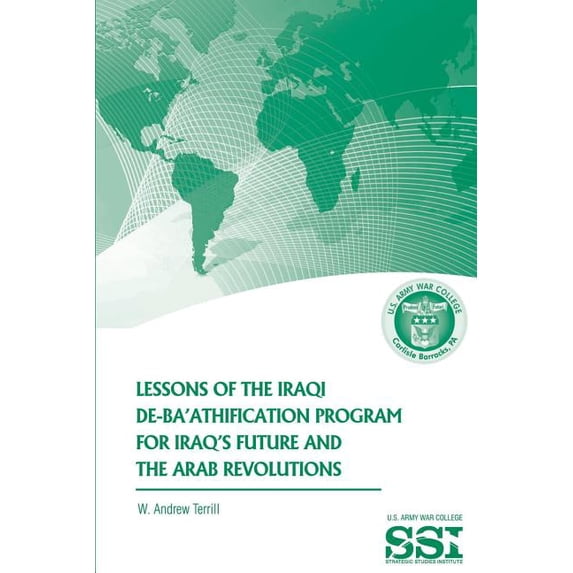
Lessons of the Iraqi De-Ba'athification Program for Iraq's Future and the Arab Revolutions, (Paperback)
(No ratings yet)
Key item features
- Lessons of the Iraqi De-Ba'athification Program for Iraq's Future and the Arab Revolutions, (Paperback)
- Author: Createspace Independent Publishing Platform
- ISBN: 9781478380115
- Format: Paperback
- Publication Date: 2012-08-06
- Page Count: 122
Specs
- Book formatPaperback
- Fiction/nonfictionNon-Fiction
- GenreHistory
- Publication dateAugust, 2012
- Pages122
- SubgenreMiddle East
Current price is USD$13.12
Price when purchased online
 Free 30-day returns
How do you want your item?
Ships to
Arrives by Fri, May 22
|Shipping fee $7.98

Sold and shipped by Best Prices & Service
4.343173431734317 stars out of 5, based on 271 seller reviews(4.3)271 seller reviews

Free 30-day returns
About this item
Product details
In December 2011, the last U.S. combat troops were withdrawn from Iraq after an almost 9-year presence in that country. This day was welcomed by the U.S. public after years of sacrifice and struggle to build a new Iraq. Yet, the Iraq that U.S. troops have left at the insistence of its government remains a deeply troubled nation. Often Iraqi leaders view political issues in sharply sectarian terms, and national unity is elusive. The Iraqi political system was organized by both the United States and Iraq, although over time, U.S. influence diminished and Iraqi influence increased. In this monograph, Dr. W. Andrew Terrill examines the policies of de-Ba'athification as initiated by the U.S.- led Coalition Provision Authority (CPA) under Ambassador L. Paul Bremer and as practiced by various Iraqi political commissions and entities created under the CPA order. He also considers the ways in which the Iraqi de-Ba'athification program has evolved and remained an important but divisive institution over time. Dr. Terrill suggests that many U.S. officials in Iraq saw problems with de-Ba'athification, but they had difficulties softening or correcting the process once it had become firmly established in Iraqi hands. Other U.S. policymakers were slower in recognizing the politicized nature of de-Ba'athification and its devolution into a process in which both its Iraqi supporters and opponents viewed it as an instrument of Shi'ite revenge and political domination of Sunni Arabs. Dr. Terrill's monograph considers both the future of Iraq and the differences and similarities between events in Iraq and the Arab Spring states. He has examined both Ba'athism as a concept and the ways in which it was practiced in Saddam Hussein's Iraq. He notes that the initial principles of Ba'athism were sufficiently broad as to allow their acquisition by a tyrant seeking ideological justification for a merciless regime. His comprehensive analysis of Iraqi Ba'athism ensures that he does not overgeneralize when drawing potential parallels to events in the Arab Spring countries. Dr. Terrill considers the nature of Iraqi de-Ba'athification in considerable depth and carefully evaluates the rationales and results of actions taken by both Americans and Iraqis involved in the process. While there are many differences between the formation of Iraq's post-Saddam Hussein government and the current efforts of some Arab Spring governing bodies to restructure their political institutions, it is possible to identify parallels between Iraq and Arab Spring countries. Some insights for emerging governments may, correspondingly, be guided by a comprehensive understanding of these parallels. The Arab Spring revolutions that have overthrown the governments of Tunisia, Egypt, Libya, and Yemen at the time of this writing are a regional process of stunning importance. While these revolutions began with a tremendous degree of hope, great difficulties loom in the future. New governments will have to apportion power, build or reform key institutions, establish political legitimacy for those institutions, and accommodate the enhanced expectations of their publics in a post-revolutionary environment. A great deal can go wrong in these circumstances, and it is important to consider ways in which these new governing structures can be supported, so long as they remain inclusive and democratic. Any lessons that can be gleaned from earlier conflicts will be of considerable value to the nations facing these problems as well as to their regional and extra-regional allies seeking to help them.
- Lessons of the Iraqi De-Ba'athification Program for Iraq's Future and the Arab Revolutions, (Paperback)
- Author: Createspace Independent Publishing Platform
- ISBN: 9781478380115
- Format: Paperback
- Publication Date: 2012-08-06
- Page Count: 122
info:
We aim to show you accurate product information. Manufacturers, suppliers and others provide what you see here, and we have not verified it.
Specifications
Book format
Paperback
Fiction/nonfiction
Non-Fiction
Genre
History
Publication date
August, 2012
Warranty
Warranty information
Please be aware that the warranty terms on items offered for sale by third party Marketplace sellers may differ from those displayed in this section (if any). To confirm warranty terms on an item offered for sale by a third party Marketplace seller, please use the 'Contact seller' feature on the third party Marketplace seller's information page and request the item's warranty terms prior to purchase.
Customer ratings & reviews
0 ratings|0 reviews
This item does not have any reviews yet
