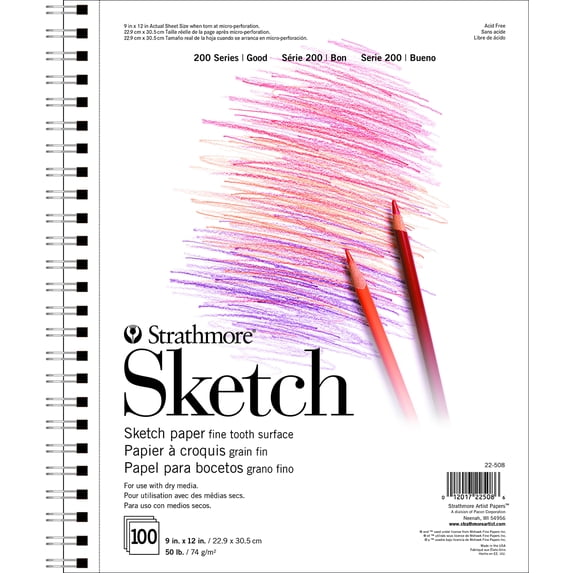
Strathmore 200 Series Sketch Pad, 50 Pound Weight, 9'' x 12'', 100 White Sheets
- Sold as a sketchpad with 100 sheets
- Paper Weight: 50 lb / 74 gsm, lightweight
- 9'' x 12'', measured from micro-perforation edge
- Micro-perforation for easy page removal
- Side Spiral Binding: Wire, pages turn easily and lie flat
- Fine tooth surface- best for experimentation
- High-quality artist paper for independent work
- Acid-free sheets
- Use in art class or for independent drawings
- For use with graphite pencil sketch, sketching stick and charcoal
- Excellent drawing tablet for sketching
Strathmore offers a wide-variety of paper products for educational and artistic use:
- Drawing & Illustration: Tracing, Newsprint, Sketch, Drawing, Colored Pencil, Bristol, Sequential Art Bristol, Marker & Layout, Pastel, Charcoal, Boards, Mixed Media, Toned Paper,
- Painting: Watercolor, Palette, Canvas, Acrylic, Boards, Mixed Media,
- Books & Art Journals: Softcover Art Journals, Hardbound Art Journals, Wirebound Art Journals, Visual Journals
- Specialty Arts & Crafts: Calligraphy, Parchment, Textures, Decorative Sheets, Translucent Vellum
How to Become Better at Drawing:
- Learn how to hold your pencil: Place the pencil between your forefinger and thumb on your dominant hand. Try holding it about a fourth of the way up from the tip. For basic drawing, you don’t want to hold your pencil too close to the tip or you won’t be able to move it enough, while holding it too far back won’t give you enough control. Maintain a loose enough grip so that you can move your fingers, hand, and wrist.
- Practice basic techniques: Practice drawing basic shapes freehand. A lot of what you draw is essentially made up of shapes like circles, ovals, squares, rectangles, and triangles. Your art will incorporate these shapes in different ways to form an image. Practice shading. Fill a sheet of UCreate drawing paper with 2 centimeter boxes and number them off. Leave the first block blank, then very lightly shade the first block. As you continue to each new block, make it a darker shade until the last box is colored in black, creating a shading gradient reference guide.
- Draw what you see around you: The best way to improve your drawing abilities is going back to the basics! Find an ordinary object around you and begin drawing it. Look at how the light source casts a shadow on and around the object. You can tell where a light source is coming from because the shadow will be pointing opposite the light, and this will help you to understand how to shade an object and incorporate depth. Consider proportions and dissect the object into the basic shapes you practiced before.