

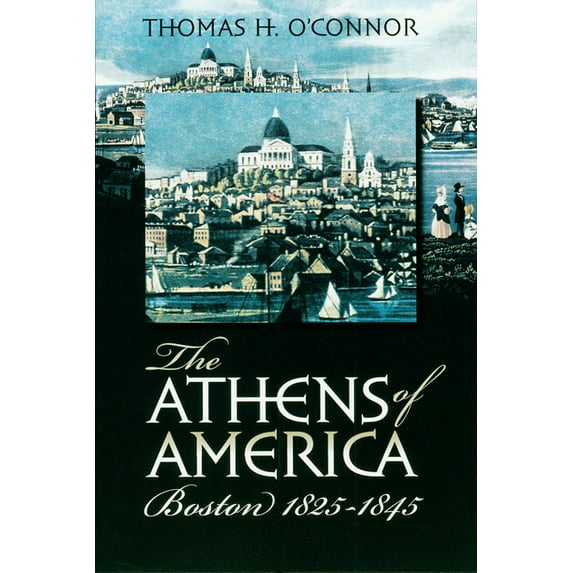
The Athens of America : Boston, 1825-1845 (Paperback)
(No ratings yet)
Key item features
Many people are generally familiar with the fact that Boston was once known as "the Athens of America." Very few, however, are clear about exactly why, except for their recollections of the famous writers and poets who gave the city a reputation for literature and learning.
In this book, historian Thomas H. O'Connor sets the matter straight by showing that Boston's eminence during the first half of the nineteenth century was the result of a much broader community effort. After the nation emerged from its successful struggle for independence, most Bostonians visualized their city not only as the Cradle of Liberty, but also as the new world's Cradle of Civilization.
According to O'Connor, a leadership elite, composed of men of prominent family background, Unitarian beliefs, liberal education, and managerial experience in a variety of enterprises, used their personal talents and substantial financial resources to promote the cultural, intellectual, and humanitarian interests of Boston to the point where it would be the envy of the nation. Not only did writers, scholars, and philosophers see themselves as part of this process, but so did physicians and lawyers, ministers and teachers, merchants and businessmen, mechanics and artisans, all involved in creating a well-ordered city whose citizens would be committed to the ideals of social progress and personal perfectibility.
To accomplish their noble vision, leading members of the Boston community joined in programs designed to cleanse the old town of what they felt were generations of accumulated social stains and human failures, and then to create new programs and more efficient institutions that would raise the cultural and intellectual standards of all its citizens. Like ancient Athens, Boston would be a city of great statesmen, wealthy patrons, inspiring artists, and profound thinkers, headed by members of the "happy and respectable classes" who would assume responsibility for the safety, welfare, and education of the "less prosperous portions of the community."
Designed for the general reader and the historical enthusiast, The Athens of America is an interpretive synthesis that explores the numerous secondary sources that have concentrated on individual subjects and personalities, and draws their various conclusions into a single comprehensive narrative.
In this book, historian Thomas H. O'Connor sets the matter straight by showing that Boston's eminence during the first half of the nineteenth century was the result of a much broader community effort. After the nation emerged from its successful struggle for independence, most Bostonians visualized their city not only as the Cradle of Liberty, but also as the new world's Cradle of Civilization.
According to O'Connor, a leadership elite, composed of men of prominent family background, Unitarian beliefs, liberal education, and managerial experience in a variety of enterprises, used their personal talents and substantial financial resources to promote the cultural, intellectual, and humanitarian interests of Boston to the point where it would be the envy of the nation. Not only did writers, scholars, and philosophers see themselves as part of this process, but so did physicians and lawyers, ministers and teachers, merchants and businessmen, mechanics and artisans, all involved in creating a well-ordered city whose citizens would be committed to the ideals of social progress and personal perfectibility.
To accomplish their noble vision, leading members of the Boston community joined in programs designed to cleanse the old town of what they felt were generations of accumulated social stains and human failures, and then to create new programs and more efficient institutions that would raise the cultural and intellectual standards of all its citizens. Like ancient Athens, Boston would be a city of great statesmen, wealthy patrons, inspiring artists, and profound thinkers, headed by members of the "happy and respectable classes" who would assume responsibility for the safety, welfare, and education of the "less prosperous portions of the community."
Designed for the general reader and the historical enthusiast, The Athens of America is an interpretive synthesis that explores the numerous secondary sources that have concentrated on individual subjects and personalities, and draws their various conclusions into a single comprehensive narrative.
Specs
- Book formatPaperback
- Fiction/nonfictionNon-Fiction
- GenreHistory
- Pub date2006-02-06
- Pages240
- Reading levelGeneral Adult
Current price is USD$36.78
Price when purchased online
- Free shipping
 Free 30-day returns
How do you want your item?
Columbus, 43215
Arrives between Apr 17 - Apr 22
|
Sold and shipped by newbookdeals
4.558372952984681 stars out of 5, based on 1893 seller reviews(4.6)1893 seller reviews

Free 30-day returns
About this item
Product details
Many people are generally familiar with the fact that Boston was once known as "the Athens of America." Very few, however, are clear about exactly why, except for their recollections of the famous writers and poets who gave the city a reputation for literature and learning.
In this book, historian Thomas H. O'Connor sets the matter straight by showing that Boston's eminence during the first half of the nineteenth century was the result of a much broader community effort. After the nation emerged from its successful struggle for independence, most Bostonians visualized their city not only as the Cradle of Liberty, but also as the new world's Cradle of Civilization. According to O'Connor, a leadership elite, composed of men of prominent family background, Unitarian beliefs, liberal education, and managerial experience in a variety of enterprises, used their personal talents and substantial financial resources to promote the cultural, intellectual, and humanitarian interests of Boston to the point where it would be the envy of the nation. Not only did writers, scholars, and philosophers see themselves as part of this process, but so did physicians and lawyers, ministers and teachers, merchants and businessmen, mechanics and artisans, all involved in creating a well-ordered city whose citizens would be committed to the ideals of social progress and personal perfectibility. To accomplish their noble vision, leading members of the Boston community joined in programs designed to cleanse the old town of what they felt were generations of accumulated social stains and human failures, and then to create new programs and more efficient institutions that would raise the cultural and intellectual standards of all its citizens. Like ancient Athens, Boston would be a city of great statesmen, wealthy patrons, inspiring artists, and profound thinkers, headed by members of the "happy and respectable classes" who would assume responsibility for the safety, welfare, and education of the "less prosperous portions of the community." Designed for the general reader and the historical enthusiast, The Athens of America is an interpretive synthesis that explores the numerous secondary sources that have concentrated on individual subjects and personalities, and draws their various conclusions into a single comprehensive narrative. Many people are generally familiar with the fact that Boston was once known as "the Athens of America." Very few, however, are clear about exactly why, except for their recollections of the famous writers and poets who gave the city a reputation for literature and learning.
In this book, historian Thomas H. O'Connor sets the matter straight by showing that Boston's eminence during the first half of the nineteenth century was the result of a much broader community effort. After the nation emerged from its successful struggle for independence, most Bostonians visualized their city not only as the Cradle of Liberty, but also as the new world's Cradle of Civilization.
According to O'Connor, a leadership elite, composed of men of prominent family background, Unitarian beliefs, liberal education, and managerial experience in a variety of enterprises, used their personal talents and substantial financial resources to promote the cultural, intellectual, and humanitarian interests of Boston to the point where it would be the envy of the nation. Not only did writers, scholars, and philosophers see themselves as part of this process, but so did physicians and lawyers, ministers and teachers, merchants and businessmen, mechanics and artisans, all involved in creating a well-ordered city whose citizens would be committed to the ideals of social progress and personal perfectibility.
To accomplish their noble vision, leading members of the Boston community joined in programs designed to cleanse the old town of what they felt were generations of accumulated social stains and human failures, and then to create new programs and more efficient institutions that would raise the cultural and intellectual standards of all its citizens. Like ancient Athens, Boston would be a city of great statesmen, wealthy patrons, inspiring artists, and profound thinkers, headed by members of the "happy and respectable classes" who would assume responsibility for the safety, welfare, and education of the "less prosperous portions of the community."
Designed for the general reader and the historical enthusiast, The Athens of America is an interpretive synthesis that explores the numerous secondary sources that have concentrated on individual subjects and personalities, and draws their various conclusions into a single comprehensive narrative.
In this book, historian Thomas H. O'Connor sets the matter straight by showing that Boston's eminence during the first half of the nineteenth century was the result of a much broader community effort. After the nation emerged from its successful struggle for independence, most Bostonians visualized their city not only as the Cradle of Liberty, but also as the new world's Cradle of Civilization.
According to O'Connor, a leadership elite, composed of men of prominent family background, Unitarian beliefs, liberal education, and managerial experience in a variety of enterprises, used their personal talents and substantial financial resources to promote the cultural, intellectual, and humanitarian interests of Boston to the point where it would be the envy of the nation. Not only did writers, scholars, and philosophers see themselves as part of this process, but so did physicians and lawyers, ministers and teachers, merchants and businessmen, mechanics and artisans, all involved in creating a well-ordered city whose citizens would be committed to the ideals of social progress and personal perfectibility.
To accomplish their noble vision, leading members of the Boston community joined in programs designed to cleanse the old town of what they felt were generations of accumulated social stains and human failures, and then to create new programs and more efficient institutions that would raise the cultural and intellectual standards of all its citizens. Like ancient Athens, Boston would be a city of great statesmen, wealthy patrons, inspiring artists, and profound thinkers, headed by members of the "happy and respectable classes" who would assume responsibility for the safety, welfare, and education of the "less prosperous portions of the community."
Designed for the general reader and the historical enthusiast, The Athens of America is an interpretive synthesis that explores the numerous secondary sources that have concentrated on individual subjects and personalities, and draws their various conclusions into a single comprehensive narrative.
info:
We aim to show you accurate product information. Manufacturers, suppliers and others provide what you see here, and we have not verified it.
Specifications
Book format
Paperback
Fiction/nonfiction
Non-Fiction
Genre
History
Pub date
2006-02-06
Warranty
Warranty information
Please be aware that the warranty terms on items offered for sale by third party Marketplace sellers may differ from those displayed in this section (if any). To confirm warranty terms on an item offered for sale by a third party Marketplace seller, please use the 'Contact seller' feature on the third party Marketplace seller's information page and request the item's warranty terms prior to purchase.
Similar items you might like
Based on what customers bought
Building a New Boston: Selected Essays of Sterling A. Brown (Paperback) $27.00
 $2700current price $27.00
Building a New Boston: Selected Essays of Sterling A. Brown (Paperback)
James Fenimore Cooper; American Men Of Letters, (Paperback) $18.41 Was $21.99
 $1841current price $18.41, Was $21.99$21.99
James Fenimore Cooper; American Men Of Letters, (Paperback)
Great Cities in America, (Paperback) $27.27
 $2727current price $27.27
Great Cities in America, (Paperback)
Shock & Awe in America $19.99
 $1999current price $19.99
Shock & Awe in America
A History of Early Glenside, (Paperback) $19.50 Was $24.99
 $1950current price $19.50, Was $24.99$24.99
A History of Early Glenside, (Paperback)
The Light of Egypt: The Science of the Soul and the Stars, (Paperback) $22.68
 $2268current price $22.68
The Light of Egypt: The Science of the Soul and the Stars, (Paperback)
The Crisis (Paperback) $20.95
 $2095current price $20.95
The Crisis (Paperback)
Chasing History, (Paperback) $31.31
 $3131current price $31.31
Chasing History, (Paperback)
Greece A.G.: After The Gods, (Paperback) $14.95
 $1495current price $14.95
Greece A.G.: After The Gods, (Paperback)
The History of Thomas of Reading, and Other Worthy Clothiers of England. ... (Paperback) $26.20
 $2620current price $26.20
The History of Thomas of Reading, and Other Worthy Clothiers of England. ... (Paperback)
Illustrated Boston: The metropolis of New England, (Paperback) $29.71
 $2971current price $29.71
Illustrated Boston: The metropolis of New England, (Paperback)
An Analysis And History Of The Currency Question (Paperback) $24.95
 $2495current price $24.95
An Analysis And History Of The Currency Question (Paperback)
A Commonwealth of Women (Paperback) $17.95
 $1795current price $17.95
A Commonwealth of Women (Paperback)
Beyond 1917: The United States and the Global Legacies of the Great War, (Paperback) $39.08
 $3908current price $39.08
Beyond 1917: The United States and the Global Legacies of the Great War, (Paperback)
Raw Deal, (Paperback) $15.99
 $1599current price $15.99
Raw Deal, (Paperback)
Ineffable (Paperback) $16.43
 $1643current price $16.43
Ineffable (Paperback)
American Fraulein (Paperback) $25.65
 $2565current price $25.65
American Fraulein (Paperback)
The Chronicles of Baltimore (Paperback) $42.89
 $4289current price $42.89
The Chronicles of Baltimore (Paperback)
Customer ratings & reviews
0 ratings|0 reviews
This item does not have any reviews yet

Related pages
- Fremont Library
- Vermont Life Magazine
- Haight Ashbury 1960s
- George Lyttelton Baron Lyttelton; John 1735-1826 Adams; John Adams Library (boston Public Lib
- Library Of Congress; Virginia Company Of London
- American Assa
- Caribbean & Latin American Political Books
- Cuban History Books
- Former Soviet Republics Travel Books, Maps & Guides
- Asian Political Books
- New England State & Local United States History Books
- South America History Books