

Hero image 0 of Cubesat Engineering (Paperback) by Patrick Stakem, 0 of 1
Cubesat Engineering (Paperback) by Patrick Stakem
(No ratings yet)
Key item features
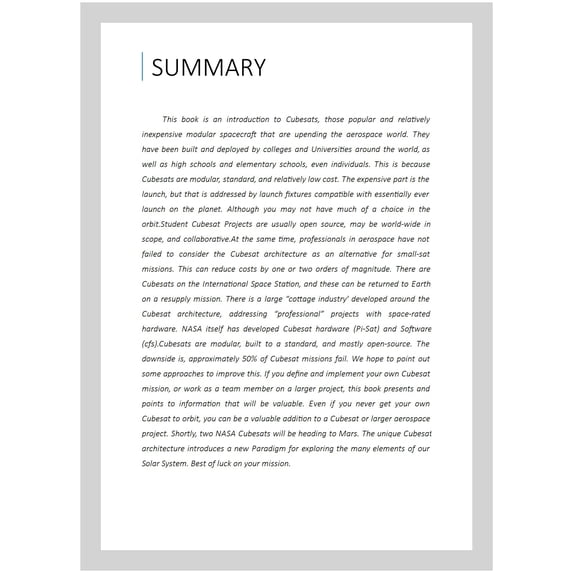
This book is an introduction to Cubesats, those popular and relatively inexpensive modular spacecraft that are upending the aerospace world. They have been built and deployed by colleges and Universities around the world, as well as high schools and elementary schools, even individuals. This is because Cubesats are modular, standard, and relatively low cost. The expensive part is the launch, but that is addressed by launch fixtures compatible with essentially ever launch on the planet. Although you may not have much of a choice in the orbit. Student Cubesat Projects are usually open source, may be world-wide in scope, and collaborative. At the same time, professionals in aerospace have not failed to consider the Cubesat architecture as an alternative for small-sat missions. This can reduce costs by one or two orders of magnitude. There are Cubesats on the International Space Station, and these can be returned to Earth on a resupply mission. There is a large "cottage industry' developed around the Cubesat architecture, addressing "professional" projects with space-rated hardware. NASA itself has developed Cubesat hardware (Pi-Sat) and Software (cfs). Cubesats are modular, built to a standard, and mostly open-source. The downside is, approximately 50% of Cubesat missions fail. We hope to point out some approaches to improve this. If you define and implement your own Cubesat mission, or work as a team member on a larger project, this book presents and points to information that will be valuable. Even if you never get your own Cubesat to orbit, you can be a valuable addition to a Cubesat or larger aerospace project. Shortly, two NASA Cubesats will be heading to Mars. The unique Cubesat architecture introduces a new Paradigm for exploring the many elements of our Solar System. Best of luck on your mission.
Specs
- Book formatPaperback
- Fiction/nonfictionNon-Fiction
- Pages106
- Series titleCubesat
- Number in series1
- Original languagesEnglish
Current price is USD$10.67
Price when purchased online
 Free 90-day returns
How do you want your item?
Try 30 days of Free Shipping with Walmart+! Choose plan at checkout.
Columbus, 43215
Arrives by Mon, Apr 13
Sold and shipped by Walmart.com

Free 90-day returns

This item is gift eligible

Get free delivery, shipping and more*
*Restrictions apply Try Walmart+ now
About this item
Product details
9781986506267. New condition. Trade paperback. Language: English. Pages: 106. Trade paperback (US). Glued binding. 106 p. Cubesat, 1. This book is an introduction to Cubesats, those popular and relatively inexpensive modular spacecraft that are upending the aerospace world. They have been built and deployed by colleges and Universities around the world, as well as high schools and elementary schools, even individuals. This is because Cubesats are modular, standard, and relatively low cost. The expensive part is the launch, but that is addressed by launch fixtures compatible with essentially ever launch on the planet. Although you may not have much of a choice in the orbit.Student Cubesat Projects are usually open source, may be world-wide in scope, and collaborative.At the same time, professionals in aerospace have not failed to consider the Cubesat architecture as an alternative for small-sat missions. This can reduce costs by one or two orders of magnitude. There are Cubesats on the International Space Station, and these can be returned to Earth on a resupply mission. There is a large "cottage industry' developed around the Cubesat architecture, addressing "professional" projects with space-rated hardware. NASA itself has developed Cubesat hardware (Pi-Sat) and Software (cfs).Cubesats are modular, built to a standard, and mostly open-source. The downside is, approximately 50% of Cubesat missions fail. We hope to point out some approaches to improve this. If you define and implement your own Cubesat mission, or work as a team member on a larger project, this book presents and points to information that will be valuable. Even if you never get your own Cubesat to orbit, you can be a valuable addition to a Cubesat or larger aerospace project. Shortly, two NASA Cubesats will be heading to Mars. The unique Cubesat architecture introduces a new Paradigm for exploring the many elements of our Solar System. Best of luck on your mission.
This book is an introduction to Cubesats, those popular and relatively inexpensive modular spacecraft that are upending the aerospace world. They have been built and deployed by colleges and Universities around the world, as well as high schools and elementary schools, even individuals. This is because Cubesats are modular, standard, and relatively low cost. The expensive part is the launch, but that is addressed by launch fixtures compatible with essentially ever launch on the planet. Although you may not have much of a choice in the orbit. Student Cubesat Projects are usually open source, may be world-wide in scope, and collaborative. At the same time, professionals in aerospace have not failed to consider the Cubesat architecture as an alternative for small-sat missions. This can reduce costs by one or two orders of magnitude. There are Cubesats on the International Space Station, and these can be returned to Earth on a resupply mission. There is a large "cottage industry' developed around the Cubesat architecture, addressing "professional" projects with space-rated hardware. NASA itself has developed Cubesat hardware (Pi-Sat) and Software (cfs). Cubesats are modular, built to a standard, and mostly open-source. The downside is, approximately 50% of Cubesat missions fail. We hope to point out some approaches to improve this. If you define and implement your own Cubesat mission, or work as a team member on a larger project, this book presents and points to information that will be valuable. Even if you never get your own Cubesat to orbit, you can be a valuable addition to a Cubesat or larger aerospace project. Shortly, two NASA Cubesats will be heading to Mars. The unique Cubesat architecture introduces a new Paradigm for exploring the many elements of our Solar System. Best of luck on your mission.
info:
We aim to show you accurate product information. Manufacturers, suppliers and others provide what you see here, and we have not verified it.
Specifications
Book format
Paperback
Fiction/nonfiction
Non-Fiction
Genre
Political & Social Sciences
Pages
106
Customer ratings & reviews
0 ratings|0 reviews
This item does not have any reviews yet
