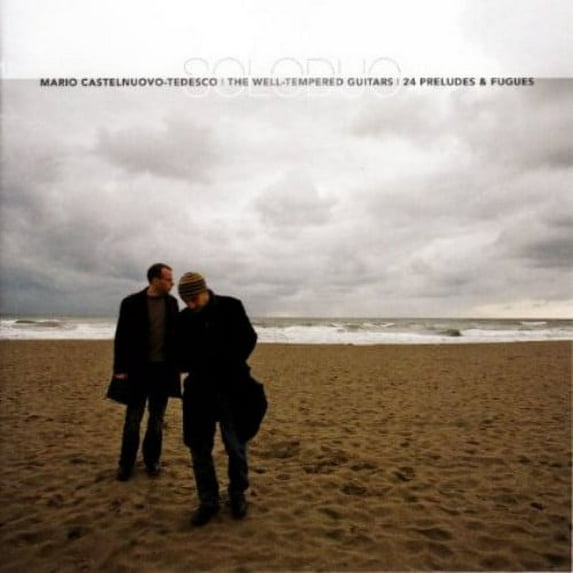
When he signed the last of his twenty-four preludes and fugues on 3 June 1962, probably Mario Castelnuovo-Tedesco was unaware that he had completed the longest and most important cycle of work for two guitars ever composed; that quot;les guitares bien tempéréesquot; (as he had ironically entitled the text) would enjoy uninterrupted and growing success in the decades to come; that also, five years later, precisely a prelude and fugue - apart from the four incomplete books of the quot;Appuntiquot; - would be his last work for the guitar, the instrument that perhaps he loved and cultivated more than any other for thirty-five years of his life. quot;The Well-Tempered Guitarsquot; began to take shape at the beginning of March 1962, when the performances of the French guitar duo formed by Ida Presti and Alexandre Lagoya aroused great enthusiasm in the Californian musical community. The preludes and fugues were the most admirable result of an intense and concentrated period of composition to which the quot;Sonatina Canonicaquot; Op. 196 (1961) and the quot;Concertoquot; Op. 201 (1962) also belong. The speed of the composer in the creation was prodigious: less than three months of disciplined work for more than two hundred pages of score. The first of the four books into which the cycle is subdivided was completed between 8 and 27 March; Castelnuovo-Tedesco worked on the second between 23 and 11 May, after a pause of more than three weeks; the third book bears the dates of 14 and 26 May, and the last, begun on the 22 May, was completed on 3 June 1962. Similarly to the two books of the Bach model of reference (quot;The Well-Tempered Clavierquot;), the twenty-four preludes and fugues of the quot;guitares bien tempéréesquot; are written in all the major and minor keys. For an instrument that rarely and reluctantly departs from the close context of the usual keys, it was an ambitious challenge, taken up by the composer who in his youth, as an enthusiastic composition student of Ildebrando Pizzetti, had set himself the task of writing three hundred and sixty-five fugues in a year - one a day - with the purpose of perfecting his command of counterpoint. The series of keys moves forward in ascending fifth intervals, stating from G minor and alternating rigorously between preludes and fugues in a minor key and preludes and fugues in a major key: a different and original solution from the quot;Well-Tempered Clavierquot; (in which the progression of the keys takes place by ascending semitones) and texts like the 24 Preludes Op. 28 by Chopin or the 24 Preludes and Fugues Op. 87 by Shostakovich, where the major keys - starting from that of C - are certainly organised according to the cycle of ascending fifths, but always coupled with their respective minor key. The construction of the two pairs of books is perfectly symmetrical, with an inversion between the minor and the major key at the beginning of the third book: the first cycle of twelve preludes and fugues (Cahiers I and II) opens in G minor and closes on a triumphant C major, the second cycle of twelve (Cahiers III and IV) starts from a graceful G major and concludes in C minor, according to the following scheme: Books I and II: G minor to C major I. G minor II. D major III. A minor IV. E major V. B minor VI. F sharp major VII. C sharp minor VIII. A flat major IX. E flat minor X. B flat major XI. F minor XII. C major Books III and IV: G major to C minor XIII. G major XIV. D minor XV. A major XVI. E minor XVII. B major XVIII. F sharp minor XIX. C sharp major XX.