

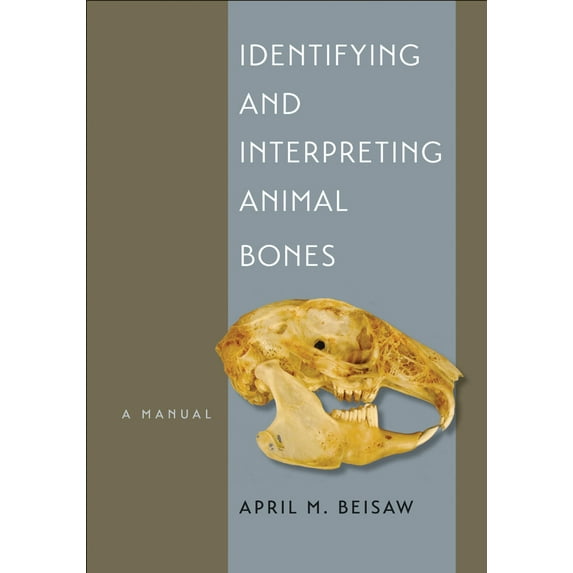
Hero image 0 of Texas A&M University Anthropology Series: Identifying and Interpreting Animal Bones : A Manual (Series #18) (Paperback), 0 of 1
Texas A&M University Anthropology Series: Identifying and Interpreting Animal Bones : A Manual (Series #18) (Paperback)
(No ratings yet)
Key item features
Offering a field-tested analytic method for identifying faunal remains, along with helpful references, images, and examples of the most commonly encountered North American species, Identifying and Interpreting Animal Bones: A Manual provides an important new reference for students, avocational archaeologists, and even naturalists and wildlife enthusiasts. Using the basic principles outlined here, the bones of any vertebrate animal, including humans, can be identified and their relevance to common research questions can be better understood.
Because the interpretation of archaeological sites depends heavily on the analysis of surrounding materials—soils, artifacts, and floral and faunal remains—it is important that non-human remains be correctly distinguished from human bones, that distinctions between domesticated and wild or feral animals be made correctly, and that evidence of the reasons for faunal remains in the site be recognized. But the ability to identify and analyze animal bones is a skill that is not easy to learn from a traditional textbook. In Identifying and Interpreting Animal Bones, veteran archaeologist and educator April Beisaw guides readers through the stages of identification and analysis with sample images and data, also illustrating how specialists make analytical decisions that allow for the identification of the smallest fragments of bone.
Extensive additional illustrative material, from the author’s own collected assemblages and from those in the Archaeological Analytical Research Facility at Binghamton University in New York, are also available in the book’s online supplement. There, readers can view and interact with images to further understanding of the principles explained in the text.
Because the interpretation of archaeological sites depends heavily on the analysis of surrounding materials—soils, artifacts, and floral and faunal remains—it is important that non-human remains be correctly distinguished from human bones, that distinctions between domesticated and wild or feral animals be made correctly, and that evidence of the reasons for faunal remains in the site be recognized. But the ability to identify and analyze animal bones is a skill that is not easy to learn from a traditional textbook. In Identifying and Interpreting Animal Bones, veteran archaeologist and educator April Beisaw guides readers through the stages of identification and analysis with sample images and data, also illustrating how specialists make analytical decisions that allow for the identification of the smallest fragments of bone.
Extensive additional illustrative material, from the author’s own collected assemblages and from those in the Archaeological Analytical Research Facility at Binghamton University in New York, are also available in the book’s online supplement. There, readers can view and interact with images to further understanding of the principles explained in the text.
Specs
- Manual & guide typeInstruction Manual
- Book formatPaperback
- Edition1
- Skill levelBeginner
- Pages192
- LanguageEnglish
More seller options (1)
Starting from $58.36
About this item
Product details
Offering a field-tested analytic method for identifying faunal remains, along with helpful references, images, and examples of the most commonly encountered North American species, Identifying and Interpreting Animal Bones: A Manual provides an important new reference for students, avocational archaeologists, and even naturalists and wildlife enthusiasts. Using the basic principles outlined here, the bones of any vertebrate animal, including humans, can be identified and their relevance to common research questions can be better understood. Because the interpretation of archaeological sites depends heavily on the analysis of surrounding materials--soils, artifacts, and floral and faunal remains--it is important that non-human remains be correctly distinguished from human bones, that distinctions between domesticated and wild or feral animals be made correctly, and that evidence of the reasons for faunal remains in the site be recognized. But the ability to identify and analyze animal bones is a skill that is not easy to learn from a traditional textbook. In Identifying and Interpreting Animal Bones, veteran archaeologist and educator April Beisaw guides readers through the stages of identification and analysis with sample images and data, also illustrating how specialists make analytical decisions that allow for the identification of the smallest fragments of bone. Extensive additional illustrative material, from the author's own collected assemblages and from those in the Archaeological Analytical Research Facility at Binghamton University in New York, are also available in the book's online supplement. There, readers can view and interact with images to further understanding of the principles explained in the text.
Offering a field-tested analytic method for identifying faunal remains, along with helpful references, images, and examples of the most commonly encountered North American species, Identifying and Interpreting Animal Bones: A Manual provides an important new reference for students, avocational archaeologists, and even naturalists and wildlife enthusiasts. Using the basic principles outlined here, the bones of any vertebrate animal, including humans, can be identified and their relevance to common research questions can be better understood.
Because the interpretation of archaeological sites depends heavily on the analysis of surrounding materials—soils, artifacts, and floral and faunal remains—it is important that non-human remains be correctly distinguished from human bones, that distinctions between domesticated and wild or feral animals be made correctly, and that evidence of the reasons for faunal remains in the site be recognized. But the ability to identify and analyze animal bones is a skill that is not easy to learn from a traditional textbook. In Identifying and Interpreting Animal Bones, veteran archaeologist and educator April Beisaw guides readers through the stages of identification and analysis with sample images and data, also illustrating how specialists make analytical decisions that allow for the identification of the smallest fragments of bone.
Extensive additional illustrative material, from the author’s own collected assemblages and from those in the Archaeological Analytical Research Facility at Binghamton University in New York, are also available in the book’s online supplement. There, readers can view and interact with images to further understanding of the principles explained in the text.
Because the interpretation of archaeological sites depends heavily on the analysis of surrounding materials—soils, artifacts, and floral and faunal remains—it is important that non-human remains be correctly distinguished from human bones, that distinctions between domesticated and wild or feral animals be made correctly, and that evidence of the reasons for faunal remains in the site be recognized. But the ability to identify and analyze animal bones is a skill that is not easy to learn from a traditional textbook. In Identifying and Interpreting Animal Bones, veteran archaeologist and educator April Beisaw guides readers through the stages of identification and analysis with sample images and data, also illustrating how specialists make analytical decisions that allow for the identification of the smallest fragments of bone.
Extensive additional illustrative material, from the author’s own collected assemblages and from those in the Archaeological Analytical Research Facility at Binghamton University in New York, are also available in the book’s online supplement. There, readers can view and interact with images to further understanding of the principles explained in the text.
info:
We aim to show you accurate product information. Manufacturers, suppliers and others provide what you see here, and we have not verified it.
Specifications
Manual & guide type
Instruction Manual
Book format
Paperback
Edition
1
Skill level
Beginner
Warranty
Warranty information
Please be aware that the warranty terms on items offered for sale by third party Marketplace sellers may differ from those displayed in this section (if any). To confirm warranty terms on an item offered for sale by a third party Marketplace seller, please use the 'Contact seller' feature on the third party Marketplace seller's information page and request the item's warranty terms prior to purchase.
Similar items you might like
Based on what customers bought
School for Advanced Research Advanced Se Shape of Script: How and Why Writing Systems Change, (Paperback) $34.37
 $3437current price $34.37
School for Advanced Research Advanced Se Shape of Script: How and Why Writing Systems Change, (Paperback)
Southern Key: Class, Race, and Radicalism in the 1930s and 1940s, (Paperback) $37.78
 $3778current price $37.78
Southern Key: Class, Race, and Radicalism in the 1930s and 1940s, (Paperback)
Berkeley Series in British Studies: Participant Observers : Anthropology, Colonial Development, and the Reinvention of Society in Britain (Series #22) (Edition 1) (Paperback) $42.02
 $4202current price $42.02
Berkeley Series in British Studies: Participant Observers : Anthropology, Colonial Development, and the Reinvention of Society in Britain (Series #22) (Edition 1) (Paperback)
Ironmaking : A History and Archaeology of the Iron Industry (Paperback) $27.29
 $2729current price $27.29
Ironmaking : A History and Archaeology of the Iron Industry (Paperback)
The Story of Our Ancestors, (Hardcover) $32.95
 $3295current price $32.95
The Story of Our Ancestors, (Hardcover)
Spooky Archaeology: Myth and the Science of the Past, (Paperback) $39.95
 $3995current price $39.95
Spooky Archaeology: Myth and the Science of the Past, (Paperback)
Prehistory of the Indo-Malaysian Archipelago, (Paperback) $28.21
 $2821current price $28.21
Prehistory of the Indo-Malaysian Archipelago, (Paperback)
Ethics in Action : Case Studies in Archaeological Dilemmas (Paperback) $27.95
 $2795current price $27.95
Ethics in Action : Case Studies in Archaeological Dilemmas (Paperback)
Beyond Anthropology: Society and the Other, (Paperback) $34.93
 $3493current price $34.93
Beyond Anthropology: Society and the Other, (Paperback)
Florida Museum of Natural History: Riple Bioarchaeology of Ethnogenesis in the Colonial Southeast, (Paperback) $24.95
 $2495current price $24.95
Florida Museum of Natural History: Riple Bioarchaeology of Ethnogenesis in the Colonial Southeast, (Paperback)
The Social Archaeology of Food: Thinking about Eating from Prehistory to the Present, (Paperback) $50.12
 2 optionsAvailable in additional 2 options$5012current price $50.12
The Social Archaeology of Food: Thinking about Eating from Prehistory to the Present, (Paperback)
Archaeology in South Carolina: Exploring the Hidden Heritage of the Palmetto State (Hardcover) $36.26
 $3626current price $36.26
Archaeology in South Carolina: Exploring the Hidden Heritage of the Palmetto State (Hardcover)
Interdisciplinary Contributions to Archa Uncertainty and Sensitivity Analysis in Archaeological Computational Modeling, Book 0, (Hardcover) $49.62
 $4962current price $49.62
Interdisciplinary Contributions to Archa Uncertainty and Sensitivity Analysis in Archaeological Computational Modeling, Book 0, (Hardcover)
American Association for State and Local History: Material Culture Studies in America : An Anthology (Paperback) $66.71
 $6671current price $66.71
American Association for State and Local History: Material Culture Studies in America : An Anthology (Paperback)
A Latina in the Land of Hollywood : and Other Essays on Media Culture (Paperback) $34.44
 $3444current price $34.44
A Latina in the Land of Hollywood : and Other Essays on Media Culture (Paperback)
Wiley Blackwell Studies in Global Archae African Archaeology: A Critical Introduction, (Paperback) $42.04
 $4204current price $42.04
Wiley Blackwell Studies in Global Archae African Archaeology: A Critical Introduction, (Paperback)
African Ethnographic Studies of the 20th Century: The Horse in West African History (Paperback) $48.99
 $4899current price $48.99
African Ethnographic Studies of the 20th Century: The Horse in West African History (Paperback)
Heritage Matters Destruction of Cultural Heritage in Iraq, Book 1, (Paperback) $41.68
 $4168current price $41.68
Heritage Matters Destruction of Cultural Heritage in Iraq, Book 1, (Paperback)


Customer ratings & reviews
0 ratings|0 reviews
This item does not have any reviews yet
