

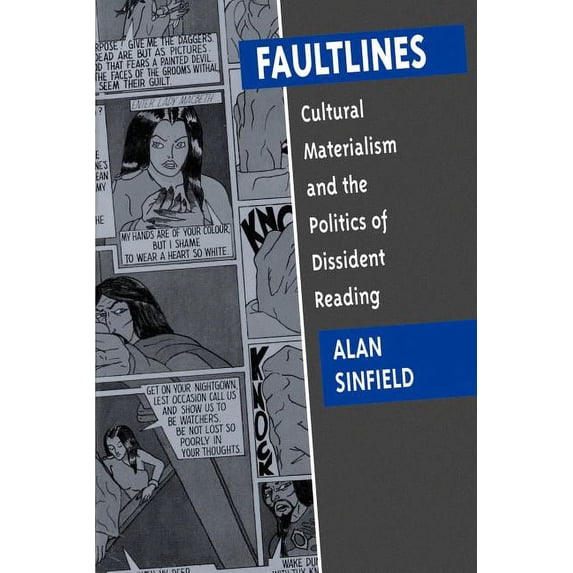
Hero image 0 of Faultlines : Cultural Materialism and the Politics of Dissident Reading (Edition 1) (Paperback), 0 of 1
Faultlines : Cultural Materialism and the Politics of Dissident Reading (Edition 1) (Paperback)
(No ratings yet)
Key item features
If we come to consciousness within a language that is complicit with the social order, how can we conceive, let alone organize, resistance to that social order? This key question in the politics of reading and subcultural practice informs Alan Sinfield's book on writing in early-modern England.
New historicism has often shown people trapped in a web of language and culture. In lively discussions of writings by Shakespeare, Marlowe, Sidney, and Donne, Sinfield reassesses the scope of dissidence and control. The early-modern state, Christianity, and the cultural apparatus, despite an ideology of unity and explicit violence, could not but allow space to challenging voices. Sinfield shows that disruptions in concepts of hierarchy, nationality, gender, and sexuality force their way into literary texts.
Sinfield is often provocative. He "rewrites" Julius Caesar to produce a different politics, compares Sidney's idea of poetry to Leonid Brezhnev's, and reinstates the concept of character in the face of post-structuralist theory. He keeps the current politics of literary study in view, especially in a substantial chapter on Shakespeare in the U.S. Sinfield subjects interactions between class, ethnicity, sexuality, and the professional structures of the humanities to a detailed and hard-hitting critique, and argues for new commitments to collectivities and subcultures.
New historicism has often shown people trapped in a web of language and culture. In lively discussions of writings by Shakespeare, Marlowe, Sidney, and Donne, Sinfield reassesses the scope of dissidence and control. The early-modern state, Christianity, and the cultural apparatus, despite an ideology of unity and explicit violence, could not but allow space to challenging voices. Sinfield shows that disruptions in concepts of hierarchy, nationality, gender, and sexuality force their way into literary texts.
Sinfield is often provocative. He "rewrites" Julius Caesar to produce a different politics, compares Sidney's idea of poetry to Leonid Brezhnev's, and reinstates the concept of character in the face of post-structuralist theory. He keeps the current politics of literary study in view, especially in a substantial chapter on Shakespeare in the U.S. Sinfield subjects interactions between class, ethnicity, sexuality, and the professional structures of the humanities to a detailed and hard-hitting critique, and argues for new commitments to collectivities and subcultures.
Specs
- Book formatPaperback
- Fiction/nonfictionNon-Fiction
- GenreLiterature & Fiction
- Publication dateSeptember, 1992
- Pages380
- Reading levelCollege
Current price is USD$36.95
Price when purchased online
- Free shipping
 Free 90-day returns
How do you want your item?
Try 30 days for just $1! Choose a plan at checkout.
Ships to
Arrives by Fri, May 22
Sold and shipped by Walmart.com

Free 90-day returns

This item is gift eligible
Other sellers
$52.07
+Free shippingShipping, arrives by Sat, May 30 to Columbus, 43215
Sold and shipped by RAREWAVES-USA
Free 30-day returns

Try 30 days of Walmart+ for just $1!
T&C apply. Claim offer now
About this item
Product details
If we come to consciousness within a language that is complicit with the social order, how can we conceive, let alone organize, resistance to that social order? This key question in the politics of reading and subcultural practice informs Alan Sinfield's book on writing in early-modern England.
New historicism has often shown people trapped in a web of language and culture. In lively discussions of writings by Shakespeare, Marlowe, Sidney, and Donne, Sinfield reassesses the scope of dissidence and control. The early-modern state, Christianity, and the cultural apparatus, despite an ideology of unity and explicit violence, could not but allow space to challenging voices. Sinfield shows that disruptions in concepts of hierarchy, nationality, gender, and sexuality force their way into literary texts.
Sinfield is often provocative. He "rewrites" Julius Caesar to produce a different politics, compares Sidney's idea of poetry to Leonid Brezhnev's, and reinstates the concept of character in the face of post-structuralist theory. He keeps the current politics of literary study in view, especially in a substantial chapter on Shakespeare in the U.S. Sinfield subjects interactions between class, ethnicity, sexuality, and the professional structures of the humanities to a detailed and hard-hitting critique, and argues for new commitments to collectivities and subcultures.
New historicism has often shown people trapped in a web of language and culture. In lively discussions of writings by Shakespeare, Marlowe, Sidney, and Donne, Sinfield reassesses the scope of dissidence and control. The early-modern state, Christianity, and the cultural apparatus, despite an ideology of unity and explicit violence, could not but allow space to challenging voices. Sinfield shows that disruptions in concepts of hierarchy, nationality, gender, and sexuality force their way into literary texts.
Sinfield is often provocative. He "rewrites" Julius Caesar to produce a different politics, compares Sidney's idea of poetry to Leonid Brezhnev's, and reinstates the concept of character in the face of post-structuralist theory. He keeps the current politics of literary study in view, especially in a substantial chapter on Shakespeare in the U.S. Sinfield subjects interactions between class, ethnicity, sexuality, and the professional structures of the humanities to a detailed and hard-hitting critique, and argues for new commitments to collectivities and subcultures.
If we come to consciousness within a language that is complicit with the social order, how can we conceive, let alone organize, resistance to that social order? This key question in the politics of reading and subcultural practice informs Alan Sinfield's book on writing in early-modern England.
New historicism has often shown people trapped in a web of language and culture. In lively discussions of writings by Shakespeare, Marlowe, Sidney, and Donne, Sinfield reassesses the scope of dissidence and control. The early-modern state, Christianity, and the cultural apparatus, despite an ideology of unity and explicit violence, could not but allow space to challenging voices. Sinfield shows that disruptions in concepts of hierarchy, nationality, gender, and sexuality force their way into literary texts.
Sinfield is often provocative. He "rewrites" Julius Caesar to produce a different politics, compares Sidney's idea of poetry to Leonid Brezhnev's, and reinstates the concept of character in the face of post-structuralist theory. He keeps the current politics of literary study in view, especially in a substantial chapter on Shakespeare in the U.S. Sinfield subjects interactions between class, ethnicity, sexuality, and the professional structures of the humanities to a detailed and hard-hitting critique, and argues for new commitments to collectivities and subcultures.
New historicism has often shown people trapped in a web of language and culture. In lively discussions of writings by Shakespeare, Marlowe, Sidney, and Donne, Sinfield reassesses the scope of dissidence and control. The early-modern state, Christianity, and the cultural apparatus, despite an ideology of unity and explicit violence, could not but allow space to challenging voices. Sinfield shows that disruptions in concepts of hierarchy, nationality, gender, and sexuality force their way into literary texts.
Sinfield is often provocative. He "rewrites" Julius Caesar to produce a different politics, compares Sidney's idea of poetry to Leonid Brezhnev's, and reinstates the concept of character in the face of post-structuralist theory. He keeps the current politics of literary study in view, especially in a substantial chapter on Shakespeare in the U.S. Sinfield subjects interactions between class, ethnicity, sexuality, and the professional structures of the humanities to a detailed and hard-hitting critique, and argues for new commitments to collectivities and subcultures.
info:
We aim to show you accurate product information. Manufacturers, suppliers and others provide what you see here, and we have not verified it.
Specifications
Book format
Paperback
Fiction/nonfiction
Non-Fiction
Genre
Literature & Fiction
Publication date
September, 1992
Warranty
Warranty information
Please be aware that the warranty terms on items offered for sale by third party Marketplace sellers may differ from those displayed in this section (if any). To confirm warranty terms on an item offered for sale by a third party Marketplace seller, please use the 'Contact seller' feature on the third party Marketplace seller's information page and request the item's warranty terms prior to purchase.
Similar items you might like
Based on what customers bought
Old Man's War The Shattering Peace: Old Man's War Book 7, Book 7, (Paperback) $18.99
 $1899current price $18.99
Old Man's War The Shattering Peace: Old Man's War Book 7, Book 7, (Paperback)
Classic Criticism Literature, Politics and Culture in Postwar Britain, (Paperback) $37.72
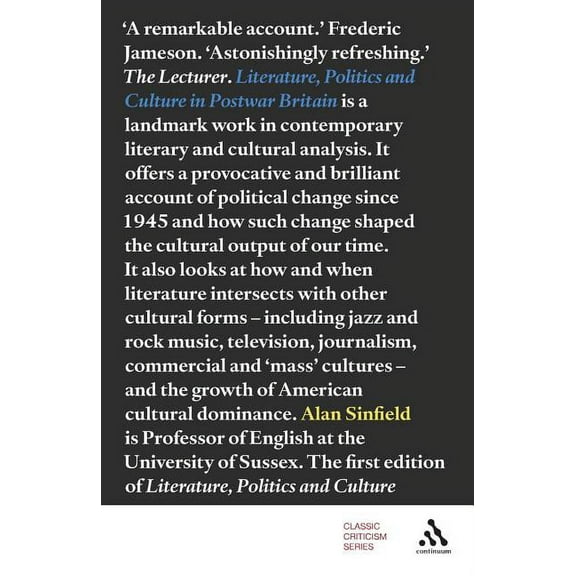 $3772current price $37.72
Classic Criticism Literature, Politics and Culture in Postwar Britain, (Paperback)
The General's Wife, (Paperback) $15.99
 $1599current price $15.99
The General's Wife, (Paperback)
Best seller King (Paperback) $13.48
Best seller $1348current price $13.48
King (Paperback)
115 out of 5 Stars. 11 reviewsThe Holiday Post, (Paperback) $18.21
 $1821current price $18.21
The Holiday Post, (Paperback)
Best seller I m Dead Now What, Book, (Paperback) $10.24
Best seller $1024current price $10.24
I m Dead Now What, Book, (Paperback)
2554.6 out of 5 Stars. 255 reviewsBest seller Good Spirits: A Novel (Paperback) $8.50 Was $11.40
Best seller $850current price $8.50, Was $11.40$11.40
Good Spirits: A Novel (Paperback)
194.5 out of 5 Stars. 19 reviewsContinuum Impacts Literature, Politics and Culture in Postwar Britain, Book 35, (Paperback) $52.75
 $5275current price $52.75
Continuum Impacts Literature, Politics and Culture in Postwar Britain, Book 35, (Paperback)
Platonism And The Spiritual Life, (Paperback) $21.95
 $2195current price $21.95
Platonism And The Spiritual Life, (Paperback)
J. M. Coetzee's Politics of Life and Late Modernism in the Contemporary Novel, (Paperback) $29.95
 $2995current price $29.95
J. M. Coetzee's Politics of Life and Late Modernism in the Contemporary Novel, (Paperback)
A Politics of Melancholia: From Plato to Arendt, (Paperback) $21.20
 $2120current price $21.20
A Politics of Melancholia: From Plato to Arendt, (Paperback)
The Cunning of Unreason: Making Sense of Politics, (Paperback) $21.61
 $2161current price $21.61
The Cunning of Unreason: Making Sense of Politics, (Paperback)
Historical Materialism The Politics of Style: Towards a Marxist Poetics, (Paperback) $22.36
 $2236current price $22.36
Historical Materialism The Politics of Style: Towards a Marxist Poetics, (Paperback)
Rooting for Humanity $9.95
 $995current price $9.95
Rooting for Humanity
Disruptive Play: The Trickster in Politics and Culture, (Paperback) $17.20
 $1720current price $17.20
Disruptive Play: The Trickster in Politics and Culture, (Paperback)
Joel Jessup Murder by Christmas (Paperback) $18.29
 $1829current price $18.29
Joel Jessup Murder by Christmas (Paperback)
We Say Shalom: 40 Words to Cultivate Curiosity and Connection, (Paperback) $16.64
 $1664current price $16.64
We Say Shalom: 40 Words to Cultivate Curiosity and Connection, (Paperback)
Rhetoric and the Digital Humanities, (Paperback) $36.70
 $3670current price $36.70
Rhetoric and the Digital Humanities, (Paperback)
Curatorial Conversations: Cultural Representation and the Smithsonian Folklife Festival, (Paperback) $23.45 Was $35.01
 $2345current price $23.45, Was $35.01$35.01
Curatorial Conversations: Cultural Representation and the Smithsonian Folklife Festival, (Paperback)
Customer ratings & reviews
0 ratings|0 reviews
This item does not have any reviews yet
