

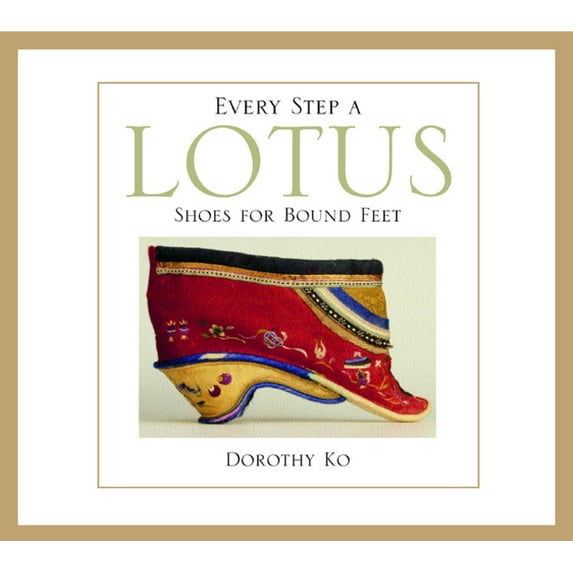
Every Step a Lotus : Shoes for Bound Feet (Edition 1) (Paperback)
(No ratings yet)
Key item features
In Every Step a Lotus, Dorothy Ko embarks on a fascinating exploration of the practice of footbinding in China, explaining its origins, purpose, and spread before the nineteenth century. She uses women's own voices to reconstruct the inner chambers of a Chinese house where women with bound feet lived and worked. Focusing on the material aspects of footbinding and shoemaking--the tools needed, the procedures, the wealth of symbolism in the shoes, and the amazing regional variations in style--she contends that footbinding was a reasonable course of action for a woman who lived in a Confucian culture that placed the highest moral value on domesticity, motherhood, and handwork. Her absorbing, superbly detailed, and beautifully written book demonstrates that in the women's eyes, footbinding had less to do with the exotic or the sublime than with the mundane business of having to live in a woman's body in a man's world.
Footbinding was likely to have started in the tenth century among palace dancers. Ironically, it was meant not to cripple but to enhance their grace. Its meaning shifted dramatically as it became domesticated in the subsequent centuries, though the original hint of sensuality did not entirely disappear. This contradictory image of footbinding as at once degenerate and virtuous, grotesque and refined, is embodied in the key symbol for the practice--the lotus blossom, being both a Buddhist sign of piety and a poetic allusion to sensory pleasures.
Every Step a Lotus includes almost one hundred illustrations of shoes from different regions of China, material paraphernalia associated with the customs and rituals of footbinding, and historical images that contextualize the narrative. Most of the shoes, from the collection of the Bata Shoe Museum in Toronto, have not been exhibited before. Readers will come away from the book with a richer understanding of why footbinding carries such force as a symbol and why, long after its demise, it continues to exercise a powerful grip on our imaginations.
A Copublication with the Bata Shoe Museum
Footbinding was likely to have started in the tenth century among palace dancers. Ironically, it was meant not to cripple but to enhance their grace. Its meaning shifted dramatically as it became domesticated in the subsequent centuries, though the original hint of sensuality did not entirely disappear. This contradictory image of footbinding as at once degenerate and virtuous, grotesque and refined, is embodied in the key symbol for the practice--the lotus blossom, being both a Buddhist sign of piety and a poetic allusion to sensory pleasures.
Every Step a Lotus includes almost one hundred illustrations of shoes from different regions of China, material paraphernalia associated with the customs and rituals of footbinding, and historical images that contextualize the narrative. Most of the shoes, from the collection of the Bata Shoe Museum in Toronto, have not been exhibited before. Readers will come away from the book with a richer understanding of why footbinding carries such force as a symbol and why, long after its demise, it continues to exercise a powerful grip on our imaginations.
A Copublication with the Bata Shoe Museum
Specs
- Book formatPaperback
- Fiction/nonfictionNon-Fiction
- Publication dateDecember, 2001
- Pages162
- Reading levelGrade 2
- Edition1
Current price is USD$28.35
Price when purchased online
 Free 90-day returns
$28.35
Out of stock
How do you want your item?
Try 30 days for just $1! Choose a plan at checkout.
Ships to
Arrives by Fri, May 22
Sold and shipped by Walmart.com

Free 90-day returns

This item is gift eligible
More seller options (1)
Starting from $37.88

Try 30 days of Walmart+ for just $1!
T&C apply. Claim offer now
About this item
Product details
In Every Step a Lotus, Dorothy Ko embarks on a fascinating exploration of the practice of footbinding in China, explaining its origins, purpose, and spread before the nineteenth century. She uses women's own voices to reconstruct the inner chambers of a Chinese house where women with bound feet lived and worked. Focusing on the material aspects of footbinding and shoemaking--the tools needed, the procedures, the wealth of symbolism in the shoes, and the amazing regional variations in style--she contends that footbinding was a reasonable course of action for a woman who lived in a Confucian culture that placed the highest moral value on domesticity, motherhood, and handwork. Her absorbing, superbly detailed, and beautifully written book demonstrates that in the women's eyes, footbinding had less to do with the exotic or the sublime than with the mundane business of having to live in a woman's body in a man's world.
Footbinding was likely to have started in the tenth century among palace dancers. Ironically, it was meant not to cripple but to enhance their grace. Its meaning shifted dramatically as it became domesticated in the subsequent centuries, though the original hint of sensuality did not entirely disappear. This contradictory image of footbinding as at once degenerate and virtuous, grotesque and refined, is embodied in the key symbol for the practice--the lotus blossom, being both a Buddhist sign of piety and a poetic allusion to sensory pleasures.
Every Step a Lotus includes almost one hundred illustrations of shoes from different regions of China, material paraphernalia associated with the customs and rituals of footbinding, and historical images that contextualize the narrative. Most of the shoes, from the collection of the Bata Shoe Museum in Toronto, have not been exhibited before. Readers will come away from the book with a richer understanding of why footbinding carries such force as a symbol and why, long after its demise, it continues to exercise a powerful grip on our imaginations.
A Copublication with the Bata Shoe Museum
Footbinding was likely to have started in the tenth century among palace dancers. Ironically, it was meant not to cripple but to enhance their grace. Its meaning shifted dramatically as it became domesticated in the subsequent centuries, though the original hint of sensuality did not entirely disappear. This contradictory image of footbinding as at once degenerate and virtuous, grotesque and refined, is embodied in the key symbol for the practice--the lotus blossom, being both a Buddhist sign of piety and a poetic allusion to sensory pleasures.
Every Step a Lotus includes almost one hundred illustrations of shoes from different regions of China, material paraphernalia associated with the customs and rituals of footbinding, and historical images that contextualize the narrative. Most of the shoes, from the collection of the Bata Shoe Museum in Toronto, have not been exhibited before. Readers will come away from the book with a richer understanding of why footbinding carries such force as a symbol and why, long after its demise, it continues to exercise a powerful grip on our imaginations.
A Copublication with the Bata Shoe Museum
In Every Step a Lotus, Dorothy Ko embarks on a fascinating exploration of the practice of footbinding in China, explaining its origins, purpose, and spread before the nineteenth century. She uses women's own voices to reconstruct the inner chambers of a Chinese house where women with bound feet lived and worked. Focusing on the material aspects of footbinding and shoemaking--the tools needed, the procedures, the wealth of symbolism in the shoes, and the amazing regional variations in style--she contends that footbinding was a reasonable course of action for a woman who lived in a Confucian culture that placed the highest moral value on domesticity, motherhood, and handwork. Her absorbing, superbly detailed, and beautifully written book demonstrates that in the women's eyes, footbinding had less to do with the exotic or the sublime than with the mundane business of having to live in a woman's body in a man's world.
Footbinding was likely to have started in the tenth century among palace dancers. Ironically, it was meant not to cripple but to enhance their grace. Its meaning shifted dramatically as it became domesticated in the subsequent centuries, though the original hint of sensuality did not entirely disappear. This contradictory image of footbinding as at once degenerate and virtuous, grotesque and refined, is embodied in the key symbol for the practice--the lotus blossom, being both a Buddhist sign of piety and a poetic allusion to sensory pleasures.
Every Step a Lotus includes almost one hundred illustrations of shoes from different regions of China, material paraphernalia associated with the customs and rituals of footbinding, and historical images that contextualize the narrative. Most of the shoes, from the collection of the Bata Shoe Museum in Toronto, have not been exhibited before. Readers will come away from the book with a richer understanding of why footbinding carries such force as a symbol and why, long after its demise, it continues to exercise a powerful grip on our imaginations.
A Copublication with the Bata Shoe Museum
Footbinding was likely to have started in the tenth century among palace dancers. Ironically, it was meant not to cripple but to enhance their grace. Its meaning shifted dramatically as it became domesticated in the subsequent centuries, though the original hint of sensuality did not entirely disappear. This contradictory image of footbinding as at once degenerate and virtuous, grotesque and refined, is embodied in the key symbol for the practice--the lotus blossom, being both a Buddhist sign of piety and a poetic allusion to sensory pleasures.
Every Step a Lotus includes almost one hundred illustrations of shoes from different regions of China, material paraphernalia associated with the customs and rituals of footbinding, and historical images that contextualize the narrative. Most of the shoes, from the collection of the Bata Shoe Museum in Toronto, have not been exhibited before. Readers will come away from the book with a richer understanding of why footbinding carries such force as a symbol and why, long after its demise, it continues to exercise a powerful grip on our imaginations.
A Copublication with the Bata Shoe Museum
info:
We aim to show you accurate product information. Manufacturers, suppliers and others provide what you see here, and we have not verified it.
Specifications
Book format
Paperback
Fiction/nonfiction
Non-Fiction
Genre
Political & Social Sciences
Publication date
December, 2001
Warranty
Warranty information
Please be aware that the warranty terms on items offered for sale by third party Marketplace sellers may differ from those displayed in this section (if any). To confirm warranty terms on an item offered for sale by a third party Marketplace seller, please use the 'Contact seller' feature on the third party Marketplace seller's information page and request the item's warranty terms prior to purchase.
Warnings
State Chemical Disclosure
None
Similar items you might like
Based on what customers bought
100+ bought since yesterday Cozy Vibes: Coloring Book for Adults and Kids, 96 pages (Paperback) $7.98
100+ bought since yesterday $798current price $7.98
Cozy Vibes: Coloring Book for Adults and Kids, 96 pages (Paperback)
334.8 out of 5 Stars. 33 reviewsBest seller Cozy Corner: Coloring Book for Adults and Kids, 96 pages (Paperback) $7.18
Best seller $718current price $7.18
Cozy Corner: Coloring Book for Adults and Kids, 96 pages (Paperback)
1304.6 out of 5 Stars. 130 reviews50+ bought since yesterday Girl Moments: Coloring Book for Adults and Kids, 96 pages (Paperback) $7.98
50+ bought since yesterday $798current price $7.98
Girl Moments: Coloring Book for Adults and Kids, 96 pages (Paperback)
274.7 out of 5 Stars. 27 reviewsNotes on Book Design: By Formal Settings, (Paperback) $21.39
 $2139current price $21.39
Notes on Book Design: By Formal Settings, (Paperback)
Best seller Jujutsu Kaisen, Vol. 29 (Paperback) $9.58
Best seller $958current price $9.58
Jujutsu Kaisen, Vol. 29 (Paperback)
214.9 out of 5 Stars. 21 reviewsBest seller Cozy Friends: Coloring Book for Adults and Kids, 96 pages (Paperback) $7.98
Best seller $798current price $7.98
Cozy Friends: Coloring Book for Adults and Kids, 96 pages (Paperback)
164.6 out of 5 Stars. 16 reviewsTouch of Leather If You Let Me, (Paperback) $16.99
 $1699current price $16.99
Touch of Leather If You Let Me, (Paperback)
Best seller Cozy Days: Coloring Book for Adults and Kids, 96 pages (Paperback) $7.98
Best seller $798current price $7.98
Cozy Days: Coloring Book for Adults and Kids, 96 pages (Paperback)
194.9 out of 5 Stars. 19 reviewsStories of the Foot-hills, (Paperback) $21.07
 $2107current price $21.07
Stories of the Foot-hills, (Paperback)
Notes from Boomerang Creek (Paperback) $17.94
 $1794current price $17.94
Notes from Boomerang Creek (Paperback)
Pre-Owned The Fabric of Her Dancing Shoes (Paperback) 0981544061 9780981544069 $7.20
 2 optionsAvailable in additional 2 options$720current price $7.20
Pre-Owned The Fabric of Her Dancing Shoes (Paperback) 0981544061 9780981544069
Ouch, There's a Pebble in My Shoe, (Paperback) $10.86
 $1086current price $10.86
Ouch, There's a Pebble in My Shoe, (Paperback)
Dorothy's Double. Volume III, (Paperback) $19.64
 $1964current price $19.64
Dorothy's Double. Volume III, (Paperback)
The Palm Tree (Paperback) $16.58
 $1658current price $16.58
The Palm Tree (Paperback)
The Tangled Skirt, (Paperback) $16.26
 $1626current price $16.26
The Tangled Skirt, (Paperback)
The Secrets of the Snowshoe Hare, (Hardcover) $45.77
 $4577current price $45.77
The Secrets of the Snowshoe Hare, (Hardcover)
The Pointe Shoe Manual, (Paperback) $21.50
 $2150current price $21.50
The Pointe Shoe Manual, (Paperback)
11 out of 5 Stars. 1 reviewsA Cowboy's Dance, (Paperback) $19.99
 $1999current price $19.99
A Cowboy's Dance, (Paperback)
The Magic of Being the Claus, (Hardcover) $21.33
 $2133current price $21.33
The Magic of Being the Claus, (Hardcover)
Snow Ink 2 Binding: Paperback $10.16 $10.16/cu ft
 $1016current price $10.16$10.16/cu ft
Snow Ink 2 Binding: Paperback
Customer ratings & reviews
0 ratings|0 reviews
This item does not have any reviews yet
