

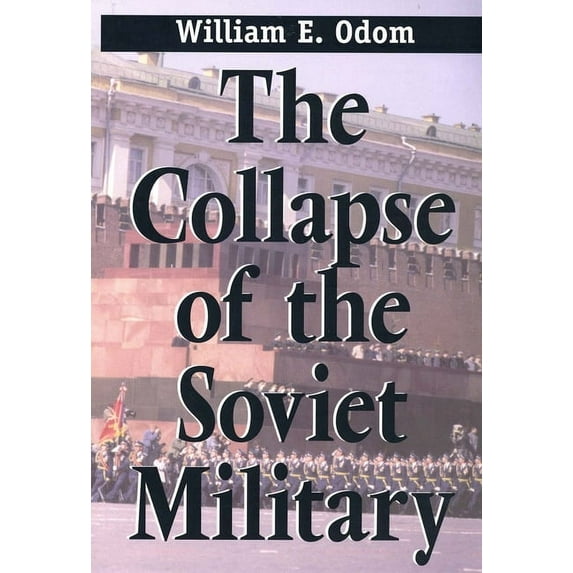
Hero image 0 of The Collapse of the Soviet Military (Paperback), 0 of 1
The Collapse of the Soviet Military (Paperback)
(No ratings yet)
Key item features
One of the great surprises in modern military history is the collapse of the Soviet Armed Forces in 1991—along with the party-state with which it was inextricably intertwined. In this important book, a distinguished United States Army officer and scholar traces the rise and fall of the Soviet military, arguing that it had a far greater impact on Soviet politics and economic development than was perceived in the West.
General William E. Odom asserts that Gorbachev saw that dramatically shrinking the military and the military-industrial sector of the economy was essential for fully implementing perestroika and that his efforts to do this led to the dissolution of the Soviet Union. Odom enhances his account with interviews with key actors in the Soviet Union before, during, and after the collapse. He describes the condition of the Soviet military during the mid-1980s and explains how it became what it was—its organizational structures, manpower policies, and military-industrial arrangements. He then moves to the dramatic events that led to its destruction, taking us to the most secret circles of Soviet policy making, as well as describing the public debates, factional struggles in the new parliament, and street combat as army units tried to repress the political forces unleashed by glasnost. Odom shows that just as the military was the ultimate source of stability for the multinational Soviet state, the communist ideology justified the military’s priority claim on the economy. When Gorbachev tried to shift resources from the military to the civilian sector to overcome economic stagnation, he had to revise the official ideology in order to justify removing the military from its central place. Paralyzed by corruption, mistrust, and public disillusionment, the military was unable and unwilling to intervene against either Gorbachev’s perestroika or Yeltsin’s dissolution of the Soviet Union.
General William E. Odom asserts that Gorbachev saw that dramatically shrinking the military and the military-industrial sector of the economy was essential for fully implementing perestroika and that his efforts to do this led to the dissolution of the Soviet Union. Odom enhances his account with interviews with key actors in the Soviet Union before, during, and after the collapse. He describes the condition of the Soviet military during the mid-1980s and explains how it became what it was—its organizational structures, manpower policies, and military-industrial arrangements. He then moves to the dramatic events that led to its destruction, taking us to the most secret circles of Soviet policy making, as well as describing the public debates, factional struggles in the new parliament, and street combat as army units tried to repress the political forces unleashed by glasnost. Odom shows that just as the military was the ultimate source of stability for the multinational Soviet state, the communist ideology justified the military’s priority claim on the economy. When Gorbachev tried to shift resources from the military to the civilian sector to overcome economic stagnation, he had to revise the official ideology in order to justify removing the military from its central place. Paralyzed by corruption, mistrust, and public disillusionment, the military was unable and unwilling to intervene against either Gorbachev’s perestroika or Yeltsin’s dissolution of the Soviet Union.
Specs
- Book formatPaperback
- Fiction/nonfictionNon-Fiction
- GenreHistory
- Publication dateMarch, 2000
- Pages544
- SubgenreHistory
Current price is USD$52.40
Price when purchased online
- Free shipping
 Free 30-day returns
How do you want your item?
Ships to
Arrives between May 23 - May 26
|
Sold and shipped by Alibris Books
4.5687372256287215 stars out of 5, based on 11253 seller reviews(4.6)11253 seller reviews

Free 30-day returns
Other sellers
$51.43
+ $7.98 shippingShipping, arrives by Fri, May 22 to Columbus, 43215
Sold and shipped by Best Prices & Service
Free 30-day returns
About this item
Product details
One of the great surprises in modern military history is the collapse of the Soviet Armed Forces in 1991--along with the party-state with which it was inextricably intertwined. In this important book, a distinguished United States Army officer and scholar traces the rise and fall of the Soviet military, arguing that it had a far greater impact on Soviet politics and economic development than was perceived in the West. General William E. Odom asserts that Gorbachev saw that dramatically shrinking the military and the military-industrial sector of the economy was essential for fully implementing perestroika and that his efforts to do this led to the dissolution of the Soviet Union. Odom enhances his account with interviews with key actors in the Soviet Union before, during, and after the collapse. He describes the condition of the Soviet military during the mid-1980s and explains how it became what it was--its organizational structures, manpower policies, and military-industrial arrangements. He then moves to the dramatic events that led to its destruction, taking us to the most secret circles of Soviet policy making, as well as describing the public debates, factional struggles in the new parliament, and street combat as army units tried to repress the political forces unleashed by glasnost. Odom shows that just as the military was the ultimate source of stability for the multinational Soviet state, the communist ideology justified the military's priority claim on the economy. When Gorbachev tried to shift resources from the military to the civilian sector to overcome economic stagnation, he had to revise the official ideology in order to justify removing the military from its central place. Paralyzed by corruption, mistrust, and public disillusionment, the military was unable and unwilling to intervene against either Gorbachev's perestroika or Yeltsin's dissolution of the Soviet Union.
One of the great surprises in modern military history is the collapse of the Soviet Armed Forces in 1991—along with the party-state with which it was inextricably intertwined. In this important book, a distinguished United States Army officer and scholar traces the rise and fall of the Soviet military, arguing that it had a far greater impact on Soviet politics and economic development than was perceived in the West.
General William E. Odom asserts that Gorbachev saw that dramatically shrinking the military and the military-industrial sector of the economy was essential for fully implementing perestroika and that his efforts to do this led to the dissolution of the Soviet Union. Odom enhances his account with interviews with key actors in the Soviet Union before, during, and after the collapse. He describes the condition of the Soviet military during the mid-1980s and explains how it became what it was—its organizational structures, manpower policies, and military-industrial arrangements. He then moves to the dramatic events that led to its destruction, taking us to the most secret circles of Soviet policy making, as well as describing the public debates, factional struggles in the new parliament, and street combat as army units tried to repress the political forces unleashed by glasnost. Odom shows that just as the military was the ultimate source of stability for the multinational Soviet state, the communist ideology justified the military’s priority claim on the economy. When Gorbachev tried to shift resources from the military to the civilian sector to overcome economic stagnation, he had to revise the official ideology in order to justify removing the military from its central place. Paralyzed by corruption, mistrust, and public disillusionment, the military was unable and unwilling to intervene against either Gorbachev’s perestroika or Yeltsin’s dissolution of the Soviet Union.
General William E. Odom asserts that Gorbachev saw that dramatically shrinking the military and the military-industrial sector of the economy was essential for fully implementing perestroika and that his efforts to do this led to the dissolution of the Soviet Union. Odom enhances his account with interviews with key actors in the Soviet Union before, during, and after the collapse. He describes the condition of the Soviet military during the mid-1980s and explains how it became what it was—its organizational structures, manpower policies, and military-industrial arrangements. He then moves to the dramatic events that led to its destruction, taking us to the most secret circles of Soviet policy making, as well as describing the public debates, factional struggles in the new parliament, and street combat as army units tried to repress the political forces unleashed by glasnost. Odom shows that just as the military was the ultimate source of stability for the multinational Soviet state, the communist ideology justified the military’s priority claim on the economy. When Gorbachev tried to shift resources from the military to the civilian sector to overcome economic stagnation, he had to revise the official ideology in order to justify removing the military from its central place. Paralyzed by corruption, mistrust, and public disillusionment, the military was unable and unwilling to intervene against either Gorbachev’s perestroika or Yeltsin’s dissolution of the Soviet Union.
info:
We aim to show you accurate product information. Manufacturers, suppliers and others provide what you see here, and we have not verified it.
Specifications
Book format
Paperback
Fiction/nonfiction
Non-Fiction
Genre
History
Publication date
March, 2000
Warranty
Warranty information
Please be aware that the warranty terms on items offered for sale by third party Marketplace sellers may differ from those displayed in this section (if any). To confirm warranty terms on an item offered for sale by a third party Marketplace seller, please use the 'Contact seller' feature on the third party Marketplace seller's information page and request the item's warranty terms prior to purchase.
Warnings
State Chemical Disclosure
None
Similar items you might like
Based on what customers bought
Dictionnaire de l'Armée de Terre. Partie 8 (Paperback) $24.95
 $2495current price $24.95
Dictionnaire de l'Armée de Terre. Partie 8 (Paperback)
Vietnam Combat Operations 1972 - 1975, (Paperback) $22.95
 $2295current price $22.95
Vietnam Combat Operations 1972 - 1975, (Paperback)
Fixing Intelligence : For a More Secure America (Edition 2) (Paperback) $33.70
 $3370current price $33.70
Fixing Intelligence : For a More Secure America (Edition 2) (Paperback)
Gibbon's The Atrillerists' Manual, (Paperback) $24.95
 $2495current price $24.95
Gibbon's The Atrillerists' Manual, (Paperback)
Military Government in the Ryukyu Islands, 1945-1950 (Paperback) $22.71
 $2271current price $22.71
Military Government in the Ryukyu Islands, 1945-1950 (Paperback)
Le Général Amédée De La Harpe... (Paperback) $22.43
 $2243current price $22.43
Le Général Amédée De La Harpe... (Paperback)
Lettres Et Récits Militaires. Afrique Et Armée d'Orient (Paperback) $22.95
 $2295current price $22.95
Lettres Et Récits Militaires. Afrique Et Armée d'Orient (Paperback)
Lenin: La coherencia de su pensamiento, (Paperback) $19.99
 $1999current price $19.99
Lenin: La coherencia de su pensamiento, (Paperback)
An Essay on Liberation, (Paperback) $25.28
 $2528current price $25.28
An Essay on Liberation, (Paperback)
Le bourgeois, (Paperback) $20.12
 $2012current price $20.12
Le bourgeois, (Paperback)
The Quintessence Of Capitalism (Paperback) $25.95
 $2595current price $25.95
The Quintessence Of Capitalism (Paperback)
Defense Inventory, (Paperback) $13.95
 $1395current price $13.95
Defense Inventory, (Paperback)
Stalin (1878 - 1953), (Paperback) $20.95
 $2095current price $20.95
Stalin (1878 - 1953), (Paperback)
Pre-Owned Washington's Crossing (Paperback) 019518159X 9780195181593 $4.08
 3 optionsAvailable in additional 3 options$408current price $4.08
Pre-Owned Washington's Crossing (Paperback) 019518159X 9780195181593
Korea: The Mongol Invasions (Paperback) $36.05
 $3605current price $36.05
Korea: The Mongol Invasions (Paperback)
Make America Healthy Again, (Paperback) $8.99
 $899current price $8.99
Make America Healthy Again, (Paperback)
Pre-Owned Nelson: Love and Fame (Paperback) 0300102607 9780300102604 $7.78
 $778current price $7.78
Pre-Owned Nelson: Love and Fame (Paperback) 0300102607 9780300102604
The Generals (Paperback) $17.99
 $1799current price $17.99
The Generals (Paperback)
Le général Drouot. 8e édition (Paperback) $16.95
 $1695current price $16.95
Le général Drouot. 8e édition (Paperback)
Gun Digest 2026, (Paperback) $25.28
 $2528current price $25.28
Gun Digest 2026, (Paperback)
54.6 out of 5 Stars. 5 reviews
Customer ratings & reviews
0 ratings|0 reviews
This item does not have any reviews yet

Related pages
- War 2020
- Crucible Military
- Bombardment
- Great Reset War World
- Battlefield 1942
- War Room Strategy
- Biological & Chemical Warfare Military History Books
- Wars & Conflicts Military History Books
- Nuclear Warfare Military History Books
- Ancient Military History Books
- World War II Military History Books
- Medieval Military History Books